


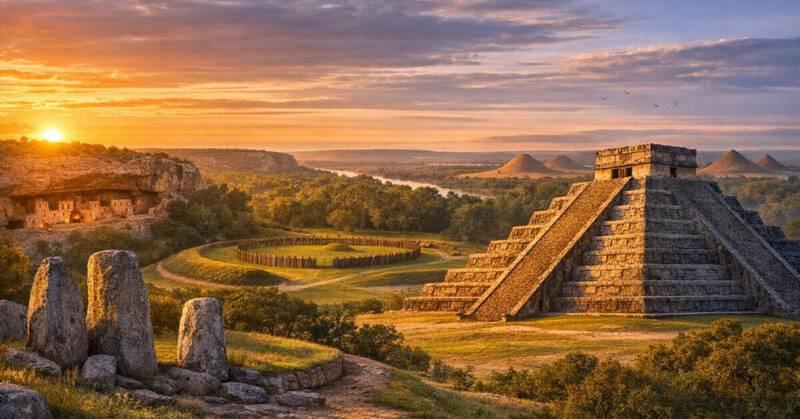
Before The Pilgrims: 15 Ancient Sites You Can See In North America Today

0
28

Before The Pilgrims: 15 Ancient Sites You Can See In North America Today

6. Taos Pueblo (New Mexico)

Before The Pilgrims: 15 Ancient Sites You Can See In North America Today
Taos Pueblo: A UNESCO World Heritage Site showcasing over 1,000 years of Tiwa heritage.

Taos Pueblo, located in northern New Mexico, is a multi-storied adobe settlement that has been continuously inhabited for over 1,000 years. Constructed by the Taos-speaking (Tiwa) Native American tribe, the pueblo features terraced adobe dwellings rising up to five stories, exemplifying traditional Puebloan architecture. The community remains active, with approximately 4,500 residents living both within the pueblo and in surrounding areas. Designated a UNESCO World Heritage Site in 1992, Taos Pueblo offers a direct connection to indigenous history and culture. (whc.unesco.org)

7. Spiro Mounds (Oklahoma)

Before The Pilgrims: 15 Ancient Sites You Can See In North America Today
Explore Spiro Mounds: a pivotal Mississippian ceremonial center rich in history and artifacts.

Spiro Mounds, located in Le Flore County, Oklahoma, was a significant Mississippian ceremonial center active between 900 and 1450 AD. The 150-acre site features 12 mounds, including platform mounds for elite residences and burial mounds containing elaborate artifacts. Archaeological excavations have uncovered a wealth of ceremonial objects, shell carvings, and trade goods, highlighting Spiro’s role in an extensive trade network. Today, the Spiro Mounds Archaeological Center offers visitors interpretive trails and exhibits, providing insights into this influential prehistoric culture. (okhistory.org)

8. Casa Grande Ruins (Arizona)

Before The Pilgrims: 15 Ancient Sites You Can See In North America Today
Casa Grande Ruins: a monumental legacy of the ancient Hohokam civilization in Arizona.

Casa Grande Ruins, located near Coolidge, Arizona, is a four-story adobe structure built around 1350 AD by the ancient Hohokam people. The “Great House” remains the largest known prehistoric earthen building in the American Southwest. Constructed using caliche, a natural concrete-like material, the structure stands 60 feet tall and 60 feet wide. Its purpose remains a mystery, though it may have served as a residence, ceremonial center, or astronomical observatory. The site was designated a National Monument in 1918 and is managed by the National Park Service. (nps.gov).

9. Moundville Archaeological Park (Alabama)

Before The Pilgrims: 15 Ancient Sites You Can See In North America Today
Moundville Archaeological Park showcases the grandeur of a significant Mississippian-era city.

Moundville Archaeological Park, located near Tuscaloosa, Alabama, was a major Mississippian-era city between 1000 and 1450 AD. The site features 29 platform mounds arranged around a central plaza, serving as foundations for elite residences and ceremonial structures. Moundville was a significant political and religious center, with a population estimated between 1,000 and 3,000 people within the city walls and an additional 10,000 in the surrounding valley. The park includes an interpretive museum and hosts an annual Native American Festival. (Encyclopedia of Alabama)

10. Bighorn Medicine Wheel (Wyoming)

Before The Pilgrims: 15 Ancient Sites You Can See In North America Today
Ancient Bighorn Medicine Wheel, a celestial observatory crafted by Plains cultures, Wyoming.

Perched atop Medicine Mountain in Wyoming’s Bighorn National Forest, the Bighorn Medicine Wheel is an 80-foot-diameter stone structure constructed by Plains cultures, possibly the Crow, Cheyenne, or Shoshone, between 1200 and 1700 AD. The wheel features 28 spokes radiating from a central cairn, with six additional cairns positioned around its perimeter. The site is aligned with celestial events, suggesting its use for ceremonial and astronomical purposes. Accessible via a marked gravel road from U.S. Highway 14A, the wheel is located at an elevation of approximately 9,640 feet. (fs.usda.gov)

11. Templo Mayor of Tenochtitlán (Mexico City, Mexico)

Before The Pilgrims: 15 Ancient Sites You Can See In North America Today
Remnants of Templo Mayor reveal the rich Aztec heritage beneath modern Mexico City.

At the heart of modern Mexico City, remnants of the great Aztec Templo Mayor provide evidence of a thriving metropolis before European contact. Excavated temples and ceremonial platforms shed light on Aztec religious life. The Templo Mayor was the main temple of the Mexica people in their capital city of Tenochtitlan, which is now Mexico City. Its architectural style belongs to the late Postclassic period of Mesoamerica. The temple was called the huey teocalli in the Nahuatl language and dedicated simultaneously to two gods, Huitzilopochtli, god of war and Tlaloc, god of rain and agriculture, each of which had a shrine at the top of the pyramid with separate staircases. The Templo Mayor was approximately 100 by 80 m (330 by 260 ft) at its base, dominated a Sacred Precinct, and was rebuilt seven times after its initial construction. Today, the Templo Mayor Archaeological Site and Museum present more than 3,000 important artifacts of Mexica culture, including offerings, burials, and objects from the colonial occupation. (mexicocity).

12. Cueva de las Manos (Baja California, Mexico)

Before The Pilgrims: 15 Ancient Sites You Can See In North America Today
Prehistoric rock art at Cueva de las Manos reveals ancient human expression and spirituality.

Cueva de las Manos, located in Baja California, Mexico, is renowned for its prehistoric rock art, including stenciled hands and geometric forms, believed to be over 7,000 years old. The cave art offers insight into ancient lifeways and spiritual practices. (lugares)

13. Effigy Mounds National Monument (Iowa)

Before The Pilgrims: 15 Ancient Sites You Can See In North America Today
Effigy Mounds National Monument preserves ancient animal-shaped mounds, reflecting Native American spirituality.

Effigy Mounds National Monument, located in northeastern Iowa along the Mississippi River, preserves over 200 prehistoric mounds built by Native American cultures between 450 BCE and 1300 CE. Among these, approximately 30 are effigy mounds shaped like animals, including bears and birds, reflecting the spiritual beliefs of ancient Woodland cultures. The largest bear-shaped mound, known as the Great Bear Mound, measures 137 feet (42 meters) in length and 3.5 feet (1 meter) in height. The monument offers visitors opportunities to explore these ancient structures and contemplate the meanings of the mounds and the people who built them. (nps.gov)

14. Gault Site (Texas)

Before The Pilgrims: 15 Ancient Sites You Can See In North America Today
Uncovering 16,000 years of history, the Gault Site reveals Paleo-Indian artifacts and insights.

The Gault Site, located near Florence, Texas, is a significant archaeological site that has provided evidence of human habitation in North America dating back over 16,000 years. Excavations have uncovered a vast array of artifacts, including stone tools and projectile points, challenging previous timelines of early human presence on the continent. These findings offer valuable insights into the lives and technologies of Paleo-Indian peoples. The site is managed by the Gault School of Archaeological Research, which offers guided tours and educational programs. (txstate.edu)

15. L’Anse aux Meadows (Newfoundland, Canada)

Before The Pilgrims: 15 Ancient Sites You Can See In North America Today
L’Anse aux Meadows: North America’s only confirmed Norse site, showcasing Viking architecture and artifacts.

L’Anse aux Meadows, located at the northern tip of Newfoundland’s Great Northern Peninsula, is the only confirmed Norse site in North America, dating to around 1000 AD. Excavations have revealed eight timber-framed turf structures, including dwellings, workshops, and a forge, reflecting the Norse architectural style. Artifacts such as iron nails, a bronze cloak clasp, and a spindle whorl have been uncovered, providing evidence of Norse presence and activities. The site was designated a National Historic Site of Canada in 1968 and a UNESCO World Heritage Site in 1978. Today, visitors can explore reconstructed buildings and view artifacts at the on-site museum. (Parks Canada)

Continuing the Story: Preserving North America’s Ancient Heritage

Before The Pilgrims: 15 Ancient Sites You Can See In North America Today
Ancient sites like the Hopewell Earthworks honor Native heritage and enrich our historical understanding.

Preserving North America’s ancient sites is vital for honoring the rich cultural heritage of Native peoples and understanding their historical contributions. These sites, such as the Hopewell Ceremonial Earthworks in Ohio, recognized as a UNESCO World Heritage site, offer invaluable insights into ancient lifeways and spiritual practices. (apnews.com) Ongoing archaeological research and community engagement continue to uncover new discoveries, emphasizing the importance of safeguarding these irreplaceable landmarks for future generations.

Pesquisar
Categorias
Leia mais
Outro
Real-Time Monitoring Solutions Accelerate IoT Implantable Cardiac Devices Market
 The IoT Implantable Cardiac Devices Market is witnessing rapid growth due to the...
Por Sia Snowman 2026-05-08 09:41:40 0 497
Food
Don't Throw Away Onion Peels — They Belong In Your Garden
Don't Throw Away Onion Peels — They Belong In Your Garden...
Por Test Blogger1 2026-05-12 00:00:06 0 349
Stories
Were There Really Female Samurai? 15 Revisionist Claims That Polarised The World
Were There Really Female Samurai? 15 Revisionist Claims That Polarised The World...
Por Test Blogger2 2026-04-13 05:00:09 0 1KB
Outro
Rising Chronic Wound Cases Fuel Biomaterial Wound Dressings Market Growth
The Biomaterial Wound Dressings Market is...
Por Sia Snowman 2026-05-20 08:10:12 0 303
Food
The Healthy Snacks Alison Brie Could Eat Every Single Day - Exclusive
The Healthy Snacks Alison Brie Could Eat Every Single Day - Exclusive...
Por Test Blogger1 2026-03-29 13:00:09 0 1KB