


AMD Radeon RX 9070 GRE review - a new mid-range graphics card champion
AMD Radeon RX 9070 GRE review - a new mid-range graphics card champion
Verdict

The AMD Radeon RX 9070 GRE is a great choice if you're seeking a GPU with significantly more grunt than an RTX 5060 Ti or RX 9060 XT but don't have the budget for a full fat RX 9070 or an RTX 5070. It slots in around $75-$100 cheaper than either of those cards while not compromising too much on performance, and is far faster than cheaper choices.
Pros
- Reliable performance at 1440p or lower res
- Can stretch to 4K gaming
- Not limited to 8GB VRAM like cheaper cards
Cons
- AMD FSR tech still not as good as Nvidia DLSS
- Bulky card for the performance
Like previous Golden Rabbit Edition (GRE) launches, the AMD Radeon RX 9070 GRE is a graphics card that first started out as a China-only release, but now AMD is making it available worldwide. A stripped-back version of the RX 9070, it features a GPU with slightly reduced core counts, and it's partnered with 12GB of VRAM instead of 16GB. With a healthy, if not huge, price drop, it's well-positioned to be a sensible mid-range choice for a lot of buyers.
This set of features and pricing pits the RX 9070 GRE directly against the Nvidia GeForce RTX 5060 Ti, while above it sits the slightly more expensive RX 9070 and Nvidia GeForce RTX 5070, and below it are the substantially cheaper RX 9060 XT and RTX 5060. Crucially, while the RX 9070 GRE does have less VRAM than more expensive options, it has the same amount as the RTX 5070.
Specs
| AMD Radeon RX 9070 GRE specs | |
| Compute units | 48 |
| Stream processors | 3,072 |
| RT cores | 48 |
| AI cores | 96 |
| ROPs | 96 |
| Infinity Cache | 48MB |
| Game clock | 2,220MHz |
| Boost clock | Up to 2,790MHz |
| VRAM | 12GB 20Gbps GDDR6 |
| Memory interface | 192-bit |
| Memory bandwidth | 432GB/s |
| Interface | 16x PCIe 5.0 |
| Total board power | 220W |
| Power connectors | 2 x 8-pin |
In terms of specs, the RX 9070 GRE is no surprise, as it has been out in China for many months. However, the short version is that it's nearly an RX 9070, but not quite. It uses the same Navi 48 GPU die, but instead of housing 56 compute units with 3,584 stream processors, 56 ray tracing cores, and 128 ROPs, you get 48 compute units, 3,072 stream processors, and 96 ROPs. Meanwhile, the VRAM allocation has dropped from 16GB of 20Gbps GDDR6 to 12GB.

Clock speeds have been cranked up to compensate a little for the loss in cores and VRAM, though. While the RX 9070 officially tops out at 2,520 MHz (though overclocked versions are available), the RX 9070 GRE hits 2,790MHz in its default configuration.

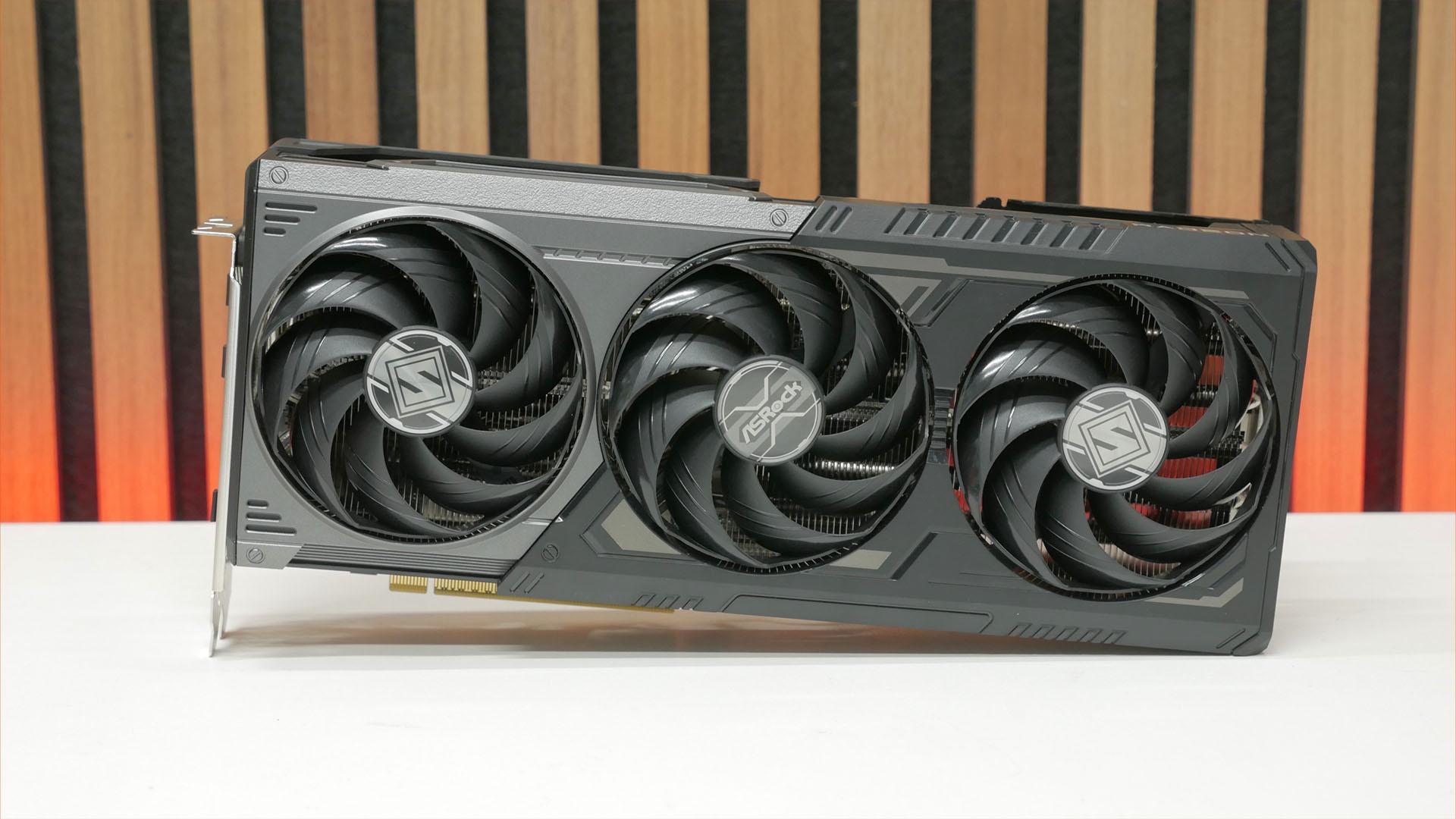
Elsewhere, though, the cards are largely identical. In fact, the ASRock RX 9070 GRE Steel Legend card I was sent for review is physically indistinguishable from the company's Steel Legend RX 9070, other than one being black and the other white.

To that end, this is quite a large card for its relative graphics grunt. It's nearly three PCIe slots wide (58mm) and is 298mm long. It also needs two eight-pin PCIe power connectors, although its suggested power supply rating is only 550W - a far cry from the 1,000W required for an RTX 5090.
Like other AMD RDNA 4 GPUs, the RX 9070 GRE supports the latest tech in AMD's FSR suite, including its latest upscaling and frame generation modes. These still aren't as good as Nvidia's equivalent DLSS options, but, fundamentally, they do help unlock playable frame rates at resolutions and detail settings that would otherwise be a struggle for this card.
How we test
To assess the gaming performance of the RX 9070 GRE, I tested a smaller selection of games than usual, as benchmarks for the card are already out there, and its performance in initial tests showed that it's entirely in line with expectations. So, I fired up the card in Doom: The Dark Ages, Cyberpunk 2077, and Indiana Jones and the Great Circle. Each test is run three times, recorded with Nvidia FrameView, and I report the mean average of the results, discarding any obvious anomalies. I then report two figures for frame rates - firstly, the average, which gives you an idea of the general frame rate you will achieve. Secondly, I report the 1% low, which is an average of the lowest one percent of results recorded during the benchmark.

The latter is a more reliable indicator of performance than the outright minimum, as it removes outliers, such as moments where a Windows system event causes the game to stutter, which is unrelated to the performance of the GPU. The 1% low is what you can expect the actual typical minimum frame rate to be in these games.
GPU test system specs:
- CPU: AMD Ryzen 7 7800X3D
- CPU cooler: Corsair H100X RGB Elite
- Memory: 32GB 6,000MHz G.Skill TridentZ RGB, CL28
- Motherboard: MSI MAG X870E Carbon WiFi
- SSD: 2TB WD Black SN850X
- PSU: Corsair RM1000X Shift
Benchmarks
Cyberpunk 2077
We always start our GPU testing with Cyberpunk 2077, as it has long proven to be a reliable benchmark and a game that's regularly updated to include the latest, cutting-edge graphics options, such as the latest versions of DLSS and FSR. The latter aren't overly relevant here, but it's still a great place to start.

At 1080p in this game, this card is unremarkable, with a frame rate that's a touch further back from the RX 9070 than you might imagine and hope. Still, we test with the very demanding Ultra Ray Tracing preset, and this card still delivered 64fps. That is behind the RTX 5070 and RX 9070, but well ahead of the RTX 5060 Ti and RX 9060 XT, which hit 54fps and 47fps, respectively.

It's a similar story at 1440p, with the RTX 5070 and RX 9070 still comfortably ahead, but cheaper cards again comfortably behind. A frame rate of 40fps is on the low side for this game, if playing with a keyboard and mouse, but you can easily get back above 60fps by dropping to ultra settings without ray tracing, or turning on FSR upscaling.

At 4K, this card somewhat crumbles. At just 14fps, it really can't cope with this resolution with such demanding detail settings. However, switch to high settings with no ray tracing, and you'll get 56fps.
Indiana Jones and the Great Circle
Indy's latest adventure paints an even prettier picture for the RX 9070 GRE. With 111fps at 1080p using Ultra High settings, the RX 9070 GRE is miles ahead of most cheaper options and only just trails the 144fps of the RX 9070. Even the RTX 5070 is only a little ahead, on 127fps.

The picture stays rosy at 1440p, with this card delivering 87fps, which is again in a niche of its own between cheaper and more expensive cards, but with performance closer to the pricier options. Here we also see the pitfall of graphics cards with 8GB of VRAM - they won't even run this game at these settings and with this resolution.

What's more, at 4K, this game still performs brilliantly. You'll get 62fps in a game that looks incredible and uses lots of ray tracing. The RTX 5070 is only 2fps faster.

Doom: The Dark Ages
Finishing things off with another favorite title of mine from last year, Doom: The Dark Ages is a breeze for the RX 9070 GRE. It delivered 117fps at 1080p with Ultra Nightmare settings, which is only just behind the RX 9070 XT at 117fps, and miles ahead of the RX 9060 XT and RTX 5060 Ti, which hit under 80fps.

At 1440p, you'll get 80fps, which again compares well to pricier cards and is over 20fps faster than its main cheaper rivals.

4K is just about playable too, with these settings. You'll probably want to reduce detail settings a bit to push above 60fps, but 40fps on max detail settings is still just about playable in this game.

Power draw
Despite its need for two eight-pin PCIe power connectors, the RX 9070 GRE is a relatively modest card when it comes to power consumption. It hit just 370W total system power in our gaming test, which is admittedly above the impressively efficient RTX 5070, but otherwise below all other faster cards, and not that much more than cheaper options.

Price
Pricing is constantly a thorny issue when it comes to recent graphics card launches, as MSRPs are so often not reflected in real-world pricing. However, an MSRP of $549 for the RX 9070 GRE is in line with current pricing for other cards, so I'd hope it's a fair reflection of the price you'll pay.
Based on that price, then, the RX 9070 GRE makes for a really decent-value card. Based on our average frame rates across the games we've tested, this card is the best cost per frame in its class right now. That means that it's not only in a tempting overall cost niche of its own, but that it does offer good value at that price too.
Verdict
The AMD Radeon RX 9070 GRE had every chance of being a bit of a non-event of a launch, thanks to the current graphics card price situation making any new card feel like inherently middling value. However, as things stand, this is a fairly compelling option.
Yes, paying $550 for a low-to-mid-range graphics card does still feel pretty whince-inducing, but given that's the reality of the market, this pricing does actually make this a pretty compelling card. Its performance is enough for really rapid frame rates at 1080p, solid frame rates at 1440p, and it can stretch to 4K in plenty of titles, too. Add in that its cost per frame is the best out there right now, and it doesn't do much wrong.

One factor to consider is that you will need a power supply with two eight-pin PCIe power connectors, and all cards are likely to be quite large. So, while its performance might hint at a great option for a more compact PC build, in reality, you're going to need a fairly large case to accommodate one.
Otherwise, if real-world pricing stays true to that MSRP, this is a new go-to option for those with just over $500 available to spend on an upgrade.

 English
 Arabic
 French
 Portuguese
 Deutsch
 Turkish
 Dutch
Dutch
 Italiano
 Russian
 Romaian
 Portuguese (Brazil)
 Greek
Greek