


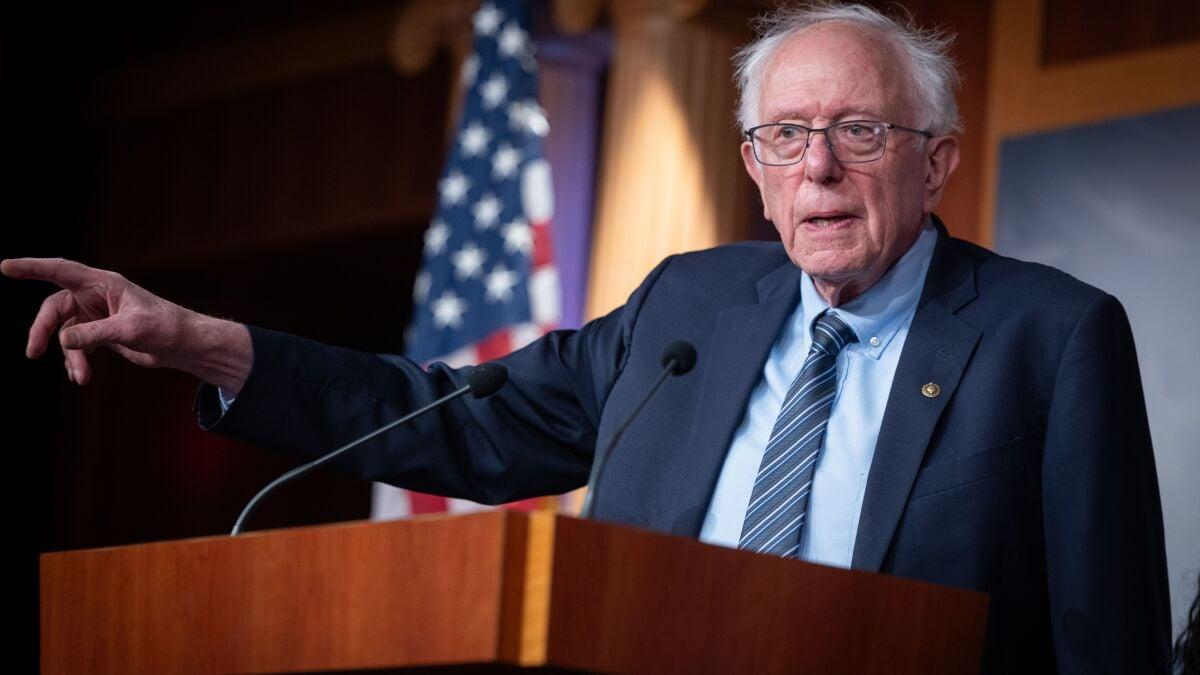
Vermont Senator Bernie Sanders announced today that he will introduce legislation to give the American public a direct ownership stake in the country's largest artificial intelligence companies.
Writing in the New York Times, Sanders laid out the case for the American AI Sovereign Wealth Fund Act — a bill that would create a federally managed fund created not with cash, but with stock. Specifically, Sanders proposes a one-time transfer of 50 percent of equity from companies like OpenAI, Anthropic, and xAI to the government. The idea: since AI is built on the accumulated knowledge, creativity, conversations, and labor of the American people — typically without permission or payment — the American people deserve a cut of the profits.
This Tweet is currently unavailable. It might be loading or has been removed.
Here's what Sanders is proposing.
What the American AI Sovereign Wealth Fund Act would accomplish
The fund would acquire half the stock of the largest AI companies in the country through a mandated equity transfer — Sanders is explicit that this is not a profits tax. The government would then hold voting shares and receive equal board representation at each company, giving it formal power to block decisions deemed harmful to the public.
Revenue generated by the fund would flow directly to Americans as cash payments, with Sanders indicating that, as the fund grows, proceeds would eventually support broader public goods, including healthcare, education, and housing. He points to Norway's sovereign wealth fund and Alaska's Permanent Fund Dividend as working models of the concept.
Sanders' core argument is that AI models were built on the writing, art, journalism, code, and research produced by millions of people without their consent or compensation. Sanders argues that because the technology is derived from collective human output, the wealth it generates should be shared collectively. As Sanders prepares his legislation, AI industry leaders are prepping for a massive payday when Anthropic, OpenAI, and SpaceX (which recently merged with xAI) go public this year.
Mashable Light Speed
Sanders notes that versions of this idea have come from the AI industry itself. OpenAI CEO Sam Altman has proposed a public wealth fund tied to AI-driven economic growth. Anthropic has called for national sovereign wealth funds holding AI equity stakes. Musk has advocated for a "universal high income" to offset AI-related job displacement.
This Tweet is currently unavailable. It might be loading or has been removed.
Sanders frames these industry positions as validation — though notably, endorsing a concept in the abstract and accepting a 50 percent equity transfer are very different things.
What's still unresolved
Sanders acknowledges the legislation is still being written. Several significant questions still lack answers.
Profitability is one. OpenAI is notoriously not profitable and has operated at a loss for most of its existence. A sovereign wealth fund built on equity in companies that aren't profitable doesn't generate dividends, and Sanders hasn't addressed what the fund looks like if the AI sector's financial trajectory doesn't match analyst projections.
Scope is another. Sanders says applying government ownership to companies where AI is only part of the business is "complicated," without explaining how that would be handled in practice. Microsoft, Google, and Amazon all have major AI operations — it's unclear whether or how they'd fall under the legislation.
Environmental impact gets no mention. AI infrastructure — data centers, energy consumption, water use — carries real costs that fall on communities that don't always benefit from generative AI, and the proposal offers no specific mechanism beyond the general promise of government oversight to address them.
However, a well-structured sovereign wealth fund could distribute some AI wealth downward, in theory. Government board representation could also create some accountability for a powerful and fast-growing new industry. The populist proposal is far bolder than anything else in the current policy conversation.
Until the senator drops the actual legislation, what we have is a premise that's hard to argue with and a plan that's still very much a sketch.

 English
 Arabic
 Spanish
 Portuguese
 Deutsch
 Turkish
 Dutch
Dutch
 Italiano
 Russian
 Romaian
 Portuguese (Brazil)
 Greek
Greek