


Warhammer 40k Dark Heresy's beta flexes the game's murder mystery muscles, but exposes its limits too
Warhammer 40k Dark Heresy's beta flexes the game's murder mystery muscles, but exposes its limits too
With Warhammer behemoths like Dawn of War 4 and Total War 40k sitting on the horizon, sucking in all the attention, it's easy to overlook what a big deal (and a big risk) Warhammer 40,000: Dark Heresy is. Keeping up the high standard of lore-accurate writing and tactical CRPG battling from Rogue Trader is tough enough, but that's honestly the easy bit. The true gamble of Dark Heresy is that it's a detective game that actually makes you do the detective work, lets you get it wrong, and forces you to handle the consequences.
From the start, that bold premise had me expecting 60% thrills, 40% map-crawling, conversation-repeating, head-scratching frustration. And, after spending 20 hours with Dark Heresy's Alpha and now ten hours in the new, expanded Beta, I'm no less confident that's what we can expect. I love this game, and I'll play it to death - but at times it does feel like it'll be the death of me.
Let's pump the brakes on this Leman Russ Battle Tank one moment, and cover off the brass tacks of what's actually new in the May 21 closed beta, versus the alpha we got in December.

Mechanically, it's not a lot. The graphics feel smoother and more stable, though I still hit a few stray UI glitches here and there - most of which Owlcat's already logged for fixes. The mostly excellent isometric camera still has moments of jank, with walls and ceiling beams completely blocking your view at key moments in a distinctly not-as-polished-as-Baldur's Gate 3 way. But it's not too bad, and if that didn't bother you in 80+ hours playing Rogue Trader, it won't here.
Full voice acting - a costly but valuable upgrade - is still a long way off, though I was surprised and delighted to find one key NPC speaking all their lines, and speaking them well. When they all do, it'll work wonders for immersion (especially if you're smarter than me and don't end up repeating every conversation seven times until the crucial information sinks in). Oh, and character creation is now in, giving you a decent enough spread of body, face, and hair options to make your Acolyte your own, rather than settling for Strongchin McWhiteMan.

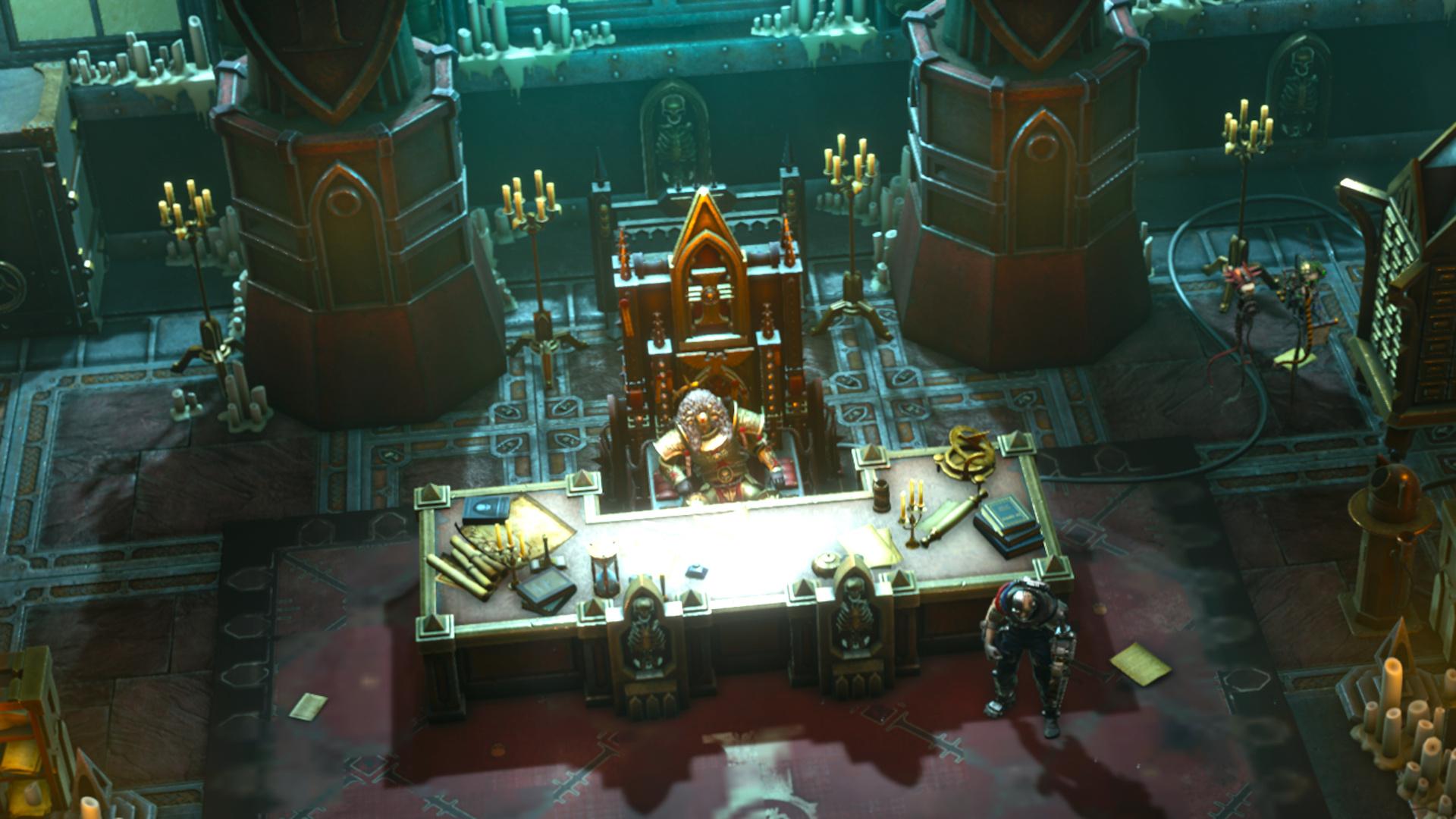
Generally speaking, though, the game plays much as it did in the Alpha - which is to say, very much like a polished-up Rogue Trader, except with detective work and the new Investigation mechanics leading you forward, instead of heroic exploration. The main draw of this Beta is simply that it opens up more game. Joining the action right after the catastrophic prologue mission (can't wait to finally play that one) we get a few extra chunks of juicy exposition, including a brief wander around the Inquisition's Bastion Serpentis headquarters. If you're not already neck-deep in 40k lore, the tasteful skull decor and literal, active torture chambers here should give a nice snapshot of just what kind of an organization you're working for.
Anyway, we're rescued from execution by our mysterious, golden-masked benefactor, Lord Inquisitor Anton Zerbe, and immediately pressed into his service. We swiftly assemble the core team from the Alpha - aloof medic Epione Spes, muscly ex-army heavy gunner Haymar, and spooky psychic spellcaster Saro - pile into our newly issued ship, and jet off to our choice of two missions.
Of those, the Lucid Palace is new for this Beta. It's a second full area, questline, and investigation to play through, with three new companions to recruit: fellow inquisitorial acolyte Tuoma, Adeptus Mechanicus tech-priest Hypatia, and Aspyce, a femme fatale Rogue Trader. And it's certainly a change from Marisportum, the grimy, impoverished underhive zone we visited in the Alpha. That first taste of Dark Heresy was a sprawling mix of chasing wide-ranging leads, exploring nooks and crannies, digging into intermixed faction storylines, and a considerable amount of fighting. It showed us the 'selective frontier justice' side of the Inquisition - who, by the way, are essentially religious secret police in Warhammer 40k's grimdark human future.
This second chapter, by comparison, is twelve hours' worth of concentrated Sunday afternoon murder mystery, trading in almost all that backstreet gunplay for a more compact, pure detective story (albeit one drenched in 40k's chaotic, convoluted, backstabbing politics). All the sector's fanciest dignitaries have come to the governor's grand palace for a major religious festival, you see, and wouldn't you know it, on the eve of the final ceremony, one of them gets mysteriously unalived.
It's delightfully on the nose; all the gang from Clue are here! Professor Plum (the Adeptus Mechanicus' senior tech-wizard); Colonel Mustard (the grizzled Imperial Guard general); Reverend Green (a high priest of the Imperial Creed); Mrs Peacock (the sector governor himself); and Miss Scarlett (the aforesaid rogue trader) all have a motive for the murder, and they all hate each other's guts enough to immediately point the finger at one another. It's up to you to find the culprit using your wits, your Inquisitorial Journal (an interactive serial killer pinboard menu that collects all the evidence as you go), and a metric buttload of clicking on stuff.
I'm not going to spoil the beats and twists of the Lucid Palace storyline, but suffice it to say, it works as a murder mystery in style and substance. It's satisfying, grilling people for their secrets and jigsawing your theories together from Owlcat's carefully written web of clues and half-truths. It's extra satisfying to disprove your own theories, whether by deduction or accident. And that's a good thing, because - unless you're the sort of person who always guesses the murderer correctly halfway through a Columbo - you're going to get it wrong and string up the wrong person sometimes. In fact, as Owlcat's Senior Developer Anatoly Shestov told me over on Wargamer, the game isn't really about finding the truth anyway; it's about deciding which story best suits your purposes.
As someone who gets off on 40k's tangled web of amoral horrors, I dig that. As someone who enjoys the juxtaposition of the dark and the silly, I also dug that this mystery had everything from agonizing self-torture rituals to Murder, She Wrote levels of campy cliche. For the Emperor's sake, one bit literally turns on the fact the suspect walks with a limp! All this bodes well for the whole game, for a certain type of player, at least - the type that went wild for Obra Dinn and old school point-and-click adventures.

But, at times, it isn't actually fun. When you're hot on the trail, buzzing across the map from clue, to suspect, to lead, it's awesome. Some less inspired, point-and-clicky mechanics, like 'find five meals to give the hungry guard in exchange for a key item,' or playing 'Hotter and Colder' with your servo-skull to follow a boring trail of nothing clues, drag my thrill-o-meter down hard, but they're in the minority. There is excitement in the chase.
When you hit a wall, though, the cracks in the experience start to show. There's a reason detective shows skip over the hours of staring at that serial killer pinboard, moving the data points around, drinking whisky, and hypothesizing: it's not the exciting part. Dark Heresy deliberately makes that independent brainwork the focus, pacing be damned. The game goes to great lengths to make its puzzles difficult, narratively satisfying, and devoid of handholding; that's what makes its most brilliant moments so special. But unless you're a genius, you will get stuck at various points with no fresh conversation options to hit, no new leads, no apparent way forward, and not enough evidence to feel confident accusing someone yet.
Importantly, that's a feature not a bug. You don't have to gather every fact or nail down the 'correct' answer to conclude investigations or progress the story. It seems quite possible to play through the whole game based on vibes and your own unproven convictions, and ironically that'll be kind of true to the spirit of being an Inquisitor.

But I, at least, constantly felt driven to actually solve the puzzle I'd been given rather than rubber stamping it - if nothing else to get my damn money's worth. And as a result, the latter part of this investigation felt like a stop-start, staccato rollercoaster, lurching from repetitive clicking around, to mounting frustration, to joyful random breakthrough, and straight back into stumped inertia again. More than once I found myself praying for another gunfight to break out, just to break the cognitive stalemate.
The final game will have plenty of those, and they're very good (if knuckle-crushingly overtuned at the moment, something I expect to be knocked back before release). And not every section will be as zoomed in and relentlessly detective-focused as the Lucid Palace. But the lesson of this beta is that, rather unlike Rogue Trader, Dark Heresy isn't going to serve you fun on a plate. It's up to you to navigate its massive sea of conflicting, 'alternative facts' and decide what level of diligent deduction, NPC interviews, and combing every wall for secret doors is fun for you. We're not in the Koronus Expanse anymore, Toto. You're in the Inquisition now, and that means you have to think.

 English
 Arabic
 French
 Spanish
 Portuguese
 Deutsch
 Turkish
 Dutch
Dutch
 Italiano
 Russian
 Romaian
 Greek
Greek