


Asteroid Ryugu’s Latest Mineral Is As Weird As Finding “A Tropical Seed In The Arctic”
Asteroid Ryugu’s Latest Mineral Is As Weird As Finding “A Tropical Seed In The Arctic”
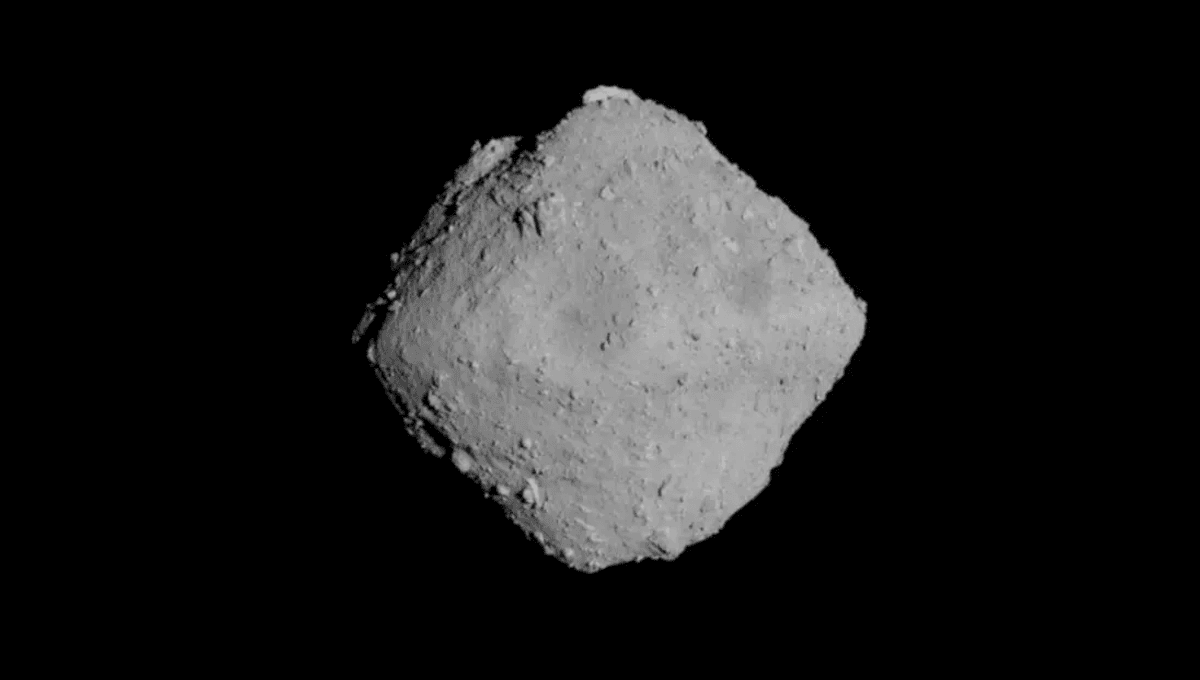
Scientists had high hopes for the sample of asteroid Ryugu collected by the Japanese Hayabusa-2 probe. The actual findings have surpassed those expectations, and the latest one adds to the extraordinary body of knowledge: researchers have found a mineral on Ryugu that shouldn’t be there.
The mineral is called djerfisherite, and it has been found on meteorites, so it is well established that it can form in space. However, it has not been found on other portions of Ryugu’s sample before, or on meteorites that were broadly similar to Ryugu. “Djerfisherite is a mineral that typically forms in very reduced environments, like those found in enstatite chondrites, and has never been reported in CI chondrites or other Ryugu grains,” first author Professor Masaaki Miyahara, from Hiroshima University, said in a statement. “Its occurrence is like finding a tropical seed in Arctic ice – indicating either an unexpected local environment or long-distance transport in the early Solar System.” Ryugu is now 900 meters (3,000 feet) across, but it was originally part of a much larger parent body. This bygone world, formed between 1.8 to 2.9 million years after the beginning of the Solar System, was very early on. This world was in the outer region of the Solar System, where ice crystals could form. It was also big enough to have internal heat sufficient for water to melt while never reaching a temperature above 50°C (122°F). Djerfisherite, meanwhile, has been found on meteorites that come from the inner Solar System with little water and a lot of heat, with the mineral forming from high-temperature gas or metallic fluids at temperatures of over 350°C (662°F). A very different environment from what the progenitor of Ryugu was expected to be like. “The discovery of djerfisherite in a Ryugu grain suggests that materials with very different formation histories may have mixed early in the Solar System’s evolution, or that Ryugu experienced localized, chemically heterogeneous conditions not previously recognized. This finding challenges the notion that Ryugu is compositionally uniform and opens new questions about the complexity of primitive asteroids,” Miyahara explained. The team currently think that a hotter Ryugu is a more likely explanation than the mixing up of very different materials in the early Solar System, but more research is necessary. It is certain that it will unlock important insights into the early Solar System. “Ultimately, our goal is to reconstruct the early mixing processes and thermal histories that shaped small bodies like Ryugu, thereby improving our understanding of planetary formation and material transport in the early Solar System,” Miyahara concluded. A paper describing the discovery is published in the journal Meteoritics & Planetary Science.

 Arabic
 French
 Spanish
 Portuguese
 Deutsch
 Turkish
 Dutch
Dutch
 Italiano
 Russian
 Romaian
 Portuguese (Brazil)
 Greek
Greek