


Google has fundamentally altered how we search the internet.
By

Chance Townsend
Editor, General Assignments
Chance Townsend is the General Assignments Editor at Mashable, covering tech, video games, dating apps, digital culture, and whatever else comes his way. He has a Master's in Journalism from the University of North Texas and is a proud orange cat father. His writing has also appeared in PC Mag and Mother Jones.
on

Credit: David Paul Morris/Bloomberg via Getty Images
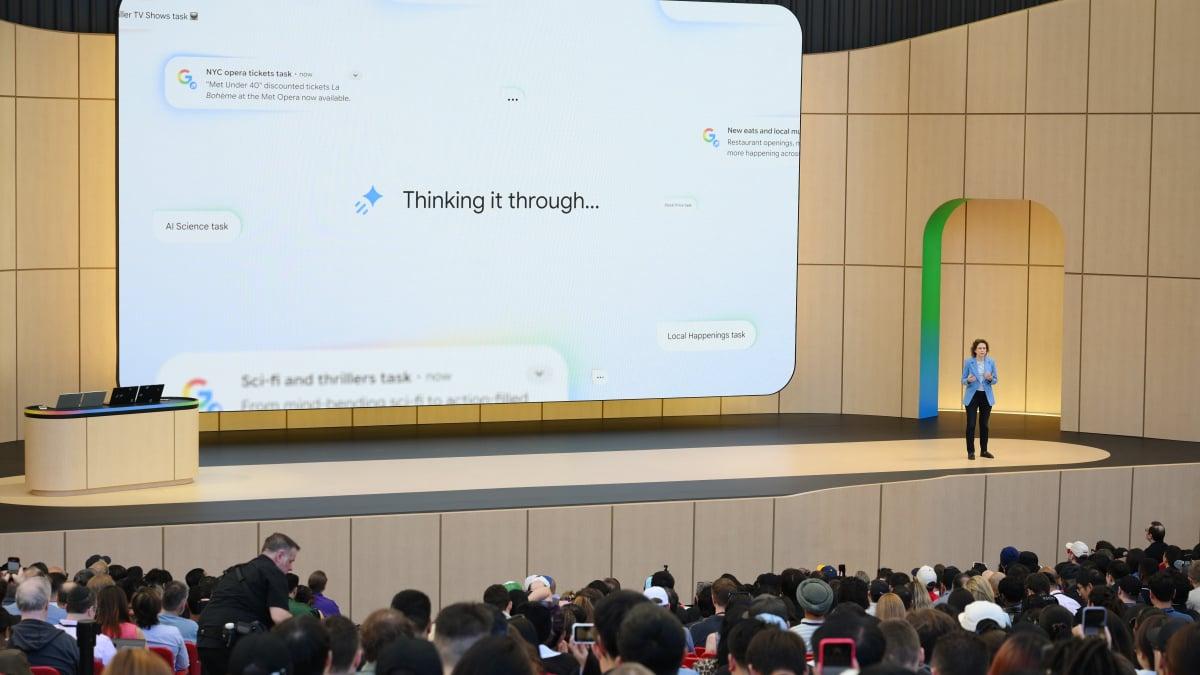
At last year's Google I/O event, we (and most outlets) modestly declared that the Google Search we had known for the past 20 years was dead. Fast forward a year, and it's still really, really dead. Not to beat on a dead horse or anything, but with I/O 2026, Google firmly established that Search is and will be built on Gemini and artificial intelligence.
Search is no longer a place you go to find a link. It's becoming a place you go to have an AI handle the whole thing for you. Based on everything Google announced at I/O 2026, the way people find information on the internet is about to look fundamentally different. Whether any of this is actually useful depends on the person being asked, but Google wants to fundamentally change how we navigate the internet.
Publishers are in trouble
AI Overviews have been chipping away at web traffic since they launched, and everything Google announced this week accelerates that trend. When Search agents are scanning the web 24/7 on your behalf, when AI Mode is handling your follow-up questions, when the search box is expanding to accept entire paragraphs of context — the implicit promise is that you won't need to click through to anyone's website to get what you need.
Google gets the query, Google surfaces the answer, and the publisher who wrote the piece that informed that answer gets nothing.
This fight between online content publishers and Google has been raging since last year, when the whole thing was dubbed the "traffic apocalypse." Google, of course, has pushed back on the framing that publishers are getting the short end of the stick, arguing that users who do click links after seeing AI Overviews engage more deeply with those sites. That may be true in a narrow sense, but it sidesteps the larger issue — fewer people are clicking at all.
That pushback comes from a Wall Street Journal report from June 2025. In it, Neil Vogel, CEO of Dotdash Meredith — the company behind People and Southern Living — told the Journal that Google search went from driving roughly 60 percent of their traffic at the time of their 2021 merger down to about a third. The floor, based on everything announced at I/O this week, hasn't been found yet.
Publishers are responding by pivoting toward direct relationships with readers — newsletters, events, apps, subscriptions — anything that doesn't depend on Google as a middleman. That's a reasonable long-term strategy, but a fundamental restructuring of how digital media works.
A new search box
The AI Search Box — the first redesign of Google's search bar in over 25 years — is built for conversations now. You can drop in images, files, videos, and Chrome tabs alongside a long-form prompt and let Google figure out what you're actually asking.
Mashable Light Speed
Obviously, this is a massive shift in how we search on the internet. Google searching used to be about compression. To ask our questions in the fewest possible words. The entire discipline of SEO was built around the assumption that people type short, imprecise fragments into a box, and that it's Google's job to interpret them. "Flights NYC to LA." "Best running shoes 2026." "Symptoms of strep throat."
Now Google is actively dismantling that habit. With the expanded search box, Google wants you to stop translating your thoughts into keyword-ese and just talk to it. Tell it you're planning a trip, attach your calendar, upload a photo of the hotel you're considering, and let Gemini piece it all together. The idea being that the more context you give it, the more helpful the AI is.
And that's true to an extent, but it's more information you're giving Google, and more data for them to collect. The company spent $68 million earlier this year settling a lawsuit after it was alleged that Google's Google Assistant recorded "private conversations without permission."
Whether users are ready to hand over that level of context — and whether Google has earned that trust — is a question the keynote didn't really address.
The hallucination problem isn't going away
For all the polish Google put on its AI features at I/O, one thing conspicuously absent from the keynote was any serious reckoning with accuracy. AI Overviews have a documented history of surfacing confidently wrong information, and the new conversational follow-up feature essentially lets you go deeper into an AI-generated summary without necessarily verifying the foundation it's built on.
Gmail VP Blake Barnes touched on this in his conversation with Mashable's Haley Henschel, noting that Gmail Live is being built with sourcing so users can check which emails informed the AI's response. That's a reasonable approach for a personal inbox tool. But for a broader search across the entire web, the bar for scrutiny needs to be higher due to the risk of misinformation and disinformation. As Google hands over more of the search experience to AI, the burden of fact-checking shifts more squarely onto users. That's worth keeping in mind every time an AI Overview tells you something with complete confidence.
The agentic push across everything Google announced this week, like Spark running your life in the background, Search agents monitoring the web on your behalf, and AI that can call businesses, make purchases, and book reservations, is the early infrastructure of something that looks a lot like what the AI research community means when it talks about AGI-adjacent systems.
Google DeepMind CEO Demis Hassabis described Gemini Omni at I/O as a meaningful step toward AGI — artificial general intelligence, the theoretical point at which an AI system can perform any intellectual task a human can. That framing was almost a throwaway line in the context of a video generation demo, which is exactly what makes it worth paying attention to.
Google's answer to the obvious concern about that — what stops it from doing something you didn't want — is the Agent Payments Protocol and a set of configurable limits that give administrators ultimate control over the AI. Josh Woodward, VP of Google Labs, described the philosophy as being like handing a teenager their first debit card. That's a candid framing, and in some ways a reassuring one. But it also acknowledges that the trajectory is toward more autonomy, not less. The guardrails are explicitly described as temporary.
Right now, when Gemini gets something wrong in a search summary, the stakes are relatively low. As these systems take on more — scheduling, purchasing, monitoring, acting — the cost of a confident wrong answer goes up considerably. Google wasn't having that conversation on stage at I/O. That's the one worth having now.

Editor, General Assignments
Chance Townsend is the General Assignments Editor at Mashable, covering tech, video games, dating apps, digital culture, and whatever else comes his way. He has a Master's in Journalism from the University of North Texas and is a proud orange cat father. His writing has also appeared in PC Mag and Mother Jones.
In his free time, he cooks, loves to sleep, and greatly enjoys Detroit sports. If you have any tips or want to talk shop about the Lions, you can reach out to him on Bluesky @offbrandchance.bsky.social or by email at [email protected].


 English
 Arabic
 Spanish
 Portuguese
 Deutsch
 Turkish
 Dutch
Dutch
 Italiano
 Russian
 Romaian
 Portuguese (Brazil)
 Greek
Greek