


On July 3, Earth Will Reach Its Farthest Point From The Sun – 152 Million Kilometers Away
On July 3, Earth Will Reach Its Farthest Point From The Sun – 152 Million Kilometers Away
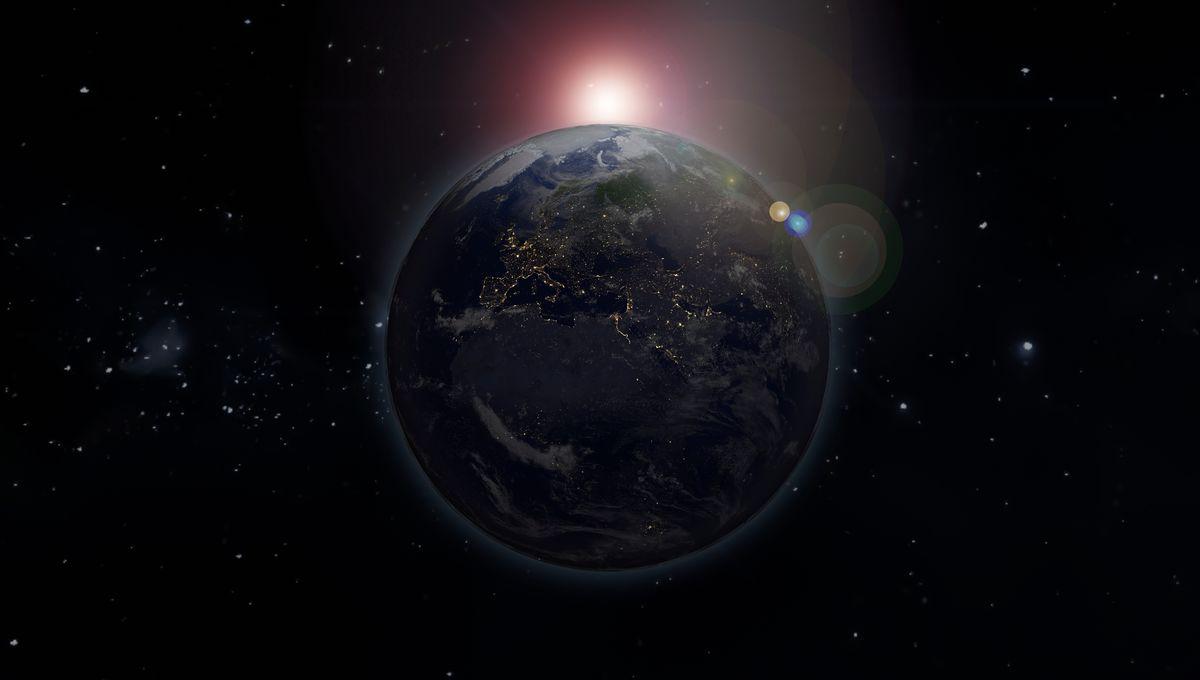
On July 3, 2025, at 3:54 pm ET, the Earth will officially reach its furthest point from the Sun for this year. This is called aphelion. Our planet’s orbit is very close to a circle, but it is not a circle. It’s an ellipse, so the Earth gets closer and farther from the Sun as it orbits. The closest point, the perihelion, happens around the first few days of January. The next one will be January 3, 2026.
At the aphelion, the distance from the Earth’s center to the Sun’s center is going to be 152,087,738 kilometers (94,502,939 miles). At its closest, Earth is roughly 5.1 million kilometers (about 3.2 million miles) nearer the Sun, which means the planet gets 6.8 percent more solar radiation in January than it will tomorrow. It is completely accidental that the aphelion and perihelion are so close to the solstices or the beginning of the year. They have nothing to do with seasons either. The seasons are dictated by the tilt of the Earth. An exaggerated view of Earth's orbit. Image Credit: CLOUD-WALKER/Shutterstock.com Basically, right now the Northern Hemisphere is pointing towards the Sun, so up here we get summer and the Southern Hemisphere gets winter. In six months, it is the Southern Hemisphere that is pointing towards the Sun, so it experiences summer while it’s winter up north. There are cyclical processes at work that shift the actual date and time of aphelion and perihelion. It has shifted by around one day every 58 years, and that shift is for good. Smaller variation, plus the need for a leap day, makes a year-on-year variation of a couple of days common. In the late 19th century, New Year’s Day was also the perihelion. In the mid-1200s, the solstices would fall on these two special days. The reason for these changes is the subtle tugging of Jupiter and Saturn on our planet. Over a period of hundreds of thousands of years, the Earth’s orbit goes from mildly elliptical to almost a circle. We are currently getting the Earth at its most circular. This is one of the Milankovitch cycles. Something fascinating is that while the shape of the orbit changes, due to the gravitational laws, the year's length doesn’t change. The orbit simply gets more squished, so during spring and autumn, the Earth tends to be closer to the Sun than it currently is. Still, the orbit affects the seasons in a peculiar way: their length. Seasons, astronomically speaking, are defined by which quadrant in the orbit our planet is passing through. The more circular the orbit, the closer the length of the seasons. Currently, summer in the Northern Hemisphere is 4.66 days longer than winter, and spring is 2.9 days longer than autumn.If we are further away from the Sun, why is it summer?

The shape of Earth’s orbit is not fixed

 English
 Arabic
 French
 Spanish
 Portuguese
 Deutsch
 Turkish
 Dutch
Dutch
 Russian
 Romaian
 Portuguese (Brazil)
 Greek
Greek