


AntAlexStudio/Shutterstock
We may receive a commission on purchases made from links.
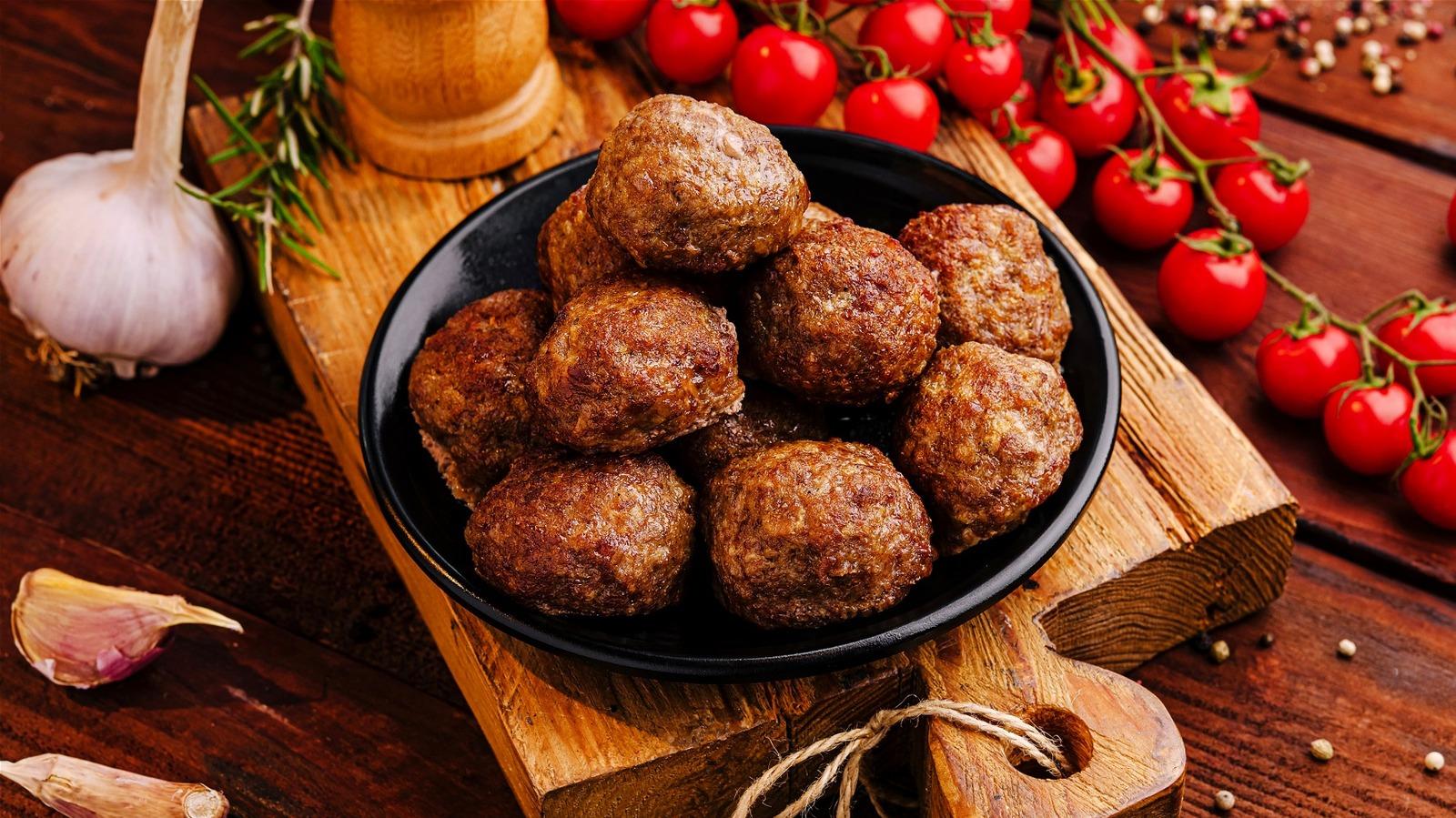
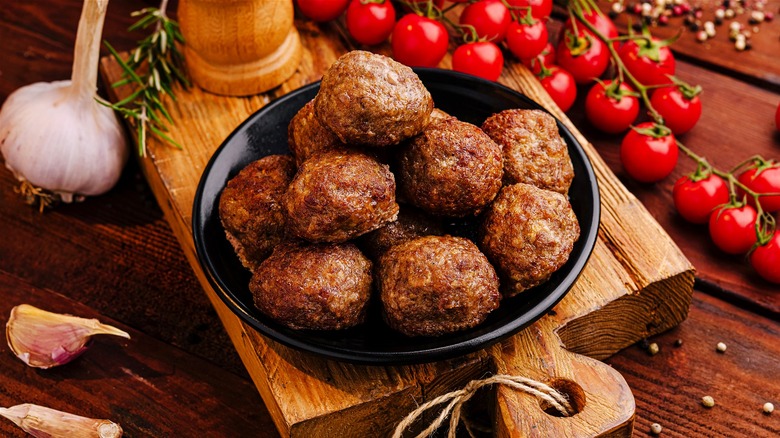
If you're having trouble preparing meatballs because they come out greasy and soggy, the solution might be a piece of cookware you've already got sitting around in your kitchen. Instead of searing them in a pan or simmering them in sauce, try popping them onto a wire baking rack and cooking them in the oven to create a crispy exterior.
The crispiness occurs as the result of a well-known process called the Maillard reaction, which takes place when heat reaches a sufficient point to cause chemical changes in a food's simple sugars and amino acids. This happens much more efficiently with minimal surface moisture on the meat. Cooking meatballs on a wire rack allows liquid to drip away instead of pooling around the protein, which is why it gets much crispier results than cooking them in a pan. The wire mesh also allows the hot air of your oven to circulate around most of the meat's surface area, letting the Maillard reaction unfold more evenly around the meatball to give you a more uniform crust.
Minimizing contact with all that melted fat can yield a significantly less greasy outcome, as well. Folks worried about drying out the food should consider using a simple step to produce more tender meatballs when making them from scratch. Whipping up a panade — a paste consisting of bread and either milk or broth — and adding it to your mix can help the meat retain juices on the inside while the exterior gets crispy.
Pick the right type of oven rack for meatballs
If you plan on baking your meatballs, make sure that your wire rack is actually for cooking instead of cooling. Not all cooling racks are made with materials that can withstand the heat of your oven. The product you use should either be explicitly labeled as oven-safe or outright state what maximum temperature it can tolerate. Racks made for baking tend to have bars that are wider apart than ones devoted to cooling, which allows air to more freely circulate around the meatballs for that uniform crust.
You'll also want to pay attention to whether the wires on the rack are arranged as a grid or as parallel bars. While both types will work well for meatballs and other dishes like roast chicken, the former tends to provide better support because it has more points of contact with the protein. This helps your meatballs retain their shape better while also reducing the risk of them rolling off the rack when you pull them out of the oven.
In some cases, you'll come across a product being advertised as both a baking and cooling rack. One such item is sold on Amazon by Ultra Cuisine. Made with stainless steel, it combines the heat tolerance of a baking rack with the tighter grid design of a cooling rack. Such equipment should do fine with meatballs as long as it's made with the right materials doesn't have a nonstick coating. The most foolproof choice is likely 304 or 316 stainless steel, both of which are considered excellent food-safe options.

 English
 Arabic
 French
 Spanish
 Portuguese
 Turkish
 Dutch
Dutch
 Italiano
 Russian
 Romaian
 Portuguese (Brazil)
 Greek
Greek