


Europe Railroad Tie Market: Trends, Growth Drivers, and Future Outlook
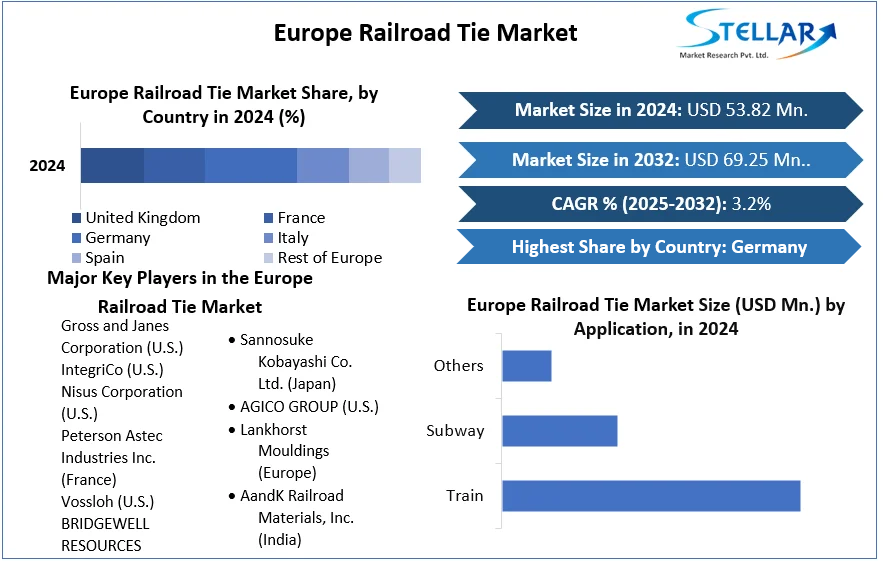
The Europe railroad tie market size plays a vital role in supporting the region’s extensive railway infrastructure. Railroad ties—also known as railway sleepers—form the foundation of railway tracks by holding rails in position, maintaining gauge, and distributing loads to the ballast. As Europe continues to modernize its rail network and promote sustainable transportation, demand for durable and high-performance railroad ties is steadily increasing.
Europe Railroad Tie Market was valued at USD$ 53.82 million in 2024. Market size is estimated to grow at a CAGR of 3.2% over the forecast period.
Get your Free Sample PDF: https://www.stellarmr.com/report/req_sample/Europe-Railroad-Tie-Market/897
Understanding Railroad Ties and Their Importance
Railroad ties are critical structural components placed perpendicular to railway rails. They ensure track stability, absorb vibrations, and transfer loads from passing trains to the track bed. The performance of railway systems depends heavily on the quality and durability of these ties.
Traditionally, wooden ties dominated the European market due to their cost-effectiveness and ease of installation. However, the growing need for longer service life and reduced maintenance has accelerated the adoption of alternative materials such as concrete, steel, and composite ties.
Market Drivers
1. Expansion of High-Speed Rail Networks
Europe is home to some of the world’s most advanced high-speed rail systems, including services operated by SNCF in France and Deutsche Bahn in Germany. The continuous expansion and upgrading of high-speed corridors demand high-strength concrete railroad ties that can withstand heavy loads and higher speeds.
Concrete ties are increasingly preferred for high-speed and heavy-haul routes due to their durability, resistance to weathering, and lower long-term maintenance requirements. As countries invest in cross-border rail connectivity and electrification projects, the demand for concrete ties is expected to remain strong.
2. Infrastructure Modernization and Rehabilitation
Many European rail networks were built decades ago and require significant rehabilitation. Governments across the region are investing in track renewal programs to enhance safety, efficiency, and capacity. Replacement of aging wooden ties with concrete or composite alternatives is a major part of these initiatives.
Track maintenance strategies now emphasize lifecycle cost optimization rather than just initial installation expenses. This shift favors advanced materials that offer longer operational life and reduced replacement frequency.
3. Sustainability and Environmental Regulations
Europe’s focus on sustainability has influenced material choices in the railroad tie market. Environmental concerns regarding chemically treated wooden ties have encouraged the exploration of eco-friendly alternatives. Composite railroad ties made from recycled plastics and rubber are gaining attention for their environmental benefits and durability.
Additionally, rail transport is considered one of the most energy-efficient and low-emission modes of transportation. As European nations work to reduce carbon emissions and promote rail freight over road transport, investments in rail infrastructure—including railroad ties—are increasing.
Material Segment Analysis
Wooden Railroad Ties
Wooden ties have historically been the most widely used type in Europe. They are easy to manufacture and install, and they provide good electrical insulation—an important feature for signaling systems. However, their relatively shorter lifespan and susceptibility to decay, insects, and moisture limit their long-term performance.
Despite these challenges, wooden ties remain common in secondary lines, rural routes, and areas with lower traffic density.
Concrete Railroad Ties
Concrete ties dominate new construction projects and high-speed rail lines. They offer superior strength, uniformity, and resistance to environmental factors. Their heavier weight enhances track stability, especially for high-speed and freight corridors.
The higher initial cost of concrete ties is offset by their extended service life and reduced maintenance requirements, making them a preferred choice for modern rail systems.
Steel and Composite Ties
Steel ties are valued for their strength and recyclability but are less common compared to concrete and wood. Composite ties, on the other hand, represent a growing segment. They combine durability with environmental sustainability and are suitable for bridges, tunnels, and areas exposed to extreme conditions.
As innovation continues, composite materials are expected to gain greater market share in the coming years.
Regional Insights
Western Europe leads the railroad tie market due to its well-developed rail infrastructure and strong focus on modernization. Countries such as France, Germany, and the United Kingdom are investing heavily in upgrading existing rail networks and expanding high-speed routes.
Central and Eastern European countries are also witnessing increased railway investments. European Union funding programs aimed at improving regional connectivity have accelerated track renewal projects in countries such as Poland, Hungary, and Romania.
Cross-border initiatives and the development of trans-European transport corridors are further driving the need for standardized, high-quality railroad ties across the region.
Competitive Landscape
The Europe railroad tie market is characterized by the presence of established manufacturers specializing in concrete, wooden, and composite ties. Companies focus on product innovation, sustainability, and strategic partnerships with railway authorities to secure long-term contracts.
Manufacturers are investing in advanced production technologies to enhance tie strength, uniformity, and performance. Automation and quality control systems help ensure compliance with stringent European railway standards.
Get your Free Sample PDF: https://www.stellarmr.com/report/req_sample/Europe-Railroad-Tie-Market/897
Challenges in the Market
Despite steady growth, the market faces certain challenges. Fluctuating raw material prices, especially for timber and cement, can impact production costs. Additionally, stringent regulatory requirements related to environmental compliance and safety standards may increase operational complexity for manufacturers.
Another challenge lies in balancing cost efficiency with sustainability goals. While composite and eco-friendly materials offer long-term benefits, their higher upfront costs can limit widespread adoption in cost-sensitive projects.
Future Outlook
The Europe railroad tie market is poised for stable growth in the coming years, supported by continuous investments in rail infrastructure, sustainability initiatives, and technological advancements. The shift toward high-speed rail, freight corridor expansion, and electrification projects will continue to generate demand for durable and high-performance ties.
About Stellar Market Research:
Stellar Market Research is a multifaceted market research and consulting company with professionals from several industries. Some industries we cover include medical devices, pharmaceutical manufacturers, science and engineering, electronic components, industrial equipment, technology and communication, cars and automobiles, chemical products and substances, general merchandise, beverages, personal care, and automated systems.
Contact Stellar Market Research:
S.no.8, h.no. 4-8 Pl.7/4,
Pinnacle Memories Fl. No. 3,
Pune, Maharashtra, 411029
sales@stellarmr.com
+91 9607365656

 English
 Arabic
 French
 Spanish
 Portuguese
 Deutsch
 Turkish
 Dutch
Dutch
 Italiano
 Romaian
 Portuguese (Brazil)
 Greek
Greek