


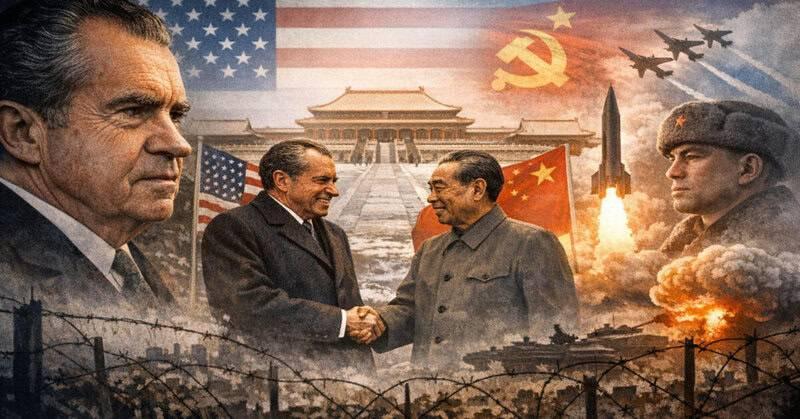
12 Reasons Nixon’s Trip to China Was a Cold War Turning Point

0
50

12 Reasons Nixon’s Trip to China Was a Cold War Turning Point

1. Breaking Decades of Hostility

12 Reasons Nixon’s Trip to China Was a Cold War Turning Point
Image Source: Pexels.

For over two decades, the United States and the People’s Republic of China maintained a policy of non-recognition, resulting in 22 years of diplomatic silence. This period was characterized by mutual distrust and ideological opposition, with the U.S. supporting the Republic of China in Taiwan. President Nixon’s 1972 visit to Beijing ended this prolonged estrangement, marking a historic thaw in relations. This breakthrough was unprecedented, as no prior U.S. president had engaged directly with Chinese Communist leaders. (history.state.gov)

2. Strategic Balance Against the Soviet Union

12 Reasons Nixon’s Trip to China Was a Cold War Turning Point
Image Source: Pexels.

President Nixon’s 1972 visit to China was a calculated move to exploit the Sino-Soviet split, aiming to shift the global balance of power during the Cold War. By engaging with China, the U.S. sought to create a counterweight to Soviet influence, thereby enhancing its strategic position. This approach, known as triangular diplomacy, involved leveraging relations with one country to extract concessions from another. Nixon’s initiative was unprecedented, as no prior U.S. president had engaged directly with Chinese Communist leaders. (history.state.gov)

3. Opening the Door to Normalized Relations

12 Reasons Nixon’s Trip to China Was a Cold War Turning Point
Nixon’s 1972 China visit paved the way for diplomatic relations and the Shanghai Communiqué.

President Nixon’s 1972 visit to China laid the groundwork for the 1979 formal establishment of diplomatic relations. During the visit, the Shanghai Communiqué was issued, acknowledging the “One China” policy and setting the stage for future negotiations. This communiqué addressed the Taiwan issue, allowing both nations to set aside differences temporarily to open trade and other contacts. The principles established in the communiqué provided the basis for the establishment of formal diplomatic relations between the two countries in 1979. (history.state.gov)

4. Facilitating US-China Trade and Exchange

12 Reasons Nixon’s Trip to China Was a Cold War Turning Point
Nixon’s 1972 China visit transformed U.S.-China relations, fostering economic cooperation and cultural exchange.

President Nixon’s 1972 visit to China marked a pivotal moment in U.S.-China relations, leading to the gradual removal of trade barriers and the initiation of cultural exchanges. This thaw in diplomatic relations paved the way for increased economic interactions and mutual understanding between the two nations. The visit set the stage for decades of globalization, as both countries recognized the benefits of cooperation and engagement. (pbs.org)

5. Influencing Vietnam War Diplomacy

12 Reasons Nixon’s Trip to China Was a Cold War Turning Point
Nixon’s 1972 China visit reshaped U.S. leverage in Vietnam War negotiations through strategic diplomacy.

President Nixon’s 1972 visit to China provided the United States with new leverage in negotiations to end the Vietnam War. By engaging with China, the U.S. aimed to exploit the Sino-Soviet split, thereby weakening North Vietnam’s support from its Chinese ally. This strategy paralleled tactics used in triangular diplomacy, where the U.S. sought to influence the dynamics between China and the Soviet Union to its advantage. The rapprochement with China was viewed as a means to pressure North Vietnam into seeking a peaceful resolution. (cfr.org)

6. Inspiring Détente

12 Reasons Nixon’s Trip to China Was a Cold War Turning Point
Nixon’s 1972 China visit reshaped Cold War dynamics, fostering U.S.-Soviet détente and nuclear restraint.

President Nixon’s 1972 visit to China significantly influenced U.S.-Soviet détente, easing tensions on both European and Asian fronts. This engagement led to the Strategic Arms Limitation Talks (SALT), resulting in agreements that limited nuclear arsenals and marked a shift toward mutual restraint. Nixon’s outreach to China and subsequent Moscow summit with Soviet General Secretary Leonid Brezhnev exemplified a strategic approach to Cold War diplomacy, fostering a period of reduced hostilities and increased cooperation between the superpowers. (history.com)

7. Transforming Global Alliances

12 Reasons Nixon’s Trip to China Was a Cold War Turning Point
Nixon’s historic 1972 China visit reshaped global diplomacy and sparked renewed international engagement.

President Nixon’s 1972 visit to China prompted nations worldwide to reassess their China policies, leading to broader diplomatic efforts. Japan, Canada, and Western European countries recognized the strategic importance of engaging with China, resulting in enhanced bilateral relations and economic partnerships. This shift in global alliances fostered a more interconnected international community, as nations sought to balance their interests amid the evolving geopolitical landscape. (brookings.edu)

8. Undermining Moscow’s Influence

12 Reasons Nixon’s Trip to China Was a Cold War Turning Point
Nixon’s 1972 China visit reshaped Soviet strategy, prompting a pivotal foreign policy reassessment.

President Nixon’s 1972 visit to China significantly altered the Soviet Union’s strategic calculations. By forming closer U.S.-China relations, the Soviet Union found itself increasingly isolated, compelling Moscow to reassess its foreign policy. This shift contributed to the eventual softening of Soviet foreign policy, as the USSR recognized the need to adapt to the changing global dynamics. The rapprochement between the U.S. and China underscored the importance of diplomatic engagement in the evolving Cold War landscape. (britannica.com)

9. Accelerating China’s Modernization

12 Reasons Nixon’s Trip to China Was a Cold War Turning Point
Image Source: Pexels.

President Nixon’s 1972 visit to China exposed Chinese leaders to Western technology and economic models, indirectly contributing to China’s later reforms under Deng Xiaoping. The visit showcased the benefits of engagement with the global economy, highlighting the potential for modernization through openness and reform. This exposure played a role in China’s decision to adopt market-oriented policies, leading to significant economic growth and integration into the global market in the subsequent decades. (history.com)

10. Changing the UN Power Structure

12 Reasons Nixon’s Trip to China Was a Cold War Turning Point
Image Source: Pexels.

President Nixon’s 1972 visit to China was pivotal in altering the United Nations’ power dynamics. By engaging with the People’s Republic of China (PRC), the United States facilitated China’s admission to the UN, ending the Republic of China’s (ROC) exclusive representation. This shift expanded the Security Council’s permanent membership from five to six, redistributing voting power and introducing a new perspective into UN deliberations. China’s entry also introduced a new dynamic in the Security Council’s decision-making process, as the PRC’s voting behavior differed from that of the ROC. (research.un.org)

11. Engendering Public Awareness

12 Reasons Nixon’s Trip to China Was a Cold War Turning Point
Nixon’s 1972 China visit reshaped American perceptions, fostering understanding through unprecedented media coverage.

President Nixon’s 1972 visit to China was extensively televised, offering Americans their first glimpse of mainland China in over two decades. This unprecedented media coverage humanized the Chinese people, fostering greater understanding and engagement between the two societies. The visit’s positive portrayal led to a significant shift in public perception, with many Americans developing a more favorable view of China. This change was reflected in subsequent public opinion polls, indicating increased interest and awareness of Chinese culture and politics. (news.gallup.com)

12. Creating a Template for High-Stakes Diplomacy

12 Reasons Nixon’s Trip to China Was a Cold War Turning Point
Nixon’s historic 1972 China visit exemplified the power of secret diplomacy in global relations.

President Nixon’s 1972 visit to China became a model for secret diplomacy and high-level summits, demonstrating how direct engagement with adversaries can break deadlocks in seemingly intractable international situations. The visit’s success showcased the effectiveness of behind-the-scenes negotiations and public diplomacy in achieving significant geopolitical shifts. This approach has since been emulated by global leaders seeking to resolve complex conflicts and foster international cooperation. (history.state.gov)

Conclusion

12 Reasons Nixon’s Trip to China Was a Cold War Turning Point
Nixon’s 1972 China visit transformed Cold War diplomacy, prioritizing dialogue and reshaping global relations.

President Nixon’s 1972 visit to China was a pivotal moment in Cold War history, reshaping international relations by prioritizing dialogue over isolation. This groundbreaking engagement not only altered the U.S.-China dynamic but also set a precedent for high-stakes diplomacy, influencing global leaders’ approaches to complex international challenges. The visit’s enduring significance continues to inspire diplomatic strategies that emphasize direct communication and mutual understanding in addressing global issues. (history.com)

البحث
الأقسام
إقرأ المزيد
Music
Live Nation Employees Caught Mocking Customers In Leaked Comments
'These People Are So Stupid' - Live Nation Directors Mocked Ticket Buyers in Leaked MessagesLive...
بواسطة Test Blogger4 2026-03-13 13:00:03 0 1كيلو بايت
الألعاب
Hades 2 update leaves its biggest secret out of the patch notes: a new game mode
Hades 2 update leaves its biggest secret out of the patch notes: a new game mode The...
بواسطة Test Blogger6 2026-04-15 10:00:11 0 747
Food
The Best Hole-In-The-Wall Restaurants In Texas
The Best Hole-In-The-Wall Restaurants In Texas...
بواسطة Test Blogger1 2026-03-15 21:00:07 0 1كيلو بايت
Food
This Filipino Comfort Food Is A Bruno Mars Favorite
This Filipino Comfort Food Is A Bruno Mars Favorite...
بواسطة Test Blogger1 2026-02-16 22:00:08 0 2كيلو بايت
الألعاب
EA just cut Apex Legends map without warning, but there is a good reason
EA just cut Apex Legends map without warning, but there is a good reason After seven years...
بواسطة Test Blogger6 2026-04-06 11:00:11 0 954