


New Approach For Interstellar Navigation Was Tested On A Spacecraft 9 Billion Kilometers Away
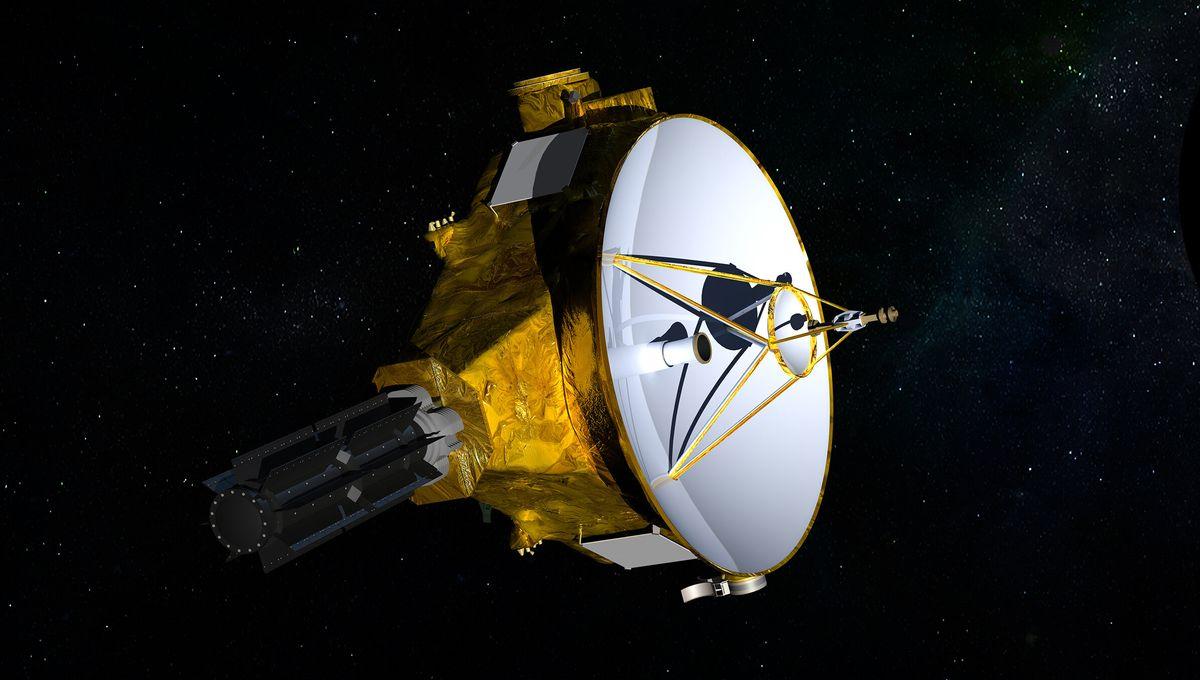
New Approach For Interstellar Navigation Was Just Tested On A Spacecraft 9 Billion Kilometers Away
For millennia, the way we found our way home has been using the stars. The tech we have sent towards those stars also uses the position of distant shining dots to find their orientation and not lose “sight” of Earth. But researchers have just demonstrated that once you are far away from the planets of the Solar System, there might be a simpler way to navigate interstellar space.
NASA’s New Horizons is the fifth ever probe that is destined to leave the Solar System, following Pioneer 10 & 11 and Voyager 1 & 2. It flew by Pluto and its moons in July 2015 and then by Kuiper Belt Object Arrokoth in 2019. Since then, it has traveled away from the Sun and it is now 9.1 billion kilometers (5.6 billion miles) from Earth. That is far enough that the apparent position in the sky of Proxima Centauri and Wolf 359 has shifted from the spacecraft's point of view. “New Horizons is so far away that the nearest stars have shifted markedly from where we see them on Earth. With the NH observed positions for two stars, from NH imagery alone we can figure out where the spacecraft is. This technique would be used on interstellar voyages,” lead author Tod Lauer, from NOIR Lab, wrote in a post on BlueSky. The parallax of Proxima Centauri (left) and Wolf 359 (right) as seen from Earth and by New Horizons on the same days in 2020. Image Credit: NASA/Johns Hopkins APL/SwRI What was used here is an effect called parallax. This means that an object's position appears to change when seen from different positions. Parallax has been used in the past to measure the distance of stars by measuring their position when the Earth is on opposite sides of its orbit. A parsec (3.26 light-years) is the distance of a star that appears to have changed position in the sky by one arcsecond (1/3,600 of a degree) when Earth has gone halfway across its orbit. There is no star that is actually just a parsec away. The closest to us is Proxima Centauri, which is just over 4 light-years away. Proxima is in a three-star system known as Alpha Centauri. Then there is Wolf 359, a red dwarf located 7.86 light-years away, among the nearest stars to us. The team imaged these two stars with New Horizons using the Long Range Reconnaissance Imager (LORRI). This camera was used for the high-resolution images of Pluto and Arrokoth as well as for navigation. They took images of the stars from a few years back, and those were compared to the measurements taken by the European Space Agency’s Gaia observatory. Gaia has created the most precise map of stars in the Milky Way, and using that catalog and the observations from New Horizons, the team was able to find its position with an uncertainty of 40 million kilometers (25 million miles). Obviously, this is bad if you are trying to find a specific restaurant, but when it comes to testing a never-before-seen approach to navigation on a spacecraft that is now 60 times farther from the Sun than the Earth, it becomes an excellent result. “The measurements were within our expected range of uncertainty for LORRI, but future deep space missions with high-resolution navigation imagers should be able to achieve dramatically better positions, using this same technique,” Lauer said in a statement. The demonstration shows that even a camera not designed for this task – and it is currently the most remote camera ever operated – can do it. So, future missions might want to incorporate this approach to help with navigation as spacecraft travel towards the stars. “This pioneering interstellar navigation demonstration and its accompanying publication show that a deep-space mission can use its onboard imaging system to find its way among the stars,” added Alan Stern, principal investigator for New Horizons from the Southwest Research Institute. “While for New Horizons, this method isn’t as accurate as NASA’s sophisticated tracking from Earth, it could be highly useful for future deep space missions in the far reaches of the Solar System and in interstellar space.” A paper describing the work has been accepted for publication in The Astronomical Journal and is available on arXiv.

 English
 Arabic
 French
 Spanish
 Portuguese
 Deutsch
 Turkish
 Dutch
Dutch
 Italiano
 Russian
 Romaian
 Portuguese (Brazil)