Mercury Seven astronauts endure rigorous training, mastering G-forces and isolation for space missions.
Intensive training pushed the Mercury Seven to their limits, including G-force simulations, isolation tanks, and simulated missions. Shepard and his peers trained for every possible contingency within the primitive confines of early 1960s technology. (nasa.gov)
5. The Redstone Rocket
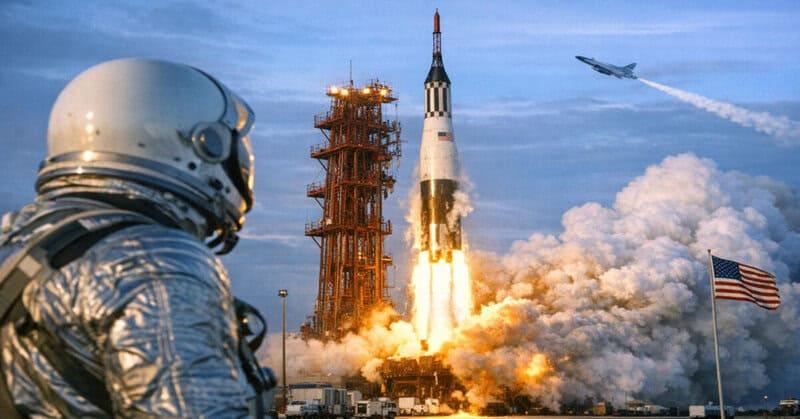
Mercury-Redstone rocket: America’s pioneering vehicle for human spaceflight, standing 83 feet tall.
The Mercury-Redstone rocket, derived from the U.S. Army’s Redstone ballistic missile, was selected to carry the first American into space. It stood 83 feet tall and was powered by a single Rocketdyne A-7 engine, producing 78,000 pounds of thrust. In comparison, the Soviet Union’s Vostok-K rocket, based on the R-7 Semyorka ICBM, was 125.85 feet tall and capable of delivering 4.7 tons to low Earth orbit. (nasa.gov)
6. The Mission: Freedom 7
Alan Shepard prepares for Freedom 7, the first crewed suborbital flight in space history.
Alan Shepard was chosen for the first crewed flight, codenamed Freedom 7. Delays and technical setbacks raised tensions. The mission plan was simple: a 15-minute suborbital flight to test human capability in space. (airandspace.si.edu)
7. Launch Day: May 5, 1961
Alan Shepard readies for his historic Freedom 7 flight amidst countdown challenges on May 5, 1961.
On May 5, 1961, Alan Shepard prepared for his historic flight aboard the Freedom 7 spacecraft. The countdown began on May 4, 1961, at 8:30 a.m. EST, with a built-in hold at T-6 hours 30 minutes for spacecraft preparations. The countdown resumed at 11:30 p.m. EST, with another hold at T-2 hours 20 minutes for final checks. At T-15 minutes, low clouds near the launch area threatened visibility, but forecasts predicted improvement. A technical issue with a power inverter led to an 86-minute delay. Despite these challenges, Shepard’s determination remained unwavering. At 9:34 a.m. EST, the Mercury-Redstone 3 rocket launched from Cape Canaveral’s Launch Complex 5, propelling Shepard into history as the first American in space. The mission lasted 15 minutes and 22 seconds, reaching an altitude of 116.5 miles and a maximum speed of 5,134 miles per hour. Shepard’s successful flight was a significant milestone in the Space Race. (nasa.gov)
8. The Flight: Into the Unknown
Alan Shepard’s pioneering 1961 flight aboard Freedom 7 marked America’s inaugural human space journey.
On May 5, 1961, Alan Shepard embarked on a historic 15-minute suborbital journey aboard the Freedom 7 spacecraft, marking America’s first human spaceflight. As the Redstone rocket propelled him skyward, Shepard experienced intense vibrations and acceleration forces. Upon reaching the apex of his trajectory at 116.5 miles, he observed the curvature of Earth and the vastness of space. During the descent, Shepard manually controlled the capsule’s orientation, demonstrating his ability to pilot the spacecraft. The mission concluded with a successful splashdown in the Atlantic Ocean, affirming America’s entry into manned space exploration. (nasa.gov)
9. Splashdown and Recovery
Alan Shepard’s historic splashdown in the Atlantic, greeted by Navy personnel aboard USS Lake Champlain.
After completing his historic 15-minute suborbital flight aboard Freedom 7, Alan Shepard splashed down in the Atlantic Ocean, approximately 3.5 miles from the recovery ship, the aircraft carrier USS Lake Champlain (CVS-39). The U.S. Navy’s Task Force 140 coordinated the recovery operation, deploying an HUS-1 helicopter from Marine Corps squadron HMR(L)-262 to retrieve Shepard and the capsule. The helicopter transported them to the USS Lake Champlain, where Shepard was greeted by Navy personnel and medical staff. The successful recovery was a significant achievement, showcasing the Navy’s capability in supporting space missions. The public’s reaction was one of immense pride and excitement, as Shepard’s safe return symbolized America’s growing prowess in space exploration. (history.navy.mil)
10. Aftermath: National Hero
Alan Shepard’s groundbreaking flight ignited America’s space race and inspired a lunar mission pledge.
Alan Shepard’s historic flight on May 5, 1961, captivated the nation, earning him a ticker-tape parade in New York City and a personal meeting with President John F. Kennedy. The media frenzy surrounding Shepard’s achievement inspired a renewed U.S. commitment to space exploration, culminating in President Kennedy’s pledge to land an American on the Moon before the decade’s end. (nasa.gov)
11. Legacy of Freedom 7
Alan Shepard’s Freedom 7 mission marked a pivotal moment in American space exploration history.
Alan Shepard’s successful journey aboard Freedom 7 unlocked new milestones, paving the way for John Glenn’s orbital flight and, ultimately, the Apollo moon missions. The mission’s success demonstrated America’s capability in human spaceflight, leading to increased investment and public interest in space exploration. Freedom 7’s legacy is commemorated through various memorials, including a crater on Mars named “Freedom 7” by NASA’s Opportunity rover, and the preservation of the Freedom 7 capsule at the John F. Kennedy Presidential Library. (jfklibrary.org)
Conclusion
Alan Shepard’s pioneering flight ignited America’s journey into space, inspiring generations to explore.
Alan Shepard’s brief but brilliant flight marked a turning point in American history. His courage and the collaboration of thousands of scientists, engineers, and military personnel fueled a national dream that made later triumphs possible. The story of the first American in space continues to inspire generations to explore beyond the horizon. (nasa.gov)





 English
 Arabic
 French
 Spanish
 Portuguese
 Turkish
 Dutch
Dutch
 Italiano
 Russian
 Romaian
 Portuguese (Brazil)
 Greek
Greek