


Doom The Dark Ages ray tracing might have killed your frame rate, but at least it saved id 110GB of disk space
Doom The Dark Ages ray tracing might have killed your frame rate, but at least it saved id 110GB of disk space
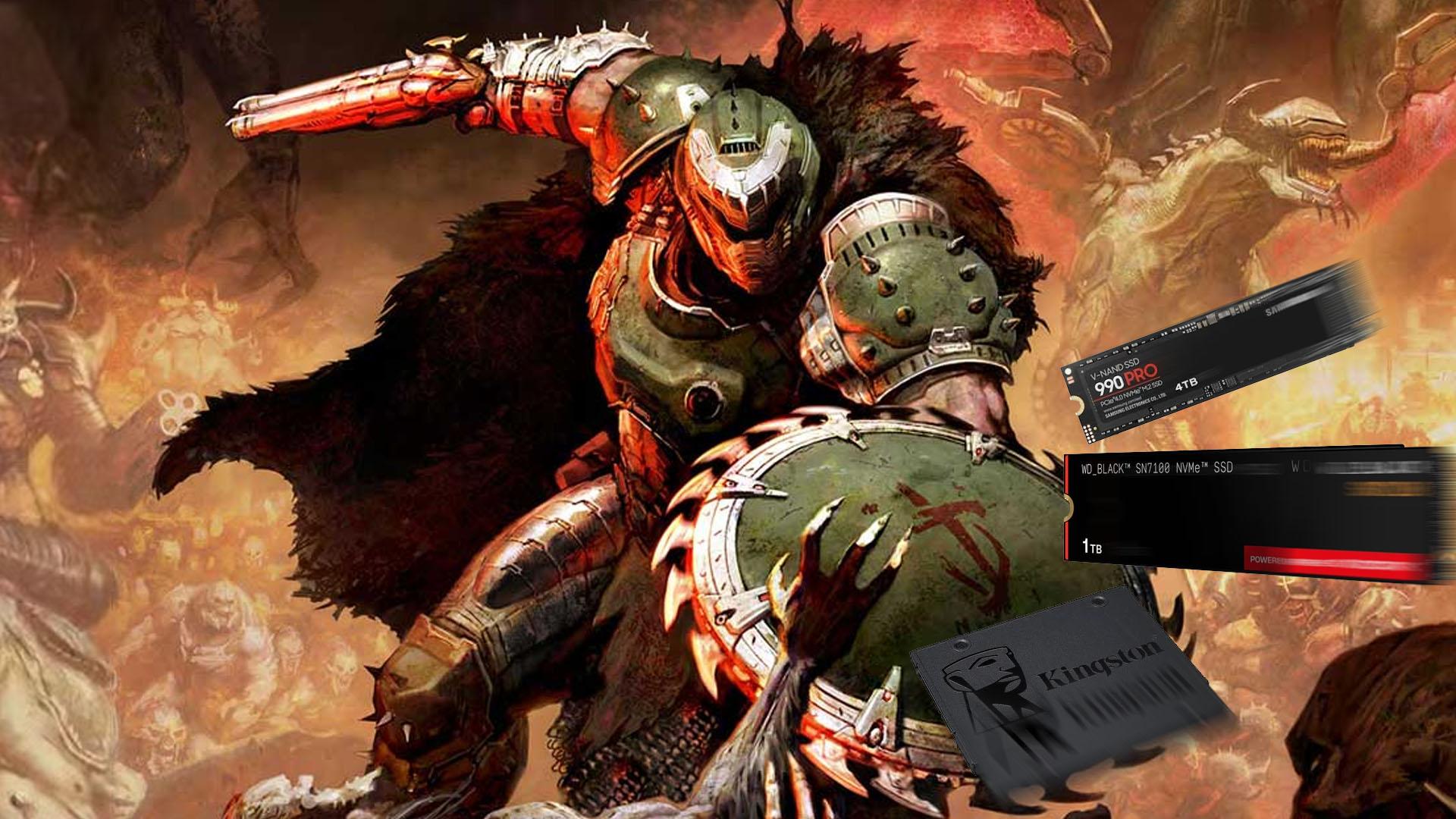
id has revealed that, if it hadn't updated its idtech engine to use ray tracing instead of pre-baked global illumination, Doom: The Dark Ages could have taken far longer to develop and been a much larger install size. The company has claimed that just the pre-baked lighting data for all the game's maps/environments could have needed as much as 110GB of storage and taken as much as two months to render fully each time. However, by making this change, the company effectively traded storage and its development time for backwards compatibility and your PC's performance.
Doom: The Dark Ages was famously one of the first games to require a GPU with ray tracing processors, with it landing around the same time as other ray-tracing-required titles such as Indiana Jones and the Great Circle (which also uses idtech8) and Black Myth: Wukong. This requirement left many gamers unable to play the game at all, or only able to play with relatively poor performance. Now, in a presentation at the graphics conference, SIGGRAPH, id has revealed its motivation for this decision.
During an in-depth explanation of how "id Software transitioned from a pre-baked global illumination to a 'fast as hell' real-time solution," Tiago Sousa, id Software's Rendering Technical Director, explained how the company had realized that its existing idtech7 engine simply wasn't going to cut it for creating the larger, more complex maps, characters, and physics it planned for Doom: The Dark Ages.
Describing the scale of some of these changes, Sousa noted that the maps totalled around 5,000km, not including the non-player areas that can be seen from their edges. This amounted to between four and ten times the level size of previous projects.
Sousa goes on to explain how, in previous games, the lighting for titles such as Doom: Eternal was pre-rendered (aka, pre-baked) so that instead of a user's PC needing to render the game's complex lighting on the fly, lighting effects were pre-rendered and built into the textures of the game. This was done on large banks of PCs at the developer's offices, taking hours to render the full game after each change to its core design.
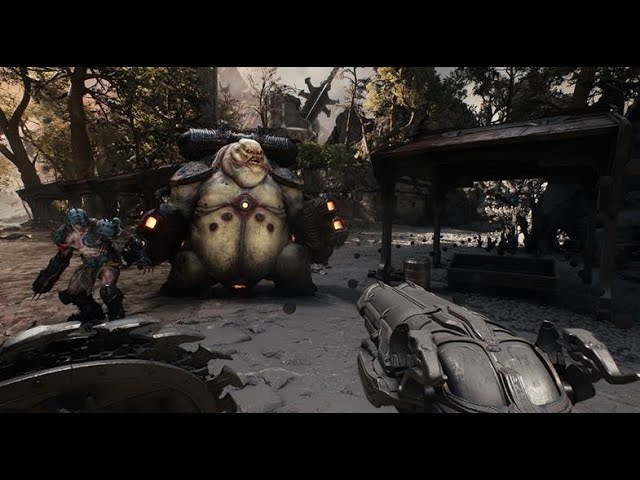
This worked for smaller projects, but for the scale of Doom: The Dark Ages, this would have resulted in ludicrous file sizes and render times. According to Sousa's data, the resultant pre-baked global illumination lighting data could have required between 44GB and 110GB of storage. That's not the whole game's install size, but just one part of it.
Not only that, but the render times for completely processing every map in the game would have been measured in weeks. Between 27 days and 68 days was the estimate, with Sousa suggesting that increasing the capacity of its render PCs would have "not massively" reduced the iteration time (the turnaround time between changes to the game that would require another rendering run) while the RAM and disk storage requirements wouldn't have changed.
That's why, then, id chose to incorporate ray tracing right into the core of the game. By using real-time ray tracing hardware in the latest GPUs - any Nvidia RTX card, Intel Arc cards, and AMD RX cards - the new idtech8 engine game could do away with much of this prerendering, instead relying on your hardware to do the grunt work.
The actual mechanics of how the company achieved this are far too complex to explain succinctly here, but the results are quite impressive. Both Indiana Jones and the Great Circle and Doom: The Dark Ages deliver decent frame rates for the image quality and level of ray-traced lighting they incorporate. However, if there was any doubt as to why ray tracing is being embraced so readily by developers without games necessarily providing a huge leap forward in image quality, now you've heard it from the horse's mouth.

The SIGGRAPH presentation where this was revealed happened a few months ago, but the data and rendering time requirements were recently highlighted by Nvidia's "GeForce Evangelist," Jacob Freeman, in a post on X earlier today.
Ultimately, this progress in technology is somewhat inevitable and has already resulted in many amazing-looking games and remasters of old games using ray tracing tech. It's just a shame that, at the moment, the best graphics card options that can take full advantage of ray tracing are so expensive.

 English
 Arabic
 French
 Spanish
 Portuguese
 Deutsch
 Turkish
 Italiano
 Russian
 Romaian
 Portuguese (Brazil)
 Greek
Greek