


Middle East & Africa Coffee Market: Growth Trends, Consumer Shifts, and Future Outlook To Forecast 2025-2032
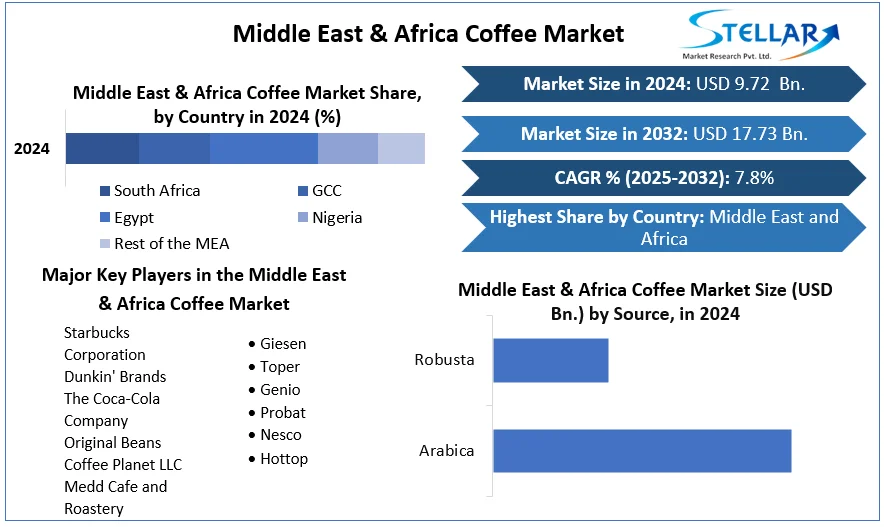
The Middle East & Africa (MEA) coffee market is experiencing dynamic growth, driven by evolving consumer lifestyles, rising disposable incomes, urbanization, and the rapid expansion of café culture across major cities. Coffee has long been embedded in cultural traditions across the region, from Arabic coffee ceremonies in the Gulf to Ethiopia’s globally recognized coffee heritage. Today, this cultural legacy is merging with modern consumption patterns, creating a vibrant and competitive marketplace.
Get your Sample PDF: https://www.stellarmr.com/report/req_sample/Middle-East--Africa-Coffee-Market/73
Market Overview
The MEA coffee market encompasses a diverse range of products, including roasted coffee, instant coffee, specialty blends, ready-to-drink (RTD) coffee beverages, and premium single-origin varieties. While traditional brewing methods still dominate in several countries, demand for convenient and innovative formats is steadily increasing.
The region can broadly be divided into two key sub-markets:
- Middle East: Characterized by strong café culture, premiumization trends, and high per capita coffee consumption, particularly in Gulf Cooperation Council (GCC) countries.
- Africa: A mix of major coffee-producing nations and emerging consumer markets, with increasing domestic consumption in urban centers.
Economic diversification efforts in oil-dependent countries, coupled with a growing youth population and exposure to global food and beverage trends, are reshaping the coffee industry landscape.
Cultural Roots and Heritage
Coffee holds deep cultural significance in many MEA countries. In the Middle East, Arabic coffee—often flavored with cardamom—is traditionally served as a gesture of hospitality. Social gatherings and business meetings frequently revolve around coffee rituals.
In Africa, countries such as Ethiopia are globally recognized as the birthplace of coffee. Ethiopian coffee ceremonies remain an essential part of social life, symbolizing community and tradition. Meanwhile, nations like Kenya and Uganda are renowned for producing high-quality Arabica and Robusta beans.
This strong cultural foundation provides a stable base for consumption, even as modern trends reshape preferences.
Key Growth Drivers
1. Rapid Urbanization and Youth Demographics
The MEA region has one of the youngest populations globally. Younger consumers are increasingly embracing café culture, international coffee chains, and specialty beverages. Urbanization is further accelerating demand, particularly in cities such as Dubai, Riyadh, Johannesburg, and Nairobi.
2. Expansion of Café Culture
International and regional café brands are expanding aggressively across the Middle East and parts of Africa. Premium coffee shops are becoming social hubs, co-working spaces, and lifestyle destinations. Specialty coffee, artisanal brewing methods, and third-wave coffee movements are gaining traction.
3. Rising Disposable Income
Economic growth in several Middle Eastern countries has boosted purchasing power, enabling consumers to opt for premium coffee products, specialty beans, and branded café experiences.
4. Growing Preference for Premium and Specialty Coffee
Consumers are becoming more discerning, seeking high-quality beans, unique flavor profiles, and ethically sourced products. Single-origin coffee and sustainable sourcing practices are increasingly influencing purchase decisions.
5. Increasing Demand for Convenience
Instant coffee and ready-to-drink formats are gaining popularity, particularly among working professionals. Busy lifestyles and the growth of modern retail channels support the expansion of these segments.
Product Segmentation Trends
Roasted and Ground Coffee
This segment remains dominant in markets with strong traditional brewing practices. Freshly ground coffee and specialty blends are particularly popular in urban centers.
Instant Coffee
Instant coffee holds a significant share in price-sensitive markets and among consumers seeking convenience. It is widely distributed through supermarkets, hypermarkets, and neighborhood stores.
Specialty Coffee
Specialty coffee is one of the fastest-growing segments. Third-wave cafés emphasize origin, roast profiles, and brewing methods such as pour-over and cold brew. Consumers are increasingly willing to pay premium prices for high-quality experiences.
Ready-to-Drink (RTD) Coffee
RTD coffee is emerging as a growth category, especially among younger consumers. Innovative flavors, cold brew options, and functional ingredients are driving interest in this segment.
Distribution Channels
Modern retail formats, including supermarkets and hypermarkets, dominate coffee sales in urban areas. E-commerce platforms are also gaining traction, particularly in the Middle East, where digital adoption is high.
Cafés and foodservice outlets play a crucial role in brand visibility and consumer engagement. The growth of delivery apps and quick-commerce services further supports at-home consumption of café-style beverages.
In African markets, traditional retail channels still hold significant importance, although modern trade is expanding steadily.
Regional Insights
Gulf Cooperation Council (GCC) Countries
Countries such as Saudi Arabia and the United Arab Emirates exhibit high per capita coffee consumption. The café culture is deeply ingrained, and premiumization is particularly strong. Specialty coffee festivals and barista competitions highlight the region’s growing sophistication.
North Africa
North African countries have established coffee traditions, with strong demand for both traditional and modern formats. Urban populations are increasingly exploring international café chains and specialty offerings.
Sub-Saharan Africa
While several Sub-Saharan countries are major exporters, domestic consumption is rising, particularly in South Africa, Kenya, and Nigeria. The expansion of middle-class populations is supporting growth in branded and packaged coffee products.
Competitive Landscape
The MEA coffee market is characterized by the presence of global multinational corporations, regional brands, and local artisanal roasters. International players leverage strong branding, product innovation, and extensive distribution networks. Meanwhile, local brands capitalize on cultural familiarity and competitive pricing.
Specialty roasters and independent cafés are carving out niche segments, particularly among urban consumers seeking unique and premium experiences.
Strategic partnerships, product launches, sustainability initiatives, and digital marketing campaigns are common competitive strategies. Companies are increasingly focusing on traceability, fair trade sourcing, and environmentally friendly packaging to attract socially conscious consumers.
Get your Sample PDF: https://www.stellarmr.com/report/req_sample/Middle-East--Africa-Coffee-Market/73
Challenges
Despite strong growth prospects, the market faces several challenges:
- Price Volatility: Fluctuations in global coffee prices can impact profitability.
- Supply Chain Disruptions: Political instability in some African regions may affect production and export logistics.
- Regulatory Variations: Different import duties, labeling regulations, and food safety standards across countries can complicate market entry.
- Competition from Alternative Beverages: Tea and energy drinks remain strong competitors in several markets.
Future Outlook
The Middle East & Africa coffee market is poised for sustained growth over the coming years. Premiumization, digital retail expansion, and rising café culture will remain key growth pillars. Sustainability and ethical sourcing are expected to become even more influential in shaping consumer choices.
About Stellar Market Research:
Stellar Market Research is a multifaceted market research and consulting company with professionals from several industries. Some industries we cover include medical devices, pharmaceutical manufacturers, science and engineering, electronic components, industrial equipment, technology and communication, cars and automobiles, chemical products and substances, general merchandise, beverages, personal care, and automated systems.
Contact Stellar Market Research:
S.no.8, h.no. 4-8 Pl.7/4,
Pinnacle Memories Fl. No. 3,
Pune, Maharashtra, 411029
sales@stellarmr.com
+91 9607365656

 English
 Arabic
 Spanish
 Portuguese
 Deutsch
 Turkish
 Dutch
Dutch
 Italiano
 Russian
 Romaian
 Portuguese (Brazil)
 Greek
Greek