


Middle East and Africa Bike Sharing Market: Emerging Trends, Growth Drivers, and Future Outlook
The Middle East and Africa (MEA) bike sharing market is witnessing steady growth as governments, urban planners, and private operators focus on sustainable mobility solutions. Rapid urbanization, traffic congestion, rising fuel prices, and growing environmental awareness are reshaping transportation preferences across major cities in the region. Bike sharing systems are increasingly being adopted as a convenient, eco-friendly, and cost-effective alternative for short-distance travel.
While the bike sharing industry in MEA is still developing compared to Europe and Asia-Pacific, the region presents significant untapped potential. Smart city initiatives, infrastructure investments, and technological advancements are expected to accelerate market expansion in the coming years.
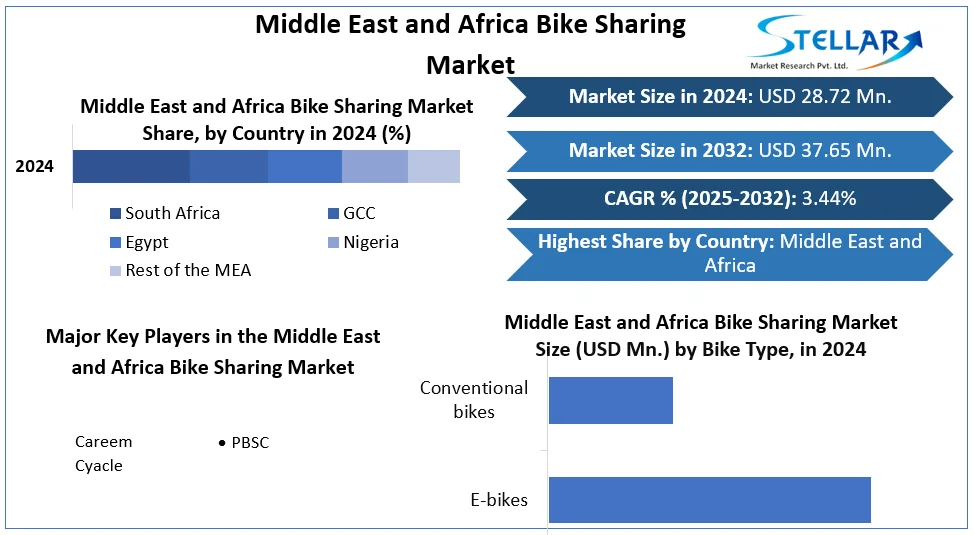
Middle East and Africa Bike Sharing Market size was valued at US$ 28.72 Million in 2024 and the total Middle East and Africa Bike Sharing Market revenue is expected to grow at 3.44% through 2025 to 2032, reaching nearly US$ 37.65 Million.
Get your Sample PDF: https://www.stellarmr.com/report/req_sample/Middle-East-and-Africa-Bike-Sharing-Market/67
Market Overview
Bike sharing systems allow users to rent bicycles for short durations, typically through docking stations or app-based dockless platforms. These systems are integrated with digital payment solutions, GPS tracking, and mobile applications, enabling seamless access and real-time availability tracking.
In the Middle East, countries such as the United Arab Emirates, Saudi Arabia, and Qatar are leading adoption due to advanced urban infrastructure and strong government backing for green mobility initiatives. In Africa, South Africa, Morocco, Kenya, and Egypt are emerging markets where pilot projects and public-private partnerships are driving awareness and usage.
The market is gradually transitioning from traditional docking-based systems to hybrid and fully dockless models. Electric bikes (e-bikes) are also gaining popularity, particularly in cities with long commuting distances or challenging terrain.
Key Growth Drivers
1. Urbanization and Traffic Congestion
MEA cities are experiencing rapid population growth, resulting in increased traffic congestion and pressure on public transportation systems. Bike sharing provides a last-mile connectivity solution that complements metro systems, buses, and tram networks.
Governments are recognizing cycling as an efficient urban mobility solution that reduces dependency on private vehicles. As infrastructure improves, cycling lanes and dedicated tracks are becoming more common in urban planning.
2. Sustainability and Environmental Initiatives
Sustainability is a major factor driving the bike sharing market. Many MEA governments have committed to reducing carbon emissions and promoting renewable energy. Bike sharing supports these goals by lowering greenhouse gas emissions and reducing air pollution.
Events such as global climate summits and national sustainability programs have accelerated the implementation of eco-friendly transportation policies. As environmental awareness increases among residents, demand for clean transportation options continues to rise.
3. Smart City Projects
Smart city development across the Middle East plays a critical role in market expansion. Large-scale urban projects are integrating intelligent transportation systems, including app-based bike rentals, digital payment systems, and IoT-enabled fleet management.
Bike sharing systems are increasingly linked with public transport cards and mobility-as-a-service (MaaS) platforms, allowing users to plan multimodal journeys efficiently. This integration enhances user convenience and boosts adoption rates.
4. Tourism Growth
Tourism is a significant contributor to bike sharing demand in several MEA countries. Tourists prefer cycling for sightseeing due to its flexibility and affordability. Coastal cities, heritage zones, and urban waterfronts are ideal locations for bike sharing programs.
In Africa, safari towns, resort destinations, and cultural hubs are beginning to adopt bike sharing as part of sustainable tourism initiatives.
5. Technological Advancements
Technological innovation is reshaping the bike sharing landscape. Features such as GPS tracking, QR-code unlocking, real-time analytics, and AI-based demand forecasting improve operational efficiency.
Electric bikes are also transforming the market by expanding accessibility to older users and those traveling longer distances. Solar-powered docking stations are being introduced in some African markets to address power supply challenges.
Get your Sample PDF: https://www.stellarmr.com/report/req_sample/Middle-East-and-Africa-Bike-Sharing-Market/67
Market Challenges
Despite positive growth prospects, the MEA bike sharing market faces several challenges.
Infrastructure Gaps: Many African cities lack dedicated cycling lanes and secure parking areas. Without safe infrastructure, large-scale adoption remains limited.
Weather Conditions: Extreme heat in parts of the Middle East can discourage cycling during certain months. Operators are addressing this by introducing shaded docking stations and promoting early morning or evening usage.
Vandalism and Theft: Security concerns, particularly in some African regions, pose risks to fleet sustainability. Advanced tracking systems and geo-fencing technologies are being implemented to mitigate these risks.
Cultural Perceptions: In certain areas, cycling is not traditionally viewed as a primary mode of transport. Awareness campaigns and government support are essential to shift public perception.
Competitive Landscape
The MEA bike sharing market includes a mix of local startups, municipal operators, and international mobility companies. Partnerships between city governments and private operators are common, as they allow shared investment and risk management.
Companies are focusing on expanding fleet sizes, improving app functionality, and introducing subscription models to enhance customer retention. E-bike fleets are expected to become a major competitive differentiator in the coming years.
Country-Level Insights
United Arab Emirates
The UAE is one of the most advanced bike sharing markets in the region. Cities such as Dubai and Abu Dhabi have implemented extensive cycling infrastructure and smart docking systems. Integration with metro networks and tourism hotspots has strengthened market penetration.
Saudi Arabia
Saudi Arabia is rapidly investing in urban mobility as part of its national transformation plans. Large infrastructure projects and smart city developments are creating opportunities for bike sharing expansion.
South Africa
South Africa leads the African bike sharing landscape, with pilot programs in major cities. The focus is on improving last-mile connectivity and promoting sustainable commuting.
Morocco and Kenya
These countries are emerging markets where bike sharing is gaining traction, particularly in urban centers and tourist destinations.
Future Outlook
The Middle East and Africa bike sharing market is projected to grow steadily over the next decade. Increased government funding, improved infrastructure, and rising environmental awareness will be key growth catalysts.
About Stellar Market Research:
Stellar Market Research is a multifaceted market research and consulting company with professionals from several industries. Some industries we cover include medical devices, pharmaceutical manufacturers, science and engineering, electronic components, industrial equipment, technology and communication, cars and automobiles, chemical products and substances, general merchandise, beverages, personal care, and automated systems.
Contact Stellar Market Research:
S.no.8, h.no. 4-8 Pl.7/4,
Pinnacle Memories Fl. No. 3,
Pune, Maharashtra, 411029
sales@stellarmr.com
+91 9607365656

 Arabic
 French
 Spanish
 Portuguese
 Deutsch
 Turkish
 Dutch
Dutch
 Italiano
 Russian
 Romaian
 Portuguese (Brazil)
 Greek
Greek