


Asia Pacific Bike Sharing Market: Growth, Trends, and Future Outlook To Forecast 2025-2032
The Asia Pacific bike sharing market has emerged as one of the most dynamic and rapidly evolving segments within the urban mobility ecosystem. As cities across the region grapple with traffic congestion, rising pollution levels, and increasing demand for sustainable transport solutions, bike sharing systems are becoming a preferred option for short-distance commuting. Governments, private operators, and technology providers are collaborating to expand infrastructure, improve accessibility, and integrate bike sharing into broader smart city initiatives.
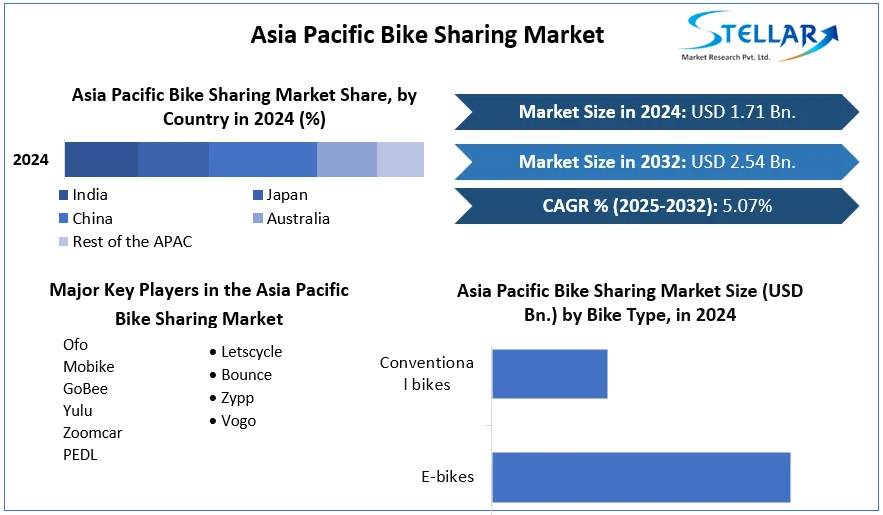
Asia Pacific Bike Sharing Market size was valued at US$ 1.71 Billion in 2024 and the total Asia Pacific Bike Sharing Market revenue is expected to grow at 5.07% through 2025 to 2032, reaching nearly US$ 2.54 Billion.
Get your Sample PDF: https://www.stellarmr.com/report/req_sample/Asia-Pacific-Bike-Sharing-Market/62
Market Overview
The Asia Pacific region accounts for a significant share of the global bike sharing market, driven primarily by large urban populations, supportive government policies, and strong adoption of digital platforms. Countries such as China, India, Japan, South Korea, Australia, and Singapore are witnessing steady growth in bike sharing networks. The model has evolved from traditional dock-based systems to flexible dockless and hybrid models, allowing users to rent and drop bikes at designated zones or anywhere within service areas using mobile applications.
China has historically led the region in bike sharing adoption, with cities like Beijing and Shanghai becoming early adopters of large-scale dockless systems. India is also experiencing rapid growth, particularly in metropolitan cities such as Delhi, Pune, and Bengaluru, where traffic congestion and last-mile connectivity challenges create strong demand for affordable alternatives. Southeast Asian countries are gradually expanding bike sharing programs as part of urban sustainability plans.
Key Growth Drivers
Several factors are fueling the growth of the Asia Pacific bike sharing market:
1. Urbanization and Population Density
Asia Pacific is home to some of the world’s most densely populated cities. Rapid urbanization has placed immense pressure on public transport systems and road infrastructure. Bike sharing provides a cost-effective and space-efficient mobility option that reduces reliance on private vehicles.
2. Government Support and Smart City Initiatives
Many governments across the region are actively promoting non-motorized transport to reduce carbon emissions and improve air quality. Investments in dedicated cycling lanes, parking zones, and public awareness campaigns have strengthened the ecosystem. Smart city projects in countries like India and Singapore often include integrated bike sharing systems as a core component of urban planning.
3. Environmental Awareness
With increasing awareness about climate change and environmental sustainability, consumers are becoming more conscious of their transportation choices. Bike sharing aligns with eco-friendly mobility goals, helping reduce greenhouse gas emissions and fuel consumption.
4. Technological Advancements
The integration of GPS tracking, IoT sensors, QR code scanning, digital payments, and mobile applications has transformed the user experience. Advanced data analytics enables operators to optimize bike distribution, monitor usage patterns, and enhance operational efficiency. E-bikes are also gaining popularity, offering assistance for longer distances and hilly terrains.
Market Segmentation
The Asia Pacific bike sharing market can be segmented based on bike type, business model, and end-user category.
By Bike Type:
- Traditional bicycles
- Electric bicycles (e-bikes)
Electric bikes are gaining momentum due to their convenience and ability to cover longer distances with less effort. They are particularly popular in urban areas with varied terrain and among commuters seeking faster travel options.
By Business Model:
- Dock-based systems
- Dockless systems
- Hybrid models
Dockless systems initially experienced explosive growth due to flexibility and lower infrastructure costs. However, challenges such as bike clutter and maintenance issues led regulators to introduce stricter controls. As a result, hybrid models that combine designated parking zones with flexible usage are becoming more common.
By End User:
- Daily commuters
- Students
- Tourists
- Corporate users
Daily commuters represent the largest user base, particularly for first-mile and last-mile connectivity to metro stations and bus terminals.
Emerging Trends
Integration with Public Transport
Bike sharing systems are increasingly integrated with metro, bus, and rail networks. Unified ticketing systems and digital payment platforms allow users to seamlessly switch between transport modes.
Rise of E-Bike Sharing
Electric bike sharing is expanding rapidly, especially in cities with longer commuting distances. Although e-bikes involve higher upfront costs, they generate higher revenue per ride and attract a broader demographic.
Corporate Partnerships
Companies are collaborating with bike sharing operators to offer sustainable commuting options for employees. Corporate campuses and IT parks are installing bike docking stations to encourage green mobility.
Data-Driven Operations
Operators are leveraging artificial intelligence and big data analytics to improve fleet management, reduce downtime, and enhance customer satisfaction. Predictive maintenance models help reduce operational costs and extend asset life.
Subscription-Based Models
Monthly and annual subscription plans are becoming popular, providing cost savings for regular users and predictable revenue streams for operators.
Get your Sample PDF: https://www.stellarmr.com/report/req_sample/Asia-Pacific-Bike-Sharing-Market/62
Challenges in the Market
Despite strong growth prospects, the Asia Pacific bike sharing market faces several challenges:
- Regulatory Uncertainty: Sudden policy changes or licensing restrictions can impact operations.
- Operational Costs: Maintenance, theft prevention, and redistribution of bikes require significant investment.
- Infrastructure Limitations: Lack of dedicated cycling lanes in certain cities affects user safety and adoption rates.
- Competition: Intense competition among operators can lead to pricing pressure and reduced profitability.
Competitive Landscape
The market comprises a mix of domestic startups, global mobility companies, and public-private partnerships. While China saw consolidation after an initial surge of operators, other countries are witnessing steady expansion with controlled growth strategies. Operators are focusing on profitability, improved service quality, and sustainable fleet management rather than aggressive expansion.
Future Outlook
The future of the Asia Pacific bike sharing market appears promising. Increasing urban mobility challenges, climate goals, and digital transformation will continue to drive adoption. Governments are expected to strengthen regulatory frameworks, encourage electric mobility, and invest in cycling infrastructure.
About Stellar Market Research:
Stellar Market Research is a multifaceted market research and consulting company with professionals from several industries. Some industries we cover include medical devices, pharmaceutical manufacturers, science and engineering, electronic components, industrial equipment, technology and communication, cars and automobiles, chemical products and substances, general merchandise, beverages, personal care, and automated systems.
Contact Stellar Market Research:
S.no.8, h.no. 4-8 Pl.7/4,
Pinnacle Memories Fl. No. 3,
Pune, Maharashtra, 411029
sales@stellarmr.com
+91 9607365656

 English
 Arabic
 French
 Spanish
 Portuguese
 Deutsch
 Turkish
 Italiano
 Russian
 Romaian
 Portuguese (Brazil)
 Greek
Greek