


The Surging Postpartum Depression Drug Market: A $62 Billion Horizon by 2032
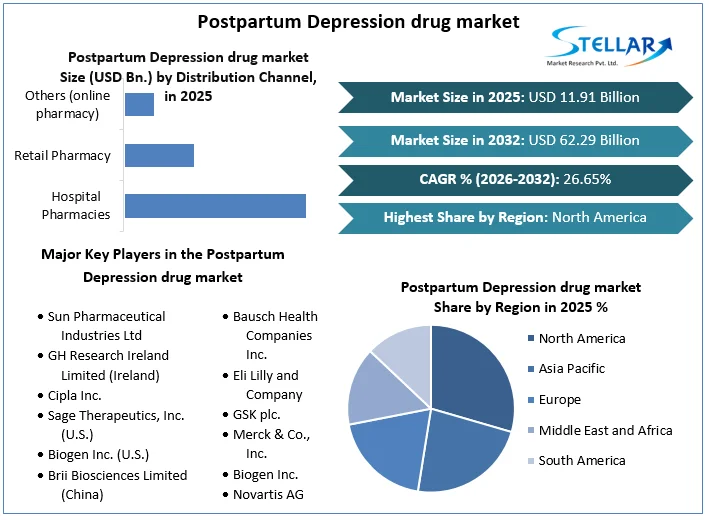
Postpartum depression (PPD) affects up to 1 in 7 new mothers worldwide, turning what should be a joyful time into a battle against overwhelming sadness, anxiety, and exhaustion. Yet, hope is rising with the postpartum depression drug market, which hit USD 11.91 billion in 2025 and is barreling toward USD 62.29 billion by 2032. This explosive growth, fueled by a compound annual growth rate (CAGR) of 26.65% from 2026 to 2032, signals a transformative era in women's mental health. Driven by innovative therapies, heightened awareness, and policy shifts, this market isn't just expanding it's revolutionizing care for new moms.
Get your Sample PDF: https://www.stellarmr.com/report/req_sample/postpartum-depression-drug-market/2462
Why the Market is Exploding Now
The PPD drug market's surge stems from a perfect storm of factors. First, greater recognition of PPD as a serious medical condition has shattered stigma. Campaigns like those from the World Health Organization and grassroots movements have pushed screening into routine prenatal and postnatal checkups. In the U.S. alone, the American College of Obstetricians and Gynecologists now recommends universal PPD screening, catching cases early and driving demand for treatments.
Second, regulatory green lights have accelerated innovation. The FDA's 2019 approval of brexanolone (Zulresso), the first drug specifically for PPD, marked a watershed. Administered via IV infusion over 60 hours, it targets the GABA-A receptor to rapidly alleviate symptoms—often within days. This was followed by zuranolone (Zurzuvae) in 2023, an oral capsule offering 14 days of treatment with effects lasting months. These breakthroughs have validated PPD as treatable, not just manageable with antidepressants like SSRIs, which were previously off-label hacks.
Economically, the numbers tell a compelling story. From 2025's USD 11.91 billion valuation, the market's 26.65% CAGR reflects blockbuster potential. By 2032, it could touch USD 62.29 billion, outpacing many pharma sectors. Investors are pouring in, with Big Pharma like Sage Therapeutics and Biogen leading charges into neurosteroid-based drugs that mimic the body's natural hormones disrupted post-delivery.
Key Market Segments Powering Growth
Breaking it down, the market thrives across drug types, routes, and regions.
By Drug Class: Neurosteroids dominate, holding over 40% share in 2025 due to their precision. Brexanolone and zuranolone exemplify this, offering faster relief than traditional SSRIs or SNRIs, which still claim 30% for their accessibility. Emerging hormonal therapies and NMDA receptor antagonists round out the field, promising even shorter treatment windows.
By Route of Administration: Oral drugs lead at 50% market share, prized for convenience no hospital stays required. Infusion therapies like brexanolone, though pricier at around USD 34,000 per course, deliver unmatched speed. Inhalers and patches are nascent but gaining traction for at-home use.
By Distribution: Hospitals and clinics control 60%, ideal for infusions, but retail pharmacies are surging with orals, making treatments as easy as picking up formula. Online pharmacies, boosted by telehealth, cater to remote moms, especially post-pandemic.
Regionally, North America rules with 45% share, thanks to robust R&D and insurance coverage. Europe follows, with the EU fast-tracking approvals. Asia-Pacific, however, is the rocket fuel India and China see PPD rates of 20-30% amid urbanization stresses, yet low diagnosis rates mean massive untapped potential. By 2032, APAC could snag 30% global share as local players like Sun Pharma develop affordable generics.
Get your Sample PDF: https://www.stellarmr.com/report/req_sample/postpartum-depression-drug-market/2462
Trailblazing Treatments and Innovations
At the forefront, Sage Therapeutics' zuranolone shines as a game-changer. Positive Phase 3 trials showed 70% symptom reduction in moderate-to-severe PPD within weeks, with minimal side effects like drowsiness. It's now expanding to bipolar depression, broadening its market.
Pipeline stars include GABAergic modulators from Minerva Neurosciences and allopregnanolone analogs from multiple firms. Gene therapies targeting estrogen fluctuations loom on the horizon, potentially preventing PPD prenatally. Digital therapeutics pair drugs with apps for mood tracking, amplifying efficacy.
Challenges persist: High costs sideline low-income moms, and side effects like sedation spark access debates. Supply chain hiccups, seen with brexanolone's initial rollout, highlight scalability needs. Still, generics entering post-patent (expected mid-2030s) will democratize care.
The Road to 2032: What Lies Ahead
Projections paint a bullish picture. By 2030, oral neurosteroids could claim 60% share, slashing hospitalization rates. AI-driven diagnostics will personalize dosing, minimizing trial-and-error. Governments are stepping up India's national mental health program now funds PPD drugs, while U.S. bills propose Medicaid expansions.
Future Outlook
The postpartum depression drug market is poised for significant expansion over the next decade. Continued innovation, improved reimbursement structures, and growing public awareness will likely drive sustained demand.
About Stellar Market Research:
Stellar Market Research is a multifaceted market research and consulting company with professionals from several industries. Some industries we cover include medical devices, pharmaceutical manufacturers, science and engineering, electronic components, industrial equipment, technology and communication, cars and automobiles, chemical products and substances, general merchandise, beverages, personal care, and automated systems.
Contact Stellar Market Research:
S.no.8, h.no. 4-8 Pl.7/4,
Pinnacle Memories Fl. No. 3,
Pune, Maharashtra, 411029
sales@stellarmr.com
+91 9607365656

 English
 Arabic
 French
 Spanish
 Portuguese
 Deutsch
 Dutch
Dutch
 Italiano
 Russian
 Romaian
 Portuguese (Brazil)
 Greek
Greek