


Simulation and Test Data Management Market Demand, Share & Competitive Analysis
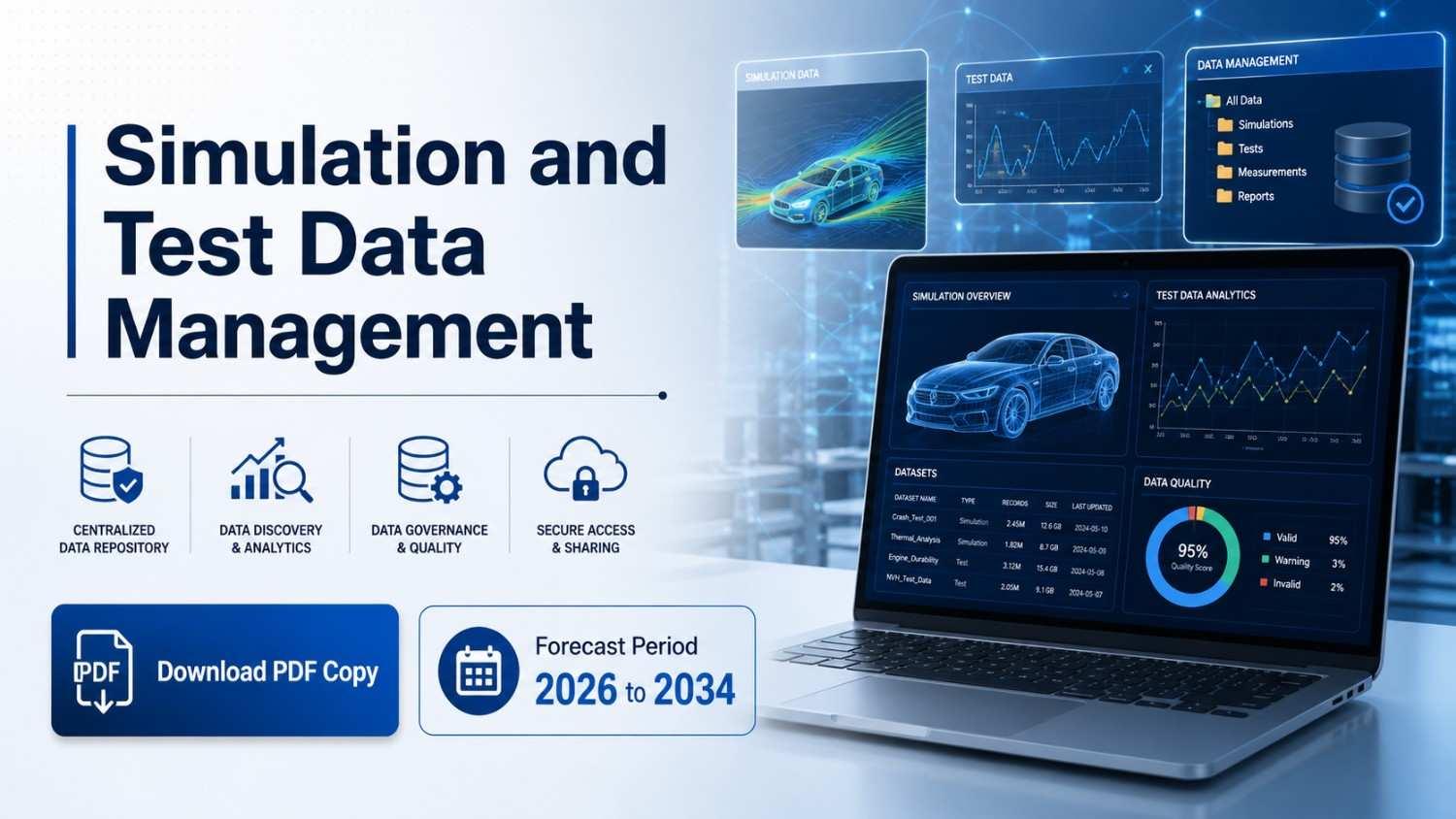
The global engineering landscape is undergoing a massive digital transformation, placing Simulation and Test Data Management (STDM) at the heart of modern product development. As industries strive to reduce time to market and enhance product reliability, the demand for structured data handling has skyrocketed. By 2034, the Simulation and Test Data Management market is projected to reach new heights, driven by the integration of artificial intelligence, the rise of digital twins, and the increasing complexity of multi physics simulation.
The global simulation and test data management market size is projected to reach US$ 2,647.91 million by 2034 from US$ 833.4 million in 2025. The market is anticipated to register a CAGR of 13.71% during the forecast period 2026-2034.
Market Overview and Evolution
Simulation and Test Data Management refers to the specialized software and processes used to manage the vast amounts of data generated during the design, simulation, and physical testing phases of product development. Traditionally, engineering data was stored in silos, leading to inefficiencies and data loss. However, the modern STDM framework provides a single source of truth, ensuring that simulation models and physical test results are traceable, searchable, and reusable.
As we look toward 2034, the market is shifting from basic data storage to intelligent data orchestration. Companies are no longer just looking to save files; they are looking to extract actionable insights from their historical data to inform future designs.
Primary Market Drivers
Several key factors are propelling the growth of the Simulation and Test Data Management market:
1. Growing Complexity of Product Designs
Modern products, especially in the automotive and aerospace sectors, are becoming increasingly complex. The shift toward electric vehicles (EVs) and autonomous systems requires thousands of simulations and physical tests to ensure safety and performance. STDM systems are essential to manage this influx of data and ensure that every iteration of a design is documented and validated.
2. Integration of AI and Machine Learning
The integration of Artificial Intelligence (AI) into simulation workflows is a major driver. AI requires high quality, structured data to train predictive models. STDM platforms provide the necessary data infrastructure to feed AI algorithms, allowing engineers to predict performance outcomes without running full scale simulations every time, thus saving significant computational costs.
3. Demand for Reduced Time to Market
In a hyper competitive global economy, the ability to launch a product faster than competitors is a significant advantage. STDM streamlines the handoff between simulation teams and physical testing labs. By automating data capture and reporting, organizations can shave weeks or even months off the development cycle.
4. Regulatory Compliance and Traceability
Industries such as healthcare, defense, and aerospace are subject to stringent safety regulations. STDM systems provide a comprehensive audit trail, documenting who performed a test, what the parameters were, and the final results. This level of traceability is vital for meeting international safety standards and passing regulatory audits.
Strategic Market Opportunities
The next decade presents several lucrative opportunities for stakeholders in the STDM ecosystem:
Digital Twin Proliferation
The concept of the digital twin—a virtual representation of a physical asset—relies heavily on the continuous flow of data between the physical and virtual worlds. STDM providers have a massive opportunity to develop platforms that sync real time sensor data from the field with high fidelity simulation models, enabling predictive maintenance and real time performance optimization.
Cloud Based Simulation Management
As remote work and global collaboration become the norm, there is a significant opportunity for Cloud based STDM solutions. Small and medium sized enterprises (SMEs) that previously found on premise STDM systems too expensive are now turning to Scalable Software as a Service (SaaS) models to manage their engineering data.
Cross Industry Expansion
While automotive and aerospace remain the largest consumers of STDM, there is untapped potential in the consumer electronics, energy, and construction sectors. As these industries adopt more rigorous virtual prototyping, the need for robust data management will grow exponentially.
Key Market Players
The Simulation and Test Data Management market is characterized by a mix of established PLM (Product Lifecycle Management) providers and specialized niche players. Top organizations leading the market include:
- Siemens Digital Industries Software: Known for its Teamcenter portfolio, which offers deep integration between simulation and lifecycle management.
- Ansys, Inc.: A leader in simulation software that provides robust data management tools to handle multi physics simulation data.
- Dassault Systèmes: Its 3DEXPERIENCE platform offers comprehensive STDM capabilities, focusing on collaborative engineering.
- MSC Software (Hexagon AB): Provides specialized solutions for managing massive datasets generated in automotive and aerospace testing.
- PTC Inc.: Focuses on linking IoT data with simulation management to support digital twin initiatives.
- Altair Engineering: Offers data analytics and simulation management tools designed for high performance computing environments.
Future Outlook
The trajectory for the Simulation and Test Data Management market through 2034 is one of convergence and intelligence. We expect to see the total disappearance of silos between the virtual office and the physical laboratory. Future STDM systems will likely feature "self healing" data protocols where the software automatically identifies inconsistencies between simulation predictions and physical test outcomes, alerting engineers in real time.
Furthermore, the democratization of simulation will be a defining trend. As interfaces become more intuitive and data management becomes automated, non specialists will be able to access and interpret simulation data, leading to a more data driven culture across all departments of an enterprise. The shift toward sustainable engineering will also see STDM being used to track the carbon footprint and lifecycle impact of materials, making it a cornerstone of green manufacturing.
Frequently Asked Questions
What is the difference between PLM and STDM?
Product Lifecycle Management (PLM) oversees the entire life of a product from conception to disposal. Simulation and Test Data Management (STDM) is a specialized subset of PLM that focuses specifically on the complex datasets, metadata, and workflows associated with virtual simulations and physical testing.
Why is STDM important for the automotive industry?
In the automotive sector, safety is paramount. STDM allows manufacturers to store and compare results from thousands of crash tests and aerodynamic simulations. This ensures that every vehicle meets safety standards and allows engineers to optimize fuel efficiency or battery range through historical data analysis.
How does STDM support the development of Electric Vehicles (EVs)?
EV development requires intense thermal management and battery life simulation. STDM systems manage the data from these specialized simulations, allowing engineers to understand how different chemical compositions or cooling systems perform under various stress tests, ultimately leading to safer and longer lasting batteries.

 English
 Arabic
 French
 Spanish
 Portuguese
 Deutsch
 Turkish
 Dutch
Dutch
 Italiano
 Russian
 Romaian
 Portuguese (Brazil)