


Data Warehouse Software Market Growth 2031: Trends, Forecast & Drivers
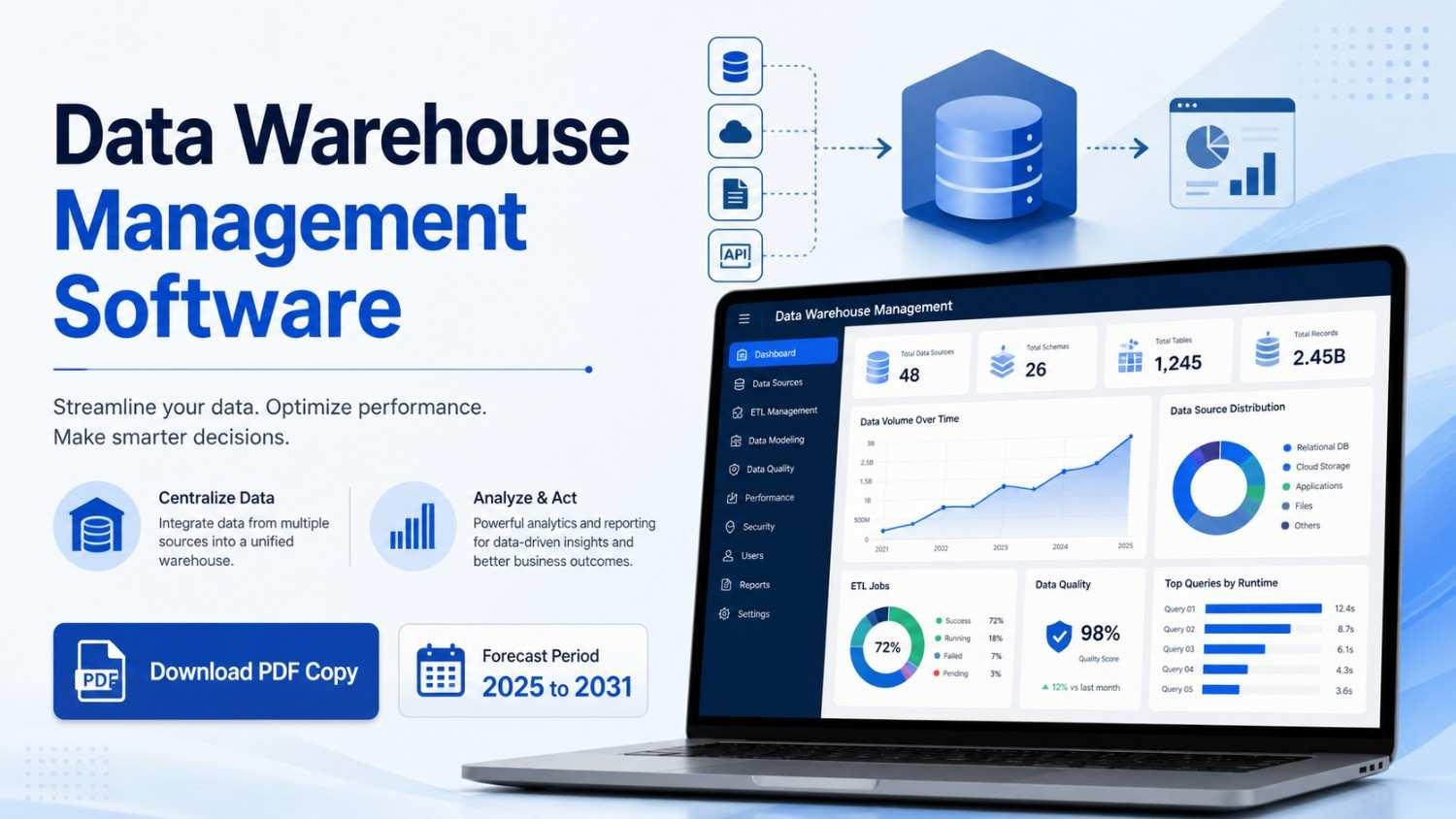
The global landscape of data management is undergoing a massive transformation as enterprises transition from traditional storage methods to agile, cloud based environments. The Data Warehouse Management Software Market is at the forefront of this evolution, serving as the foundational layer for business intelligence, advanced analytics, and strategic decision making. As organizations grapple with the exponential growth of structured and unstructured data, the demand for sophisticated management software that ensures data integrity, accessibility, and security is reaching unprecedented levels.
Market Overview and Strategic Analysis
Data warehouse management software refers to the specialized tools used to manage, monitor, and optimize data repositories. These systems are designed to consolidate data from disparate sources, providing a unified view that supports complex querying and reporting. The primary objective of these solutions is to transform raw data into actionable insights, allowing businesses to remain competitive in a data driven economy. The Data Warehouse Management Software Market size is expected to reach US$ 15.6 Billion by 2031. The market is anticipated to register a CAGR of 14.2% during 2025–2031.
The market analysis indicates that the shift toward real time analytics is a primary catalyst for growth. Traditional batch processing is increasingly being replaced by streaming data integration, which requires data warehouse management software to be more resilient and scalable than ever before. Furthermore, the rise of the Internet of Things and the proliferation of mobile devices have created a continuous stream of data points that must be ingested and analyzed instantaneously. This has led to a surge in the adoption of cloud native data warehousing solutions that offer the elasticity needed to handle fluctuating workloads without the overhead of physical infrastructure.
Key Market Drivers and Technological Trends
Several factors are influencing the trajectory of the Data Warehouse Management Software Market. One of the most prominent trends is the convergence of data lakes and data warehouses, often referred to as the data lakehouse architecture. This approach combines the flexibility and low cost storage of data lakes with the high performance and ACID compliance of data warehouses. Management software that can bridge these two environments is seeing high demand among large enterprises.
Another critical driver is the increasing focus on data governance and regulatory compliance. With global regulations becoming more stringent, organizations are prioritizing management software that offers robust auditing, data lineage, and encryption features. Automated data discovery and classification are becoming standard components of management platforms, reducing the risk of human error and ensuring that sensitive information is handled according to legal mandates.
Artificial Intelligence and Machine Learning are also playing a transformative role. Modern data warehouse management software now incorporates AI driven performance tuning, which automatically optimizes queries and manages indexing to ensure peak efficiency. This reduces the burden on database administrators and allows IT teams to focus on more strategic initiatives.
Competitive Landscape and Top Players
The Data Warehouse Management Software Market is characterized by intense competition among established technology giants and innovative niche players. These companies are continuously investing in research and development to enhance their product offerings and expand their market footprint.
Some of the top players shaping the industry include:
- Oracle Corporation
- Microsoft Corporation
- Amazon Web Services Inc.
- IBM Corporation
- Google LLC (Google Cloud)
- SAP SE
- Snowflake Inc.
- Teradata Corporation
- Cloudera Inc.
- Micro Focus (OpenText)
Regional Market Insights
Geographically, North America currently holds a dominant position in the Data Warehouse Management Software Market. This is attributed to the presence of major technology providers and the early adoption of cloud computing by enterprises in the United States and Canada. However, the Asia Pacific region is expected to register the highest growth rate through 2031. Rapid digitalization in countries like China, India, and Southeast Asian nations, coupled with increasing investments in smart city projects and high tech manufacturing, is creating a fertile ground for market expansion. Europe also remains a significant market, with a strong emphasis on data privacy and sovereign cloud solutions driving the demand for localized data management tools.
Future Outlook
The future of the Data Warehouse Management Software Market points toward a decentralized yet highly integrated ecosystem. We are likely to see a move away from monolithic architectures toward mesh and fabric patterns, where data is managed closer to where it is generated but remains accessible via a centralized management layer. Automation will become the default state, with self healing and self optimizing data warehouses becoming common in the next decade.
As edge computing gains traction, data warehouse management software will need to extend its capabilities to manage data across edge, core, and cloud environments seamlessly. The focus will shift from merely storing data to maximizing the "time to value," ensuring that insights are delivered to the right stakeholders at the exact moment they are needed. By 2031, the integration of quantum computing could further revolutionize data processing speeds, opening up new possibilities for complex simulations and predictive modeling that are currently beyond the reach of standard hardware.
Frequently Asked Questions
What is the primary purpose of data warehouse management software?
The software is designed to oversee the lifecycle of data within a warehouse, including data ingestion, storage optimization, security enforcement, and the facilitation of high speed queries for business intelligence and reporting.
How does cloud integration affect the data warehouse management market?
Cloud integration allows for greater scalability, lower upfront costs, and the ability to access data from any location. It has shifted the market focus toward "as a service" models, where the underlying infrastructure is managed by the provider, allowing businesses to focus on data analysis.
What role does automation play in modern data warehouse management?
Automation streamlines repetitive tasks such as indexing, partitioning, and backup. It uses machine learning algorithms to predict workload demands and adjust resources accordingly, significantly improving system performance and reducing operational costs.

 English
 Arabic
 Spanish
 Portuguese
 Deutsch
 Turkish
 Dutch
Dutch
 Italiano
 Russian
 Romaian
 Portuguese (Brazil)
 Greek
Greek