


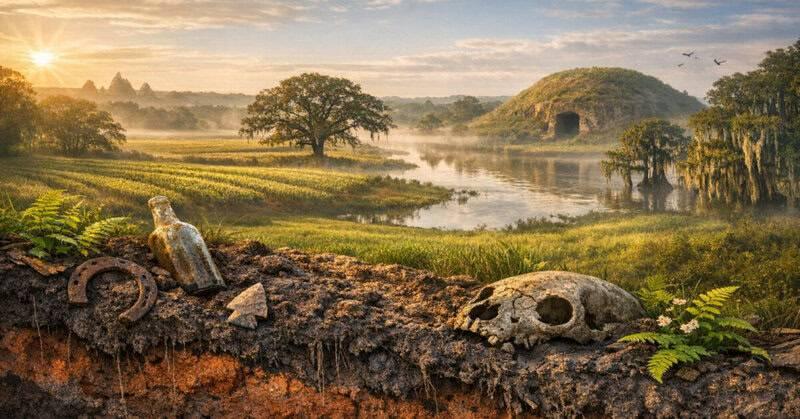
Hosts of the Black Belt: 15 Secrets Buried in Alabama’s Soil

0
21

Hosts of the Black Belt: 15 Secrets Buried in Alabama’s Soil

6. Underground Cisterns

Hosts of the Black Belt: 15 Secrets Buried in Alabama’s Soil
Elaborate brick cisterns in Alabama’s Black Belt reflect 19th-century ingenuity and rural challenges.

Many antebellum homes in Alabama’s Black Belt concealed elaborate brick cisterns designed to collect and store water. These subterranean structures showcase 19th-century ingenuity and highlight the challenges of rural Southern living. For instance, the Lewis-Long House in Gainesville, built around 1835, features two underground cisterns used for storing food and water (ruralswalabama.org). Similarly, the Shelby Iron Company site includes brick-lined cisterns that were integral to its iron production process.

7. Ironstone and Mineral Veins

Hosts of the Black Belt: 15 Secrets Buried in Alabama’s Soil
Rich ironstone deposits in the Black Belt have shaped regional industry and architecture.

The Black Belt’s soil conceals rich mineral deposits, notably nodules of ironstone. These iron-rich sedimentary rocks, composed of minerals like hematite and limonite, have historically influenced local industry and been utilized in regional architecture. For example, ironstone was mined in Bibb, Blount, Cherokee, DeKalb, Etowah, Jefferson, and Tuscaloosa Counties, contributing to the development of Birmingham as an industrial center (encyclopediaofalabama.org).

8. Lost Confederate Relics

Hosts of the Black Belt: 15 Secrets Buried in Alabama’s Soil
Unearthed Civil War relics in the Black Belt reveal rich local and national history.

The Black Belt’s soil conceals relics from Civil War skirmishes, including bullets, uniform buttons, and personal effects. Metal detecting hobbyists across the region have uncovered these artifacts, serving as tangible links to local and national history. For instance, the Crooked Creek Civil War Museum in Vinemont showcases items like bullets, brass cannonballs, and belt buckles found on-site (encyclopediaofalabama.org). Similarly, the Blue and Gray Museum in Decatur houses a vast collection of Civil War artifacts, including swords, revolvers, and muskets. These discoveries offer valuable insights into the region’s role during the Civil War.

9. Buried African Burial Grounds

Hosts of the Black Belt: 15 Secrets Buried in Alabama’s Soil
Unearthing the Black Belt’s history: honoring unmarked graves of enslaved Africans and descendants.

The Black Belt’s soil conceals unmarked graves of enslaved Africans and their descendants, often hidden beneath forests or farmland. Archaeological studies and community efforts work to preserve and commemorate these sacred sites. For instance, the Black Belt Memory Mapping project aims to document and honor the region’s African American heritage (nps.gov).

10. Prehistoric Megafauna Bones

Hosts of the Black Belt: 15 Secrets Buried in Alabama’s Soil
Unearthing Alabama’s Ice Age past: rare fossils reveal ancient giants and marine reptiles.

The Black Belt’s soil occasionally yields bones of Ice Age animals, including mastodons and giant ground sloths, offering glimpses into Alabama’s ancient wildlife. For example, a diver in Florida discovered a nearly intact Colombian mammoth leg bone, likely a tibia, which is now displayed at the North Alabama Dive Center (meridianstar.com). Additionally, the University of Alabama Museum houses fossilized remains of an 80-million-year-old giant water reptile, a type of mosasaur, found in Greene County (news.ua.edu).

11. Mysterious Indian Mounds

Hosts of the Black Belt: 15 Secrets Buried in Alabama’s Soil
Ceremonial mounds at Moundville Archaeological Park reveal insights into Mississippian culture.

Scattered across Alabama’s Black Belt, carefully shaped earthen mounds constructed by indigenous peoples serve as ceremonial or burial sites. The Moundville Archaeological Park, located near Tuscaloosa, preserves 29 massive flat-topped mounds arranged around a central plaza, reflecting the sociopolitical structure of the Mississippian culture that inhabited the area from A.D. 1000 to 1450 (moundville.museums) These mounds offer valuable insights into the region’s prehistoric societies.

12. Ghost Town Foundations

Hosts of the Black Belt: 15 Secrets Buried in Alabama’s Soil
Ruins of Old Cahawba tell stories of prosperity lost to time and hardship.

Crumbled brick and stone foundations lie buried where thriving towns once bustled, victims of economic hardship or migration. Old Cahawba, Alabama’s first state capital, now stands as a ghost town, its ruins preserved as an archaeological park (ahc.alabama.gov). Local legends and maps reveal their locations, offering glimpses into the region’s past.

13. Moonshiners’ Hidden Stills

Hosts of the Black Belt: 15 Secrets Buried in Alabama’s Soil
Ingenious moonshiners in Alabama crafted hidden stills, embodying defiance during Prohibition’s constraints.

During Prohibition, ingenious moonshiners concealed elaborate stills beneath the Black Belt soil, leaving behind clever engineering and stories of defiance. For instance, in Chambers County, Alabama, below-ground vats of liquor stills were discovered, showcasing the lengths to which distillers went to evade authorities. These clandestine operations have become a significant part of Alabama’s cultural heritage (apr.org).

14. Ancient River Channels

Hosts of the Black Belt: 15 Secrets Buried in Alabama’s Soil
Ancient riverbeds and oxbow lakes beneath the Black Belt shape agriculture and flood dynamics.

Beneath the Black Belt’s farmland, the soil conceals old riverbeds and oxbow lakes, remnants of the region’s dynamic hydrological history. The Alabama and Tombigbee rivers have long shaped and reshaped their floodplains, creating abandoned channels, oxbow lakes, and shallow swamps (alblackbeltheritage.com). These features influence modern land use, affecting both agriculture and flooding patterns. For example, the Cahaba River, Alabama’s longest free-flowing river, contributes to the region’s rich biodiversity and has historically been a vital water source.

15. Healing Mud and Medicinal Clays

Hosts of the Black Belt: 15 Secrets Buried in Alabama’s Soil
Black Belt clays, revered for their healing properties, support holistic health practices and detoxification.

Local tradition holds that certain Black Belt clays have soothing or healing properties, sought after for folk remedies and holistic practices (riordanclinic.org). These clays, rich in minerals, are believed to detoxify the body, improve skin health, and alleviate digestive issues. However, it’s essential to consult with healthcare professionals before using these clays for medicinal purposes.

Conclusion

Hosts of the Black Belt: 15 Secrets Buried in Alabama’s Soil
Unearthing the Alabama Black Belt reveals a rich history of culture, science, and resilience.

The Alabama Black Belt’s soil conceals a rich tapestry of history, culture, and science, from ancient fossils and Native American artifacts to remnants of the Civil Rights Movement. These discoveries offer invaluable insights into the region’s past and underscore the importance of preserving these treasures. Continued exploration and conservation efforts are essential to honor and understand the diverse narratives embedded beneath the Black Belt’s surface (nps.gov).

Buscar
Categorías
Read More
Directorio
15 Reasons Why The East India Company Was the World’s First Corporate Tyrant
15 Reasons Why The East India Company Was the World’s First Corporate Tyrant...
By Test Blogger2 2026-02-07 02:00:05 0 2K
Technology
Regularly over $400, the Apple Watch Series 11 is $329 with this limited-time offer
Regularly over $400, the Apple Watch Series 11 is $329 with this limited-time offer...
By Test Blogger7 2026-04-29 10:00:37 0 66
Food
15 Food Network Shows You Haven't Thought About In Years
15 Food Network Shows You Haven't Thought About In Years...
By Test Blogger1 2026-02-23 22:00:08 0 2K
Religion
What Does "Turn the Other Cheek" Mean in Modern-Day Christianity?
What Does "Turn the Other Cheek" Mean in Modern-Day Christianity? “You have heard the law...
By Test Blogger5 2026-01-23 20:02:05 0 2K
Home & Garden
Presidents Day Sales Aren’t Over Just Yet—Save Up to 42% on These Quilt and Bedding Deals at Amazon
You Thought Presidents’ Day Sales Were Over, but We Just Found Major Deals on Quilts and Bedding...
By Test Blogger9 2026-02-24 23:00:25 0 1K