Why the United States Resisted Entering World War II Until Pearl Harbor
7. Focus on Hemispheric Security
Early 20th century U.S. policy focused on regional security and the Monroe Doctrine’s principles.
In the early 20th century, the United States emphasized defending the Western Hemisphere, adhering to the Monroe Doctrine, which opposed European colonization in the Americas. This policy prioritized regional security, leading the U.S. to avoid involvement in distant conflicts and focus on safeguarding its immediate surroundings (britannica.com).
8. Political Divisions Over Intervention
The America First Committee rallied against U.S. involvement in World War II, influencing public opinion.
In the years leading up to World War II, the United States was deeply divided between interventionists and non-interventionists. The America First Committee, established in 1940, was a prominent non-interventionist group opposing U.S. involvement in the conflict. With a membership exceeding 800,000, the committee attracted influential figures such as aviator Charles A. Lindbergh and General Robert E. Wood. The organization argued that the U.S. should avoid entanglement in another European war, emphasizing the need to focus on domestic issues and maintain national security. This internal debate was further reflected in public opinion polls, which showed a nation divided over the decision to enter the war (nationalww2museum.org).
9. Uncertainty About the Axis Threat
Uncertainty looms over U.S. security as Axis powers expand, complicating military commitment.
In the early stages of World War II, the United States faced uncertainty regarding the direct threat posed by the Axis powers to its security. While Nazi Germany’s aggressive expansion in Europe was evident, the immediate impact on American interests was not clear. Similarly, Japan’s actions in Asia raised concerns, but the extent of the threat to the U.S. was still being assessed. This ambiguity contributed to the nation’s hesitance in committing to military intervention until the situation became more pressing (stanford.edu).
10. Influence of Domestic Politics
Franklin D. Roosevelt balanced foreign policy with domestic political pressures amid isolationist sentiments.
President Franklin D. Roosevelt’s approach to foreign policy was significantly influenced by domestic political considerations. Facing an isolationist public and upcoming elections, he navigated cautiously to avoid alienating voters. For instance, his “Quarantine Speech” in 1937, advocating for international cooperation against aggressors, faced public backlash, leading him to retract the proposal. Additionally, during the 1940 presidential campaign, Roosevelt’s support for aiding Britain was tempered to maintain electoral support, reflecting the delicate balance between foreign policy objectives and domestic political realities (britannica.com).
11. Ongoing Immigration and Refugee Concerns
Restrictive U.S. immigration policies in the 1930s hindered Jewish refugees fleeing persecution.
During the 1930s and 1940s, the United States maintained restrictive immigration policies, including strict quotas that limited the number of immigrants from various countries. These policies were influenced by isolationist sentiments, economic concerns, and national security considerations. As a result, many individuals fleeing persecution, particularly Jews escaping Nazi-occupied Europe, faced significant challenges in obtaining visas and asylum. Between 1933 and 1941, at least 110,000 Jewish refugees were admitted to the U.S., but hundreds of thousands more were unsuccessful in their attempts to immigrate. This restrictive approach to immigration and refugee admissions contributed to the nation’s reluctance to engage in international conflicts, as domestic debates over immigration and national security often overshadowed foreign policy considerations (ushmm.org).
12. Rising Nationalism and Patriotism
Nationalism surged in pre-WWII America, highlighting domestic unity and prioritizing national interests.
In the years leading up to World War II, the United States experienced a surge in nationalism and patriotism, exemplified by slogans like “America First.” This sentiment emphasized domestic unity and prioritized national interests, fostering a desire to focus inward rather than engage in foreign conflicts. The America First Committee, a prominent non-interventionist group, advocated for this approach, reflecting widespread public sentiment.
13. Limited Military Preparedness
Late 1930s U.S. military faced critical underpreparedness amid rising global tensions.
In the late 1930s, the United States military was underprepared for large-scale conflict. The Army’s active-duty personnel numbered just over 180,000, with inadequate training and equipment (nps.gov). The Navy, while comparatively stronger, still required significant modernization and expansion to meet the challenges posed by Germany and Japan. This lack of readiness deterred intervention until absolutely necessary.
14. Strategic Aid Short of War
March 1941: The Lend-Lease Act empowers U.S. support for Allied nations during WWII.
In March 1941, the United States enacted the Lend-Lease Act, allowing the provision of military aid to Allied nations without direct combat involvement. This legislation enabled the U.S. to supply war materials, food, and other resources to countries like Britain and the Soviet Union, thereby supporting their defense efforts while maintaining official neutrality (archives.gov).
15. The Shock of Pearl Harbor
Pearl Harbor attack: A defining moment that united America in World War II.
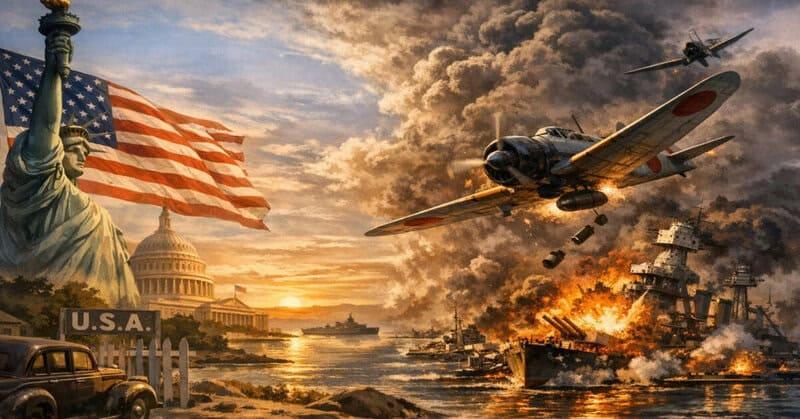
The Japanese attack on Pearl Harbor on December 7, 1941, was a pivotal moment that propelled the United States into World War II. The surprise assault resulted in significant loss of life and material damage, galvanizing public opinion and unifying the nation in support of military action. The following day, President Franklin D. Roosevelt addressed Congress, declaring December 7th “a date which will live in infamy,” and called for a declaration of war against Japan. This event marked the end of American isolationism and signified a commitment to defeating the Axis powers (nationalgeographic.com).





 English
 Arabic
 French
 Spanish
 Portuguese
 Deutsch
 Turkish
 Italiano
 Russian
 Romaian
 Portuguese (Brazil)
 Greek
Greek