


Siarhei Khaletski/Getty Images
We may receive a commission on purchases made from links.
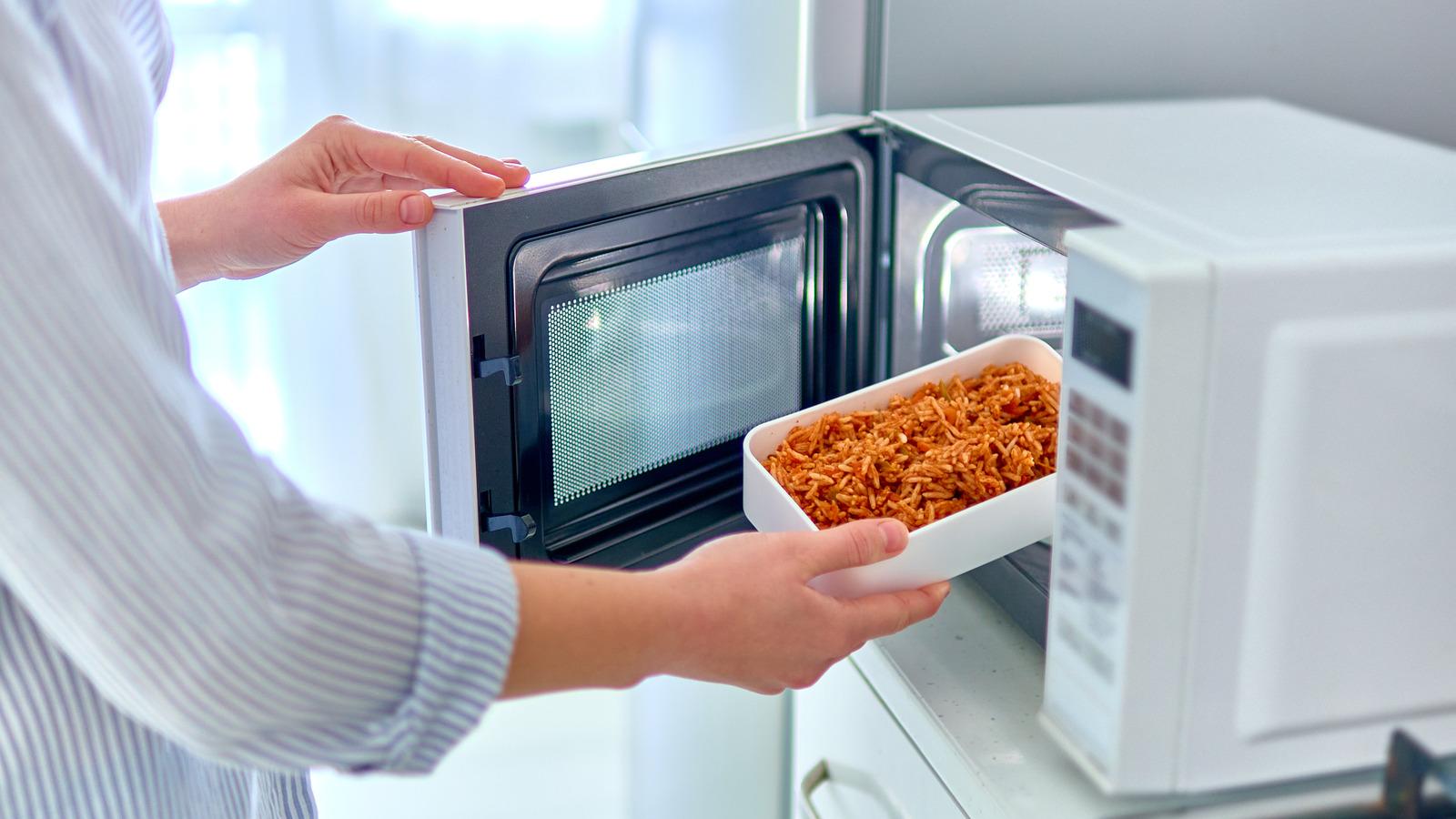
The belief that microwaves are irrelevant in modern kitchens has gained traction with consumers over the years. Microwaves are undeniably convenient, yet they also have a tendency to turn food into a mushy, water-logged mess. This issue is especially relevant when reheating food, particularly those that are supposed to have a crunchy texture.
Maybe you don't have a microwave. Or perhaps you have one, but it's broken. Maybe you own a microwave that you hate and give it a dirty look every time you walk into the kitchen. If so, these tips are tailored to you and your microwave-averse heart. When it comes to reheating foods and retaining the inherent quality of what you're warming up, there are plenty of alternatives that succeed where microwaves fail.
We recommend air fryers, conventional and toaster ovens, stovetops, and even grills for breathing new life into leftovers. It's worth noting that some of these methods don't offer the same convenience as microwaves, but the added effort will be totally worth it when you see (and taste) the delicious outcome. While effective overall, some reheating approaches are best suited to specific foods. In this case, we'll try to highlight which methods work best with which leftovers.
In the air fryer
Thai Liang Lim/Getty Images
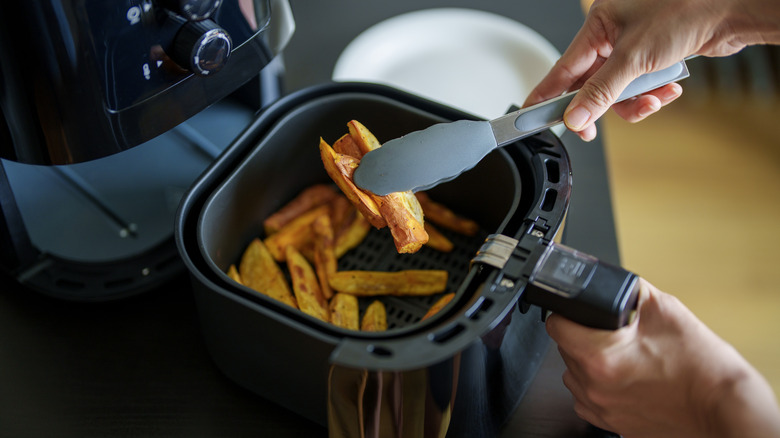
In some ways, air fryers have usurped microwaves in the realm of supplemental kitchen appliances. This device isn't quite as easy to use as a microwave, as it takes more than the push of a button to heat up your food. On the other hand, an air fryer is one of the best ways to crisp up leftovers that doesn't involve pulling out cookware or heading to the stovetop.
Despite what the name implies, air fryers don't actually fry your food. Instead, they use convection to brown items, meaning they distribute hot air over food until it develops a pleasing golden brown color. As a result, the air fryer is well-suited for reheating leftovers like french fries because it can restore crispy texture to your spuds. It's also great for reheating fried chicken, pasta, and ribs. If you want to prevent food from sticking to the air fryer, add a small amount of cooking oil with a high smoke point to the basket of the device. You can also add oil to the leftovers themselves, which can boost crispiness.
In a pan on the stovetop
PeopleImages/Shutterstock
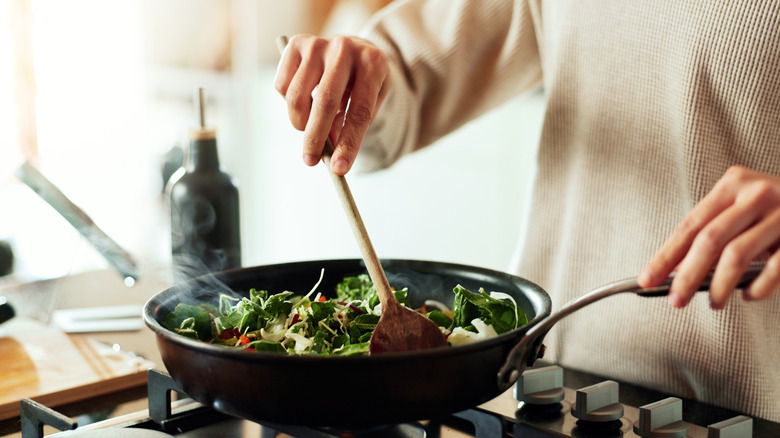
Stovetop reheating has the ability to create delightful textures, unlike the sad, damp results offered by microwaves. You can use a cast iron skillet or nonstick pan to heat up leftovers on the stovetop (durability and cook times are among the major differences between cast iron and nonstick cookware). Along with its effect on food texture, heating leftovers on the stovetop allows you to add new seasonings or ingredients such as sauce, vegetables, or cheese to liven up the flavor of what you're making.
You can reheat just about anything on the stovetop, from steak and vegetables to rice, noodles, and many other dishes. This method is also particularly adept at reheating pizza slices. To create perfect leftover pizza, set the burner to medium-low heat and drizzle a little oil into your pan. Situate the slices so they're not touching each other and pop on the lid. Cook until the bottom is crispy and the cheese has melted.
In the oven
Andrey_Vasiliskov/Shutterstock
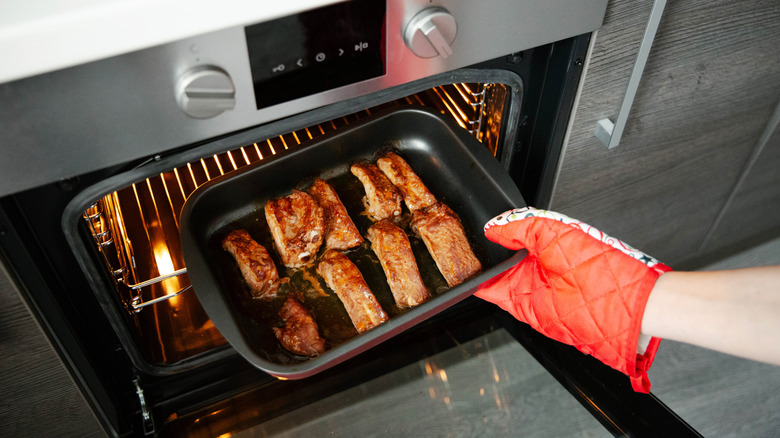
Perhaps the most versatile of our reheating methods, ovens are compatible with all sorts of foods. Like air fryers, ovens are great at helping leftovers achieve a crunchy texture. They're also more convenient thanks to their size, as you can reheat multiple items in one go. As a general rule, you'll want to use low heat (about 350 degrees Fahrenheit) and a relatively brisk cooking time (approximately 8 to 20 minutes) to prevent food from burning or becoming dry. You can also combat dryness by placing foil over the food to create a steamy, moist atmosphere.
No matter what or how you're reheating, make sure you have your handy food thermometer at the ready. Reheated foods must reach a minimum internal temperature of 165 degrees Fahrenheit to ensure safety. You'll need to exert extra care with foods that can become toxic when reheated, such as rice and pork. To get the most accurate reading, place the probe of the thermometer into the densest part of the food, avoiding bones, fat, and gristle.
On the grill
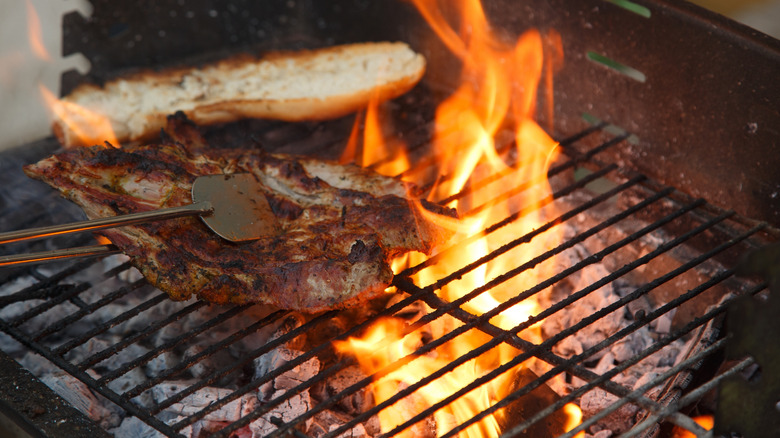
IMAGEN PUNTO DE LUZ/Shutterstock
If you're thinking, "On what planet would I fire up the grill to reheat leftovers?" We get it. Grilling is the most labor-intensive reheating method on our list, but it's also the most satisfying. Whether you use a charcoal grill or a gas grill with a smoke box, your leftovers will be infused with a smokiness that can't be recreated by the heating appliances in your kitchen. Plus, in the spring and summer, heating up leftovers on the grill gives you another reason to be out in the sunshine.
Since you're merely heating up your food and not cooking it, keeping the heat low is crucial. With a gas grill, you can use the temperature controls to keep the heat between 200 and 250 degrees Fahrenheit. Maintaining a consistent temperature on a charcoal grill is a bit trickier, but the top and bottom dampers on these grills can boost (or restrict) air flow to prevent the briquettes from getting too hot. To prevent food from getting stuck to the grill, slather some cooking oil on the grates. And if you're reheating small items, a metal mesh grill basket will keep everything where it belongs and prevent food from plunging into the fiery depths below.
In a toaster oven
WESTOCK PRODUCTIONS/Shutterstock
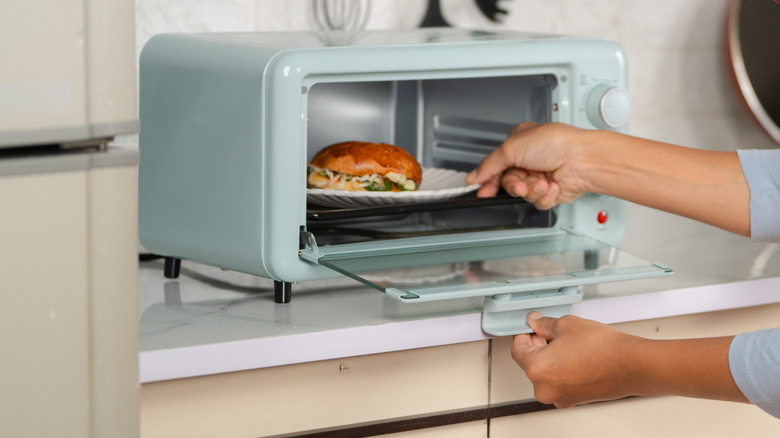
The toaster's cooler, more sophisticated cousin is the toaster oven, and it's a perfect alternative to a microwave. Its similarity to conventional ovens means that it is great for reheating leftovers. A toaster oven's ability to bake, toast, or broil food helps maintain the quality of whatever you're making. Additionally, the appliance's small size makes it ideal for compact living spaces, such as dorm rooms and tiny apartments. Though it's not quite as skilled at encouraging crispiness compared to an air fryer, but it will heat items evenly and won't lead to the unpleasant food textures a microwave often creates.
Its size may be a bit limiting (though larger models are available), but a toaster oven can accommodate a surprising variety of foods. Pasta dishes, baked fish, steak, and roasted chicken are all great candidates for the appliance. It can also bring stale bread back from the depths with a splash of water and an aluminum foil wrapping. Of course, not all leftovers are compatible with this device. Some foods that should never be put in a toaster oven include excessively greasy items, as the grease could splatter onto the heating element and cause a fire.

 Arabic
 French
 Spanish
 Portuguese
 Deutsch
 Turkish
 Dutch
Dutch
 Italiano
 Russian
 Romaian
 Portuguese (Brazil)
 Greek
Greek