


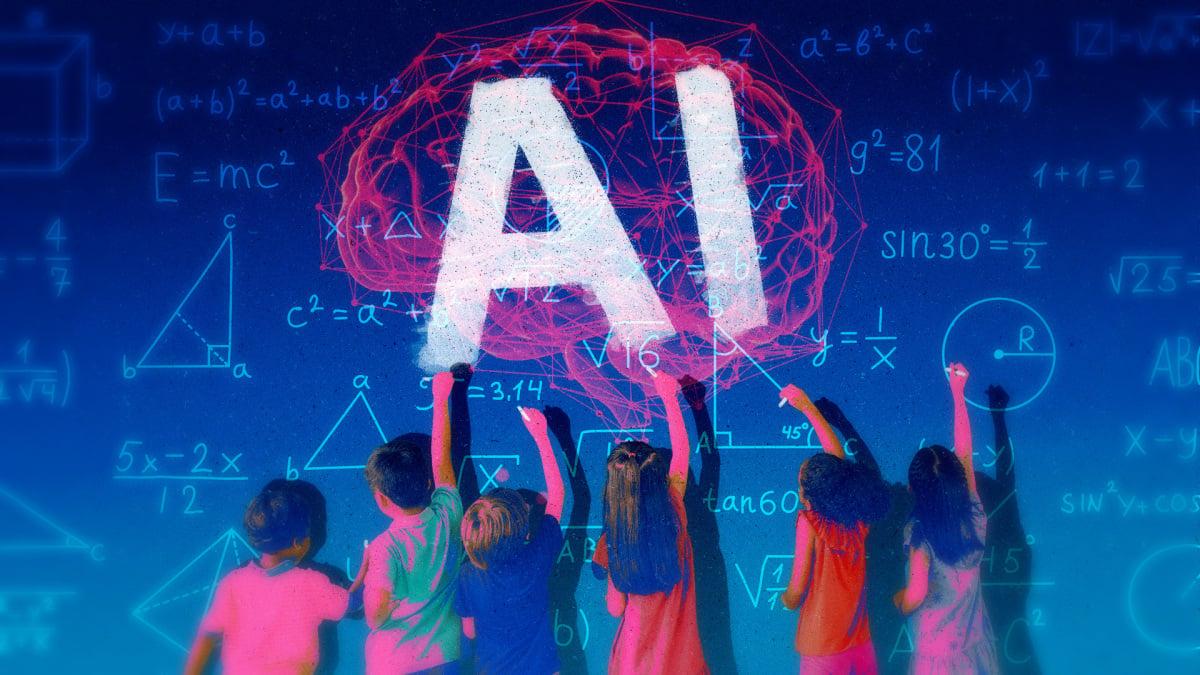
As colleges and high schools try to figure out how to integrate AI into the classroom responsibly, students aren’t waiting for permission. Young people often lead the way in adopting new technology, and students may actually know more about AI than their teachers. And for these young people, AI is just a few button presses away at all times.
As the technology proliferates more in day-to-day life, many higher learning institutions have taken it upon themselves to include AI in the learning process to prepare students to use it correctly once they graduate.
There isn’t a standard for how AI should be used in colleges, at least not yet, and with approximately 4,000 degree-granting higher learning institutions in the U.S. alone, colleges are tackling AI in some interesting ways.
Middle and high school is where it starts for most kids
AI education starts in middle and high school these days. There are more than 14,000 middle schools and 23,000 high schools in the United States, and the U.S. lacks a cohesive, nationwide approach to AI eduction like you'd find in China.
Generally speaking, AI policy starts at the state level, where governments pass laws to require schools to come up with some sort of AI policy. As an example, Ohio mandated that the state’s Department of Education come up with AI rules no later than Dec. 31, 2025.
This is still ongoing as of this writing, but schools are starting to come around. Per a study by Bowdoin College, 31 percent of high schools have an AI policy in place as of August 2025. Sometimes, these policies are more about what students should not do with AI rather than teaching them how to use it. For instance, some high schools with AI policies largely prohibit students from passing off AI-generated work as their own and require students to cite when they use AI for school projects. Students also typically need permission from teachers to use AI in the first place.
Meanwhile, some public and private school districts are taking it upon themselves to train students for an AI-first future. MIT recently published an open-source AI ethics curriculum that middle schools can use to introduce students to AI and teach them how to use it responsibly. Lessons focus on basic AI literacy, ethics, and data training basics.
At the college level
Colleges are swiftly putting general rules for AI use into place to guide students toward ethical AI use. Some schools, like the University of Georgia, have relaxed rules when it comes to AI, allowing students to use it as long as the instructor says it’s OK. UGA’s example is pretty close to what most colleges do. Students are generally allowed to use AI for basic tasks like correcting grammar or basic research, but AI is typically not allowed to complete assignments for the student.
Mashable Light Speed
This seems to be the pattern that colleges are starting to follow, with some variation on how strict the rules are. For example, Vanderbilt lets faculty decide how students can use AI in their classes, but the college requires all students to disclose when they use AI for their coursework. Rice, by contrast, considers using any idea generated by AI to be plagiarism. These policies often extend to college admissions, with most colleges having rules against using AI to write any part of an application essay.
However, rules and college AI policies are not the only way colleges are preparing students for AI.
Adding AI to the curriculum
There are few better ways to prepare students for a life in the AI age than actual classes on the topic. This is also becoming increasingly common in universities. Big-name schools such as Cornell and Harvard have taken this approach, as have many smaller liberal-arts colleges. Students studying diverse subjects such as biology, computer science, and engineering can now take classes on applying AI to these fields.
In fact, some schools are even baking an education about AI into undergraduate studies. One famous example is Ohio State University’s AI Fluency program, which embeds AI fluency directly into the curriculum, making it mandatory for students to learn about AI as they progress through their studies. The University of Florida is doing the same, as are several others.
It’s likely that more courses and mandatory curriculum inclusion are coming over the next five to 10 years as colleges figure things out, but the march to teach this technology has already begun.
Full-blown majors
The next extension of teaching AI to students is allowing them to make a career out of it, and some colleges are already preparing students for that life. Multiple large colleges have opened up new AI degrees, allowing students to get a Bachelor of Science in the study of AI. This is relatively new and still ongoing, but colleges are jumping on the train in increasing numbers.
The first such university to do so was Ohio University. It launched its program in 2024. More colleges have added similar degrees to the ranks, with LSU, Kennesaw State, and Northwestern being some of the most recent additions to the list. All three colleges announced their programs in March 2026, and they’re either available now or will be in the fall semester.
AI has already been shown to be a viable career path. Google, Apple, Microsoft, and Amazon are aggressively hiring AI professionals, along with companies like Lockheed Martin, AMD, and the AI companies themselves, like OpenAI. Goldman Sachs predicts that the market for AI jobs will increase over the next decade, so colleges preparing students for that reality is no surprise.
A long way to go
While AI literacy programs are still in their infancy at the middle and high school level, expect to see a lot more AI integrated into K-12 education in the years ahead. Already, many teachers are using AI to help them with lesson plans, while students are using AI to help study and complete assignments.
At the college level, educators are still learning how to navigate a world with an increasing amount of AI, and some are doing it faster than others. However, the patterns are pretty clear. More colleges have rules on ethical AI use to teach students how not to use generative AI (and avoid cheating accusations in the process), along with classes to help them better understand this burgeoning technology, and entire fields of study for those who want to make AI their career. These initiatives aren’t present at every college, but they’re getting there, and quickly.

 English
 Arabic
 French
 Portuguese
 Deutsch
 Turkish
 Dutch
Dutch
 Italiano
 Russian
 Romaian
 Portuguese (Brazil)
 Greek
Greek