


RF Low Noise Amplifier Market: Powering the Future of High-Frequency Communication To Forecast 2025-2032
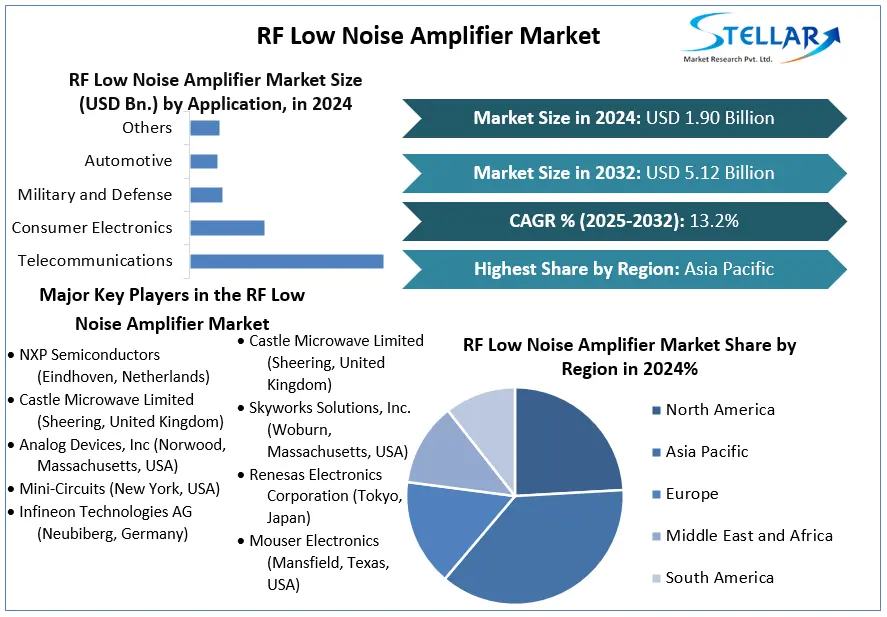
The RF Low Noise Amplifier (LNA) market is witnessing significant growth as global demand for high-speed wireless communication, advanced radar systems, satellite connectivity, and IoT devices continues to surge. RF LNAs are critical components in communication systems, designed to amplify weak radio frequency signals while minimizing additional noise. Their ability to enhance signal sensitivity and improve overall system performance makes them indispensable in modern electronic and telecommunication infrastructure.
Get your Sample PDF: https://www.stellarmr.com/report/req_sample/RF-Low-Noise-Amplifier-Market/2020
Understanding RF Low Noise Amplifiers
An RF Low Noise Amplifier is typically positioned at the front end of a receiver chain. Its primary function is to boost extremely weak incoming signals—often received from antennas—without significantly degrading the signal-to-noise ratio (SNR). Because noise added in the first amplification stage impacts the entire receiver chain, LNAs are engineered to deliver high gain with minimal noise figure.
RF LNAs are widely used across multiple industries, including telecommunications, aerospace and defense, automotive, consumer electronics, and healthcare. They operate across various frequency bands, from MHz ranges in traditional communication systems to GHz and millimeter-wave frequencies used in 5G and satellite communications.
Key Market Drivers
1. Expansion of 5G Networks
The rapid rollout of 5G networks worldwide is a major catalyst for RF LNA market growth. 5G technology operates at higher frequencies, including sub-6 GHz and millimeter-wave bands, which require advanced amplification solutions to maintain signal integrity. RF LNAs play a vital role in 5G base stations, small cells, smartphones, and customer premises equipment by ensuring reliable data transmission and enhanced coverage.
2. Growth in IoT and Connected Devices
The proliferation of Internet of Things (IoT) devices is another significant driver. Smart homes, wearable devices, industrial sensors, and connected vehicles rely on stable wireless connectivity. RF LNAs help improve receiver sensitivity, enabling IoT devices to function efficiently even in low-signal environments.
3. Rising Demand for Satellite Communication
The increasing deployment of low-earth orbit (LEO) satellites for broadband internet and global communication services is contributing to market expansion. Satellite receivers require highly sensitive LNAs capable of operating across wide frequency bands while maintaining low power consumption. The growing demand for satellite-based internet in remote and rural areas further strengthens this segment.
4. Automotive Radar and ADAS Adoption
Advanced Driver Assistance Systems (ADAS) and automotive radar systems rely on high-frequency RF components for object detection and collision avoidance. LNAs are essential in radar receivers, especially in the 24 GHz and 77 GHz frequency bands. As electric vehicles (EVs) and autonomous driving technologies gain traction, the demand for high-performance RF LNAs is expected to grow steadily.
Market Segmentation
The RF Low Noise Amplifier market can be segmented based on frequency range, application, end-user industry, and geography.
By Frequency Range
- Less than 6 GHz
- 6–60 GHz
- Above 60 GHz
Higher frequency LNAs are increasingly popular due to 5G mmWave deployment and advanced radar applications.
By Application
- Cellular infrastructure
- Satellite communication
- Wi-Fi and Bluetooth devices
- GPS systems
- Radar systems
- Test and measurement equipment
By End-User Industry
- Telecommunications
- Aerospace & Defense
- Automotive
- Consumer Electronics
- Industrial
Telecommunications remains the dominant segment, fueled by network upgrades and increasing mobile data consumption.
Technological Advancements
Continuous innovation in semiconductor materials and design techniques is shaping the RF LNA market. Gallium Arsenide (GaAs), Gallium Nitride (GaN), and Silicon Germanium (SiGe) technologies are commonly used to achieve superior performance. GaN-based LNAs are gaining attention for their high power handling capabilities and efficiency, particularly in defense and satellite applications.
Additionally, the integration of LNAs into system-on-chip (SoC) and system-in-package (SiP) designs is becoming increasingly common. This integration reduces component size, improves efficiency, and lowers manufacturing costs—beneficial for compact devices such as smartphones and wearables.
Regional Insights
North America holds a significant share of the RF LNA market due to strong investments in 5G infrastructure, defense systems, and satellite communication programs. The presence of major semiconductor manufacturers and technology innovators further strengthens the region’s market position.
Asia-Pacific is expected to witness the fastest growth rate. Countries such as China, South Korea, Japan, and India are heavily investing in 5G deployment, consumer electronics production, and automotive innovation. The expanding manufacturing ecosystem and growing demand for smartphones and connected devices make the region a key growth engine.
Europe also plays a substantial role, particularly in automotive radar and aerospace applications. The region’s focus on smart mobility and advanced defense technologies contributes to steady demand.
Challenges in the Market
Despite promising growth, the RF LNA market faces several challenges. Designing LNAs that deliver high gain, low noise, low power consumption, and wide bandwidth simultaneously is technically complex. Increased integration can sometimes lead to performance trade-offs.
Moreover, fluctuating raw material costs and supply chain disruptions can affect production timelines and pricing. Regulatory requirements and frequency spectrum allocation policies also influence product development strategies.
Get your Sample PDF: https://www.stellarmr.com/report/req_sample/RF-Low-Noise-Amplifier-Market/2020
Competitive Landscape
The RF Low Noise Amplifier market is highly competitive, with both established semiconductor companies and emerging players striving to innovate. Companies focus on research and development to enhance noise performance, reduce power consumption, and support emerging frequency bands.
Strategic collaborations, mergers, and acquisitions are common as companies aim to expand their product portfolios and geographic presence. Customization and application-specific LNA solutions are also becoming a key differentiator in the competitive landscape.
The future of the RF Low Noise Amplifier market appears robust, supported by rapid digital transformation and increasing wireless connectivity worldwide. As technologies like 6G research, autonomous vehicles, smart cities, and satellite-based broadband evolve, the need for highly efficient RF front-end components will intensify.
About Stellar Market Reserch pvt ltd.
Stellar Market Research is a multifaceted market research and consulting company with professionals from several industries. Some industries we cover include medical devices, pharmaceutical manufacturers, science and engineering, electronic components, industrial equipment, technology and communication, cars and automobiles, chemical products and substances, general merchandise, beverages, personal care, and automated systems.
Contact Stellar Market Research:
S.no.8, h.no. 4-8 Pl.7/4,
Pinnacle Memories Fl. No. 3,
Pune, Maharashtra, 411029
sales@stellarmr.com
+91 9607365656

 English
 Arabic
 French
 Spanish
 Portuguese
 Deutsch
 Turkish
 Dutch
Dutch
 Italiano
 Russian
 Romaian
 Greek
Greek