


Aviation Biofuel Market: Powering the Future of Sustainable Air Travel To Forecast 2025-2032
The global aviation industry is undergoing a transformative shift as it seeks to balance rapid growth with environmental responsibility. With air travel demand steadily increasing worldwide, the pressure to reduce greenhouse gas emissions has intensified. In this context, the aviation biofuel market—often referred to as Sustainable Aviation Fuel (SAF)—has emerged as a promising solution to decarbonize air transport and pave the way toward a more sustainable future.
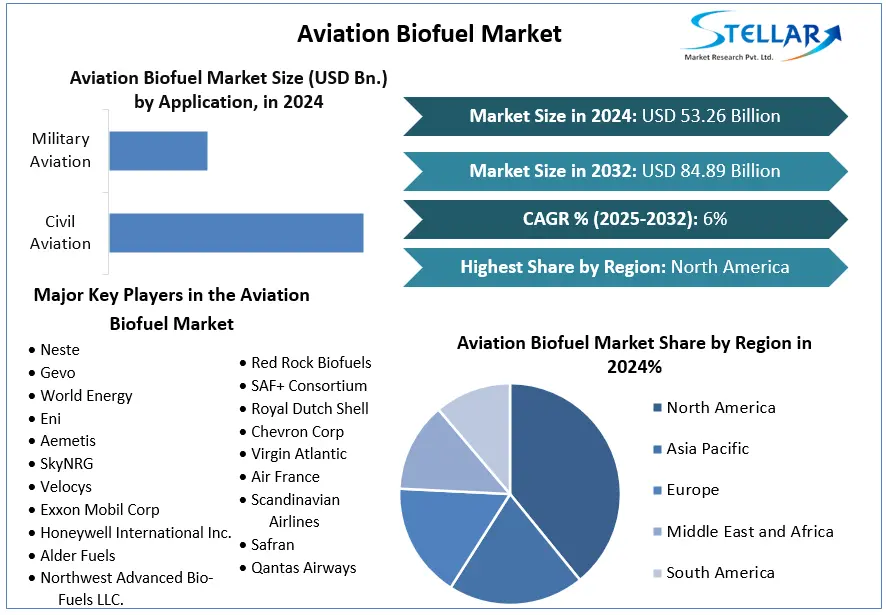
Aviation Biofuel Market size was valued at USD 53.26 Bn. in 2024 and the Aviation Biofuel revenue is expected to grow at a CAGR of 6.0% from 2025 to 2032, reaching nearly USD 84.89 Bn. by 2032.
Get your Sample PDF:https://www.stellarmr.com/report/req_sample/Aviation-Biofuel-Market/2016
Understanding Aviation Biofuel
Aviation biofuel, commonly known as Sustainable Aviation Fuel, is derived from renewable biological sources such as waste oils, agricultural residues, algae, municipal solid waste, and non-food crops. Unlike traditional jet fuel, which is refined from petroleum, aviation biofuel significantly reduces lifecycle carbon emissions. Depending on the feedstock and production process, SAF can reduce carbon emissions by up to 80% compared to conventional jet fuel.
One of the key advantages of aviation biofuel is that it is a “drop-in” fuel. This means it can be blended with conventional jet fuel and used in existing aircraft engines without requiring modifications. This compatibility makes SAF an attractive option for airlines seeking immediate emissions reductions without investing in entirely new infrastructure or fleet replacements.
Market Growth and Key Drivers
The aviation biofuel market has experienced notable growth in recent years, driven by environmental concerns, regulatory mandates, and corporate sustainability goals. Governments and international aviation bodies have introduced ambitious climate targets to curb carbon emissions from aviation, a sector responsible for approximately 2–3% of global CO₂ emissions.
Several factors are fueling the expansion of the aviation biofuel market:
1. Stringent Environmental Regulations
Governments across North America, Europe, and Asia-Pacific are implementing policies that encourage the adoption of sustainable fuels. Carbon pricing mechanisms, emissions trading systems, and blending mandates are pushing airlines to incorporate SAF into their operations.
2. Airline Sustainability Commitments
Major airlines have pledged to achieve net-zero emissions by 2050. These commitments have significantly boosted investments in SAF production and long-term purchase agreements with biofuel suppliers.
3. Rising Consumer Awareness
Passengers are becoming increasingly conscious of their carbon footprints. Airlines offering greener travel options and carbon-neutral flights are gaining competitive advantages in the market.
4. Technological Advancements
Continuous innovations in bio-refining technologies and feedstock processing are improving fuel yields, reducing costs, and expanding the range of usable raw materials. Emerging technologies such as alcohol-to-jet (ATJ) and Fischer-Tropsch processes are enhancing production scalability.
Types of Aviation Biofuels
The aviation biofuel market comprises various production pathways approved for commercial aviation use. Some of the major types include:
- Hydroprocessed Esters and Fatty Acids (HEFA): Currently the most widely used SAF pathway, derived from used cooking oil, animal fats, and vegetable oils.
- Fischer-Tropsch Synthetic Paraffinic Kerosene (FT-SPK): Produced from biomass, municipal waste, or agricultural residues through gasification and catalytic synthesis.
- Alcohol-to-Jet (ATJ): Converts alcohols such as ethanol or isobutanol into jet fuel.
- Synthetic Iso-Paraffins (SIP): Derived from fermented sugars.
Among these, HEFA-based fuels dominate the market due to established supply chains and commercial viability.
Regional Insights
North America
North America leads the aviation biofuel market, supported by strong government incentives, research funding, and airline participation. The United States, in particular, has introduced tax credits and renewable fuel standards that encourage SAF production and adoption.
Europe
Europe is a significant contributor to market growth, driven by the European Union’s ambitious climate policies and the “Fit for 55” package, which includes mandates for sustainable fuel blending in aviation. Several European airlines have already integrated SAF into regular operations.
Asia-Pacific
The Asia-Pacific region is witnessing increasing investments in sustainable aviation initiatives, particularly in countries like Japan, Singapore, and Australia. Rapid air traffic growth in emerging economies is expected to drive SAF demand in the coming years.
Middle East and Latin America
While still in early stages, these regions are exploring partnerships and pilot projects to enter the sustainable aviation fuel market. Abundant biomass resources in parts of Latin America offer significant potential for future production.
Get your Sample PDF:https://www.stellarmr.com/report/req_sample/Aviation-Biofuel-Market/2016
Challenges Facing the Market
Despite its promising outlook, the aviation biofuel market faces several challenges that may impact growth:
High Production Costs
SAF is currently more expensive than conventional jet fuel, sometimes costing two to five times more. Limited production capacity and feedstock availability contribute to the price gap.
Feedstock Supply Constraints
Sustainable and scalable feedstock sourcing remains a critical challenge. Competition with other industries, such as road transport biofuels and renewable diesel, can strain supply chains.
Infrastructure and Distribution
While SAF is compatible with existing aircraft, scaling up blending, storage, and distribution infrastructure requires substantial investment.
Policy Uncertainty
Inconsistent regulatory frameworks and varying subsidy structures across regions can create uncertainty for investors and producers.
Opportunities and Future Outlook
The long-term outlook for the aviation biofuel market remains highly optimistic. As production technologies mature and economies of scale improve, costs are expected to decline. Increased collaboration between airlines, fuel producers, airports, and governments will further accelerate market expansion.
Investment in advanced biofuels derived from non-food biomass and waste materials is expected to reduce dependency on limited feedstocks. Additionally, the integration of power-to-liquid (PtL) and synthetic e-fuels—produced using renewable electricity and captured carbon—may complement bio-based SAF in the future.
Strategic partnerships and long-term offtake agreements between airlines and biofuel producers are playing a crucial role in scaling up production. Many airlines are investing directly in SAF startups to secure supply and meet sustainability targets.
Furthermore, carbon offset programs and voluntary corporate climate initiatives are likely to drive additional demand for sustainable aviation fuel, particularly among business travelers and multinational corporations seeking greener travel solutions.
About Stellar Market Reserch pvt ltd.
Stellar Market Research is a multifaceted market research and consulting company with professionals from several industries. Some industries we cover include medical devices, pharmaceutical manufacturers, science and engineering, electronic components, industrial equipment, technology and communication, cars and automobiles, chemical products and substances, general merchandise, beverages, personal care, and automated systems.
Contact Stellar Market Research:
S.no.8, h.no. 4-8 Pl.7/4,
Pinnacle Memories Fl. No. 3,
Pune, Maharashtra, 411029
sales@stellarmr.com
+91 9607365656

 English
 Arabic
 French
 Spanish
 Portuguese
 Deutsch
 Turkish
 Dutch
Dutch
 Italiano
 Romaian
 Portuguese (Brazil)
 Greek
Greek