


PrivadoVPN review - a wonderful free VPN, and decent service all round
PrivadoVPN review - a wonderful free VPN, and decent service all round
Verdict

PrivadoVPN is a low-cost, high-value VPN that's great for gaming and streaming. I'd like to see post-quantum encryption practices integrated as well as an independent audit of its privacy policy, but if you're not planning on sharing sensitive data over the VPN, you'll find it's more than capable, and well worth taking advantage of its free plan and 30-day money-back guarantee.
Pros
- Super fast speeds with minimal slowdown
- Zero logs policy
- Free plan is plenty for anyone wanting to trial it
Cons
- Lacking post quantum security
- No independent audits
- Long-distance performance takes a big hit
I've reviewed PrivadoVPN dozens of times in my career as a VPN journalist, and have even been to one of its data centres in the Netherlands. Over the past few years it's gone from strength to strength, launching new features and tools to improve the app - all while keeping its prices low.
Its freemium plan is a great option for anyone looking to try before they buy, and gives the free VPN market leader Proton VPN a serious run for its money. PrivadoVPN is a budget-friendly option with speeds that punch well above its weight.
Let's compare specs, user experience, features, and security to see why PrivadoVPN is one of the industry's dark horses.
Specs
PrivadoVPN specs:
| Server range | 50 countries (67 locations) |
| Compatible games | Skate, Rainbow Six Siege, Diablo 4, Call of Duty, Rocket League, Fortnite, Straftat |
| Free trial | Yes (capped at 10GB, 13 countries only) |
| Money-back guarantee | 30 days |
| Simultaneous connections | 10 |
| Router support | Yes (manual configuration) |
| Average latency | 45 - 50ms |
| Average jitter | 28ms |
User experience
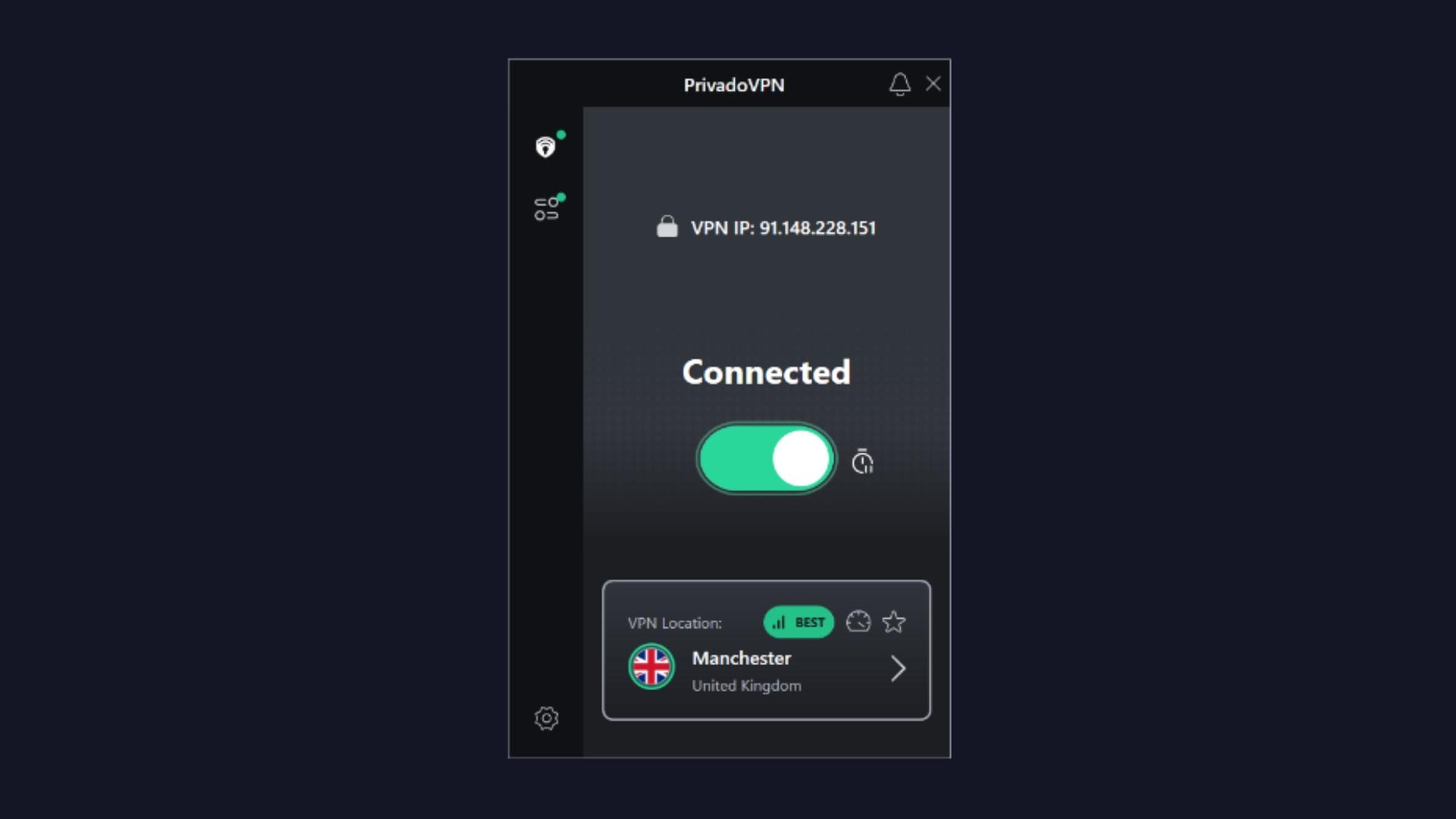
PrivadoVPN is simple and easy to use, and has apps for Windows, Mac, Android, and iOS. The apps are free from the usual clutter you getwith the likes of NordVPN, and keep everything well-contained in intuitive tabs.
My favorite test for a VPN is to "set it and forget it": connecting to a local server and just leaving the VPN to work away as I go about my day - that includes everything from browsing, to gaming, and streaming.
One of the main reasons I use a gaming VPN is to play with friends in other countries without suffering horrendous lag and geoblocking; so I booted up a few games with the VPN connected to a US server. It's worth noting that I live in Liverpool, UK, so I'm intentionally picking a server that's far away from me to see whether these games are actually playable while connected.
Rainbow Six Siege

Given the latest round of updates to the game, and its continued popularity as an esport, it felt appropriate to put the VPN through its paces first and foremost with Tom Clancy's Rainbow Six Siege.
While connected to the VPN, the game handled surprisingly well. Lag and packet loss were pretty much non-existent, and gameplay was as smooth as if I were connected to a local server. I was genuinely impressed with how well PrivadoVPN held up here, and I suspect it's because of the ownership PrivadoVPN has over its server network.
Some providers lease their servers - leading to congested virtual instances. However, PrivadoVPN owns the full network, allowing it to better manage the throughput and quality of traffic better. When I visited the data centre in the Netherlands, I was able to see those servers first-hand. It was one of my nerdiest moments of excitement
Skate

Playing Skate felt a little sluggish, but generally wasn't bad. My inputs were absolutely fine, but generally, the world around me just didn't quite feel right. It was still perfectly playable, and there wasn't anything game-breaking, it just felt slower than usual.
Straftat

Next up, I wanted to play one of my favorite indie FPS games: Straftat. I hopped into a quick match, found a lobby, and honestly, I was amazed at how well the game handled. I actually managed to hold my own in the matches, and it didn't feel like I was slowed down at all - no lag, no packet loss… It was great! Normally, I'm pretty terrible at Straftat, so I may start connecting these seemingly easier US lobbies in the future.
Thank you to the random players who were willing to let me take this screenshot. Straftat's quirky players are one of the many things I love about the game.
Privacy features
Privado's privacy and security offering is decent on paper: OpenVPN and WireGuard are commonplace VPN protocols, and the ability to integrate SOCKS5 proxies is a nice touch for anyone needing to circumvent censorship. Add to that a built-in antivirus, ad blocking, and even social media parental control settings, and there are a lot of great features to make use of - whether you're just looking to protect yourself in Call of Duty, or protecting your child on Fortnite.
However, there are two significant caveats: there are no third-party audits of its security or privacy policy to back up its claims. That doesn't mean the VPN is unsafe, nor does it mean the business is doing anything wrong - it's just that no external, independent organizations have verified the claims.
The biggest concern for me is that there's currently no post-quantum encryption (PQE) for PrivadoVPN - meaning users aren't protected against the rising threat of quantum computers and their power to break traditional encryption methods. NIST standardized the ML-KEM approach in 2024, and leading VPN providers like NordVPN, Surfshark, and ExpressVPN have already adopted hybrid 2096-bit RSA and ML-KEM key exchange methods to protect users from "store now, decrypt later" attacks.
No audits and no PQE is a problem for me, especially when the biggest competitors are already doing this. That said, if you're just planning on gaming on the VPN and you're not sharing sensitive data over the connection, the risk is minimal.
Other features
If you're a Linux gamer, Privado's support is limited to manual command line interface (CLI) and Network Manager methods. That's fine for the penguin power players, but for everyday people who don't want to learn terminal controls, it's a non-starter.
One minor thing to note is that the server list can seem absolutely random at first, but it's ordered, by default, by latency/ping (i.e. the fastest servers are at the top, and the slowest at the bottom). It's very handy if you want to get the fastest, most secure connection while you game, but if you're looking for a specific country, it may be easier to change the sorting format.
Freemium plan
If you're unsure about whether you want to commit to a VPN subscription, PrivadoVPN's free plan is one of the best in the industry. It's unlimited data, but you get 10 GB of uncapped speeds per month, after which it drops to about 1 Mb/s. Alongside that, you get 13 countries to choose from, which is better than Proton VPN's free plan, which always chooses a country automatically. For most people, this is more than enough - unless you're a Linux user. There's zero Linux support for freemium users.
Performance
A VPN won't give you faster speeds than what you're paying for, and most leading providers are running 10Gbps servers, so you're unlikely to hit the ceiling of speed with your home setup. Instead, it's more important to focus on how much the VPN slows you down when you're using it: is it still a usable amount, or is it going to kill your performance? For context, streaming in 4K uses around 25Mbps of data, and 50ms of latency is going to be barely noticeable unless you're counting frames while trying to twitch reflex moves.
So how does PrivadoVPN actually hold up when you put it under a microscope? To test the VPN, I ran a baseline speed check using Ookla's speedtest.net, then connected to a nearby server (the one the app recommended), ran the test again, and finally connected to a faraway server in the US (using the lowest latency server according to the list).

As you can see, I run a gigabit line, with low idle and download latency, and some moderate upload latency. When I connect to the UK, I only see a small jump in terms of ping, and my upload and download speeds are barely affected. However, when I connect to the US, I lose over 60% of my download speed, and my ping increases drastically. Interestingly, my upload speeds when connected to the US server were relatively unaffected.
These results are generally positive, and about what you'd expect from one of the fastest VPNs. It shows that Privado handles local connections just as well as NordVPN, but falls victim to a common long-distance routing issue that I've only really seen Surfshark's Nexus be able to properly crack. Ultimately, when you're connecting to a server that's physically far away, you're always going to be slower than you would if you were connected to one that's only a few miles away.
Final verdict
When you're connecting to a server thousands of miles away, it's pretty typical to see ping and packet loss, but for the most part, gaming on PrivadoVPN was a seamless and stress-free experience. The only exception I saw was in Skate, and even then, I don't think much of that was actually due to the VPN. It's easy to use and has apps for most platforms. The only weakness is its Linux offering.
All in all, I'd say PrivadoVPN is a great VPN for gaming on Windows, and I'd absolutely recommend it to anyone who wants a budget-friendly option. Plus, the 10GB download limit on the freemium plan is more than enough to trial it for yourself and put it to the test without putting any money on the line. If you want to give the premium service a go, there's also a 30-day money-back guarantee to fall back on.

 English
 Arabic
 French
 Portuguese
 Deutsch
 Turkish
 Dutch
Dutch
 Italiano
 Russian
 Romaian
 Portuguese (Brazil)
 Greek
Greek