


This is the finest VR headset image quality I've ever experienced, but it comes at a price
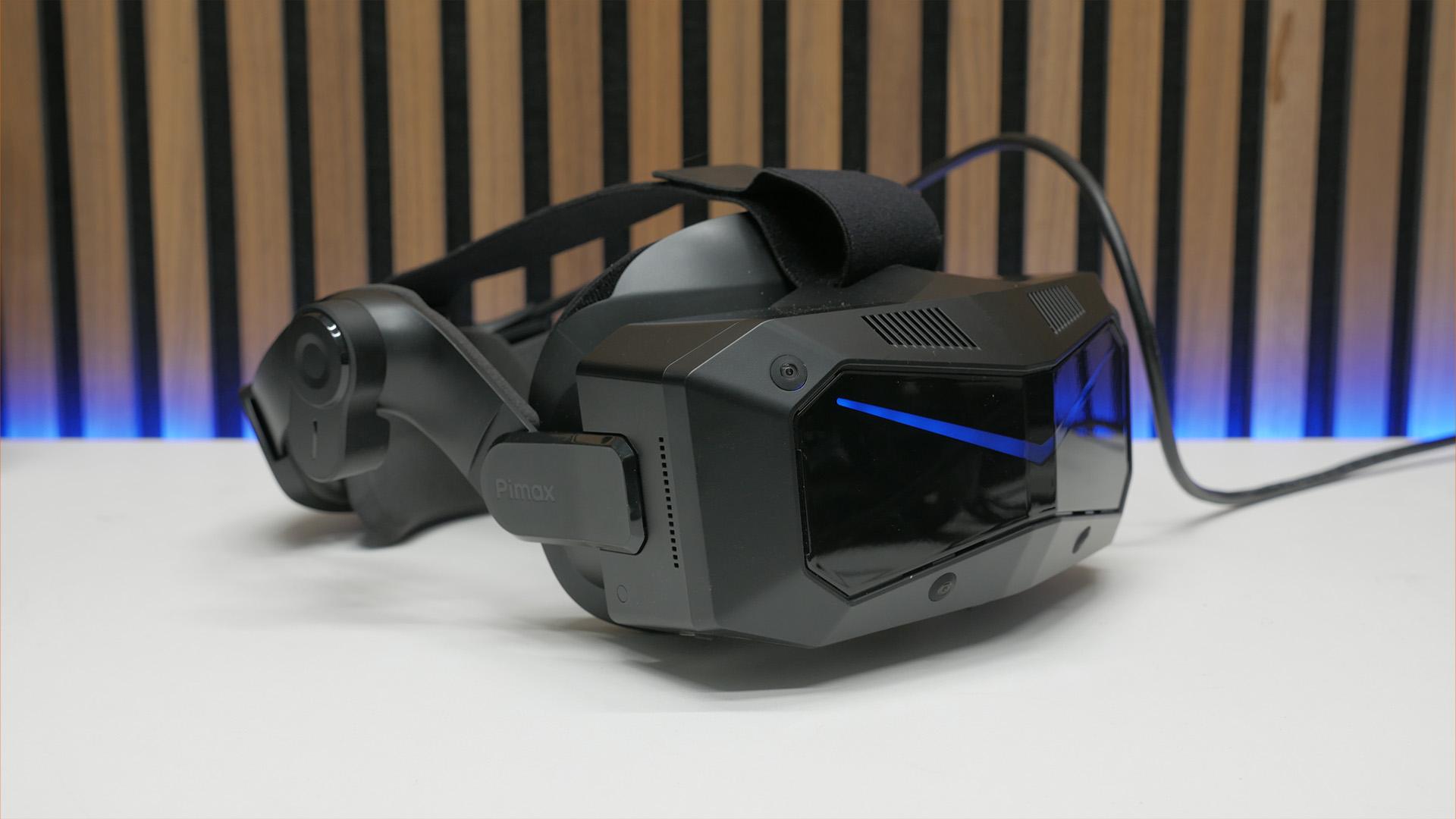
This is the finest VR headset image quality I've ever experienced, but it comes at a price
Verdict

The Pimax Crystal Super 57PPD combines fantastic displays with clever optics to deliver truly incredible image quality - this is by far the best VR image quality I've ever experienced. However, it is quite a heavy headset, with middling comfort for those with glasses, plus it lacks any standalone functionality and needs a powerful PC to run it.
Pros
- Incredible image sharpness
- Fantastic colors, contrast, and black levels
- Modular build makes upgrades possible
Cons
- Quite heavy
- Not the most comfortable
- Needs a powerful PC
The Pimax Crystal Super 57PPD is arguably the ultimate VR headset on the market right now, especially if you're looking for pin-sharp image quality above all else. With a resolution of 3,840 x 3,840 pixels per eye, Crystal Super range already has very high-resolution displays, but thanks to the 57PPD's slightly narrower field of view (FoV), it effectively boosts the sharpness of these displays from their default 50 pixels per degree (PPD) to 57PPD, for sharpness that far surpasses most headsets.
For instance, our overall best VR headset choice right now is the Meta Quest 3, because it's relatively affordable, has decent image quality, and can be used standalone - no PC required. However, its displays are just 2,064 x 2,208 per eye, giving it a PPD rating of 25PPD. As a tethered headset that needs a PC to power it, the Pimax Crystal Super is a very different beast, but if you're looking for the ultimate image quality for the best flight sims, racing games, and much more, this is among the very top choices available right now.
Specs
| Pimax Crystal Super 57PPD | |
| Display | 3,840 x 3,840 per eye, pancake lenses |
| Max refresh rate | 90Hz |
| FoV | 106-degree horizontal, vertical not stated |
| Weight | 879g without cable, ~1kg with 1m of hanging cable weight |
| Tracking | Inside out via four cameras |
| In the box | Headset, cable, two controllers |
| Connections | Single cable with DisplayPort and USB-C |
The big features here are, of course, the high-resolution displays in this headset. While several headsets are now starting to hit these numbers, the vast majority of the biggest players in the space still have screens that are a step-change lower. I've already mentioned the Meta Quest 3, but it's not alone in falling well behind the Crystal Super. The Pico 4 (2,160 × 2,160), the Oculus Rift 2 (1,834 x 1,920), and Valve Index (1,440 x 1,600) are all miles off the pace, while the Bigscreen Beyond 2 (2,560 x 2,560) and original Pimax Crystal (2,880 x 2,880) are still comfortably behind. Our Pimax Crystal review shows that headset still has incredibly image quality, but the Crystal Super seriously steps things up a notch.

These displays are quantum dot LED LCDs (QLED) panels, so they don't boast the truly infinite contrast and true black levels of OLED displays. However, the displays do employ local backlight dimming to great boost contrast and black level response, with "nearly 1,000" zones per eye. For comparison, many of the best gaming monitors with local dimming LCD panels have about that many zones spread across a 27-inch, 1440p display, so packing so many into the Crystal Super's tiny displays is quite the feat.
When it comes to optics, this is where the Crystal Super gets momentarily confusing, as it's available in three versions, all of which cost the same and use the same screens, but each has a different set of optical characteristics. There's the Ultrawide version that offers up a 140° horizontal FoV (with an unspecified PPD), the 50PPD version that has a 127° FoV, and the 57PPD version I'm looking at here that tightens up its view to 106° for a narrower view but the highest resolution per degree.
For comparison, the likes of the Meta Quest 3 (110°), Pico 4 (105°), and Valve Index have similar FoV's to the 57PPD, so while it's the narrowest of the three Crystal Supers, it's still a similar level to what most VR users are used to. The other two options just expand this out much further.

The lenses used in all three versions of the Crystal Super are glass, aspherical units, rather than pancake or Fresnel ones. This means they have the best clarity and image quality, but add to the weight of this headset.
Speaking of weight, this is a bit of a bruiser, as it tips the scales at 879g without its cable attached, and just over 1kg once you've accounted for the weight of a meter or so of the cable hanging off your head. That compares to around 500-600g for compact standalone headsets like the Pico 4 and Meta Quest 3, but is comparable to the Valve Index's 809g and the original Pimax Crystal.

This isn't a standalone headset, so there are no specs to discuss in terms of internal processors, RAM, storage, and the like, as you'd get with the Meta Quest and Pico headsets. Instead, a single cable with a proprietary connection on one end runs for five meters and terminates in a USB-C and DisplayPort plug, both of which are needed to use this headset. The latter plugs into your graphics card, while the USB-C plugs into your PC for other data. Furthermore, a separate power supply is also included, which plugs into the splitter junction where the USB and DisplayPort cables separate from the main cable.
Features
In some ways, there's not a great deal to talk about when it comes to the features of this headset. Its features are its visuals. However, there is a little more to discuss.
Firstly, in terms of visuals, this headset includes eye tracking - via its software that you'll need to run each time you want to use the headset - and this not only can be used to perform automatic interpupillary distance (IPD) setup but also allows for foveated rendering. This is where the headset's software can interact with games and other software to only render the central portion of the image - where your eyes are looking - at maximum resolution, reducing detail in your peripheral vision to save processing power.

The headset also offers what Pimax calls a swappable optical engine, which initially seems to suggest you can swap optics to access the three different types of this headset. However, this isn't just a lens swap. What this actually amounts to is that you can completely remove the entire screen+optics section and swap this out. This means that while you're not paying for the cable, controllers, eye rest, any custom optics, and the frame, you are still paying $599 to swap between the Ultrawide or 57PPD versions, although this does mean you can switch to the micro-OLED version of this headset as well, for $1,199.
Speaking of controllers, you get two included, and these are basically identical to every other VR headset these days. You get the grip with the circular top section, two main function buttons (X & Y), a couple of menu/option buttons, and a thumbstick.

Back to the headset. As well as its optical engine being modular, you can also remove the eyerest section. However, Pimax doesn't include a glasses extension section for this section, and nor does it offer its own custom optics. Instead, you'll have to use a third-party service to get prescription inserts for this headset, if needed.
The final feature to note is the included speakers that are incorporated into the headband of this headset. There's also a 3.5mm audio jack hidden just next to the main cable socket, so you can use your own earbuds if you prefer.
Design and comfort
This is a heavy headset. Weighing in at well over 50% heavier than most standalone or generally more compact rivals, wearing this headset is a completely different experience from something like the Meta Quest 3. In particular, you really have to be careful about how you arrange the cable, with it ideally being slightly supported by being clipped to your clothes, if you're stood up, or to the back of your seat, if using it at a desk or racing/flight sim rig. Without this precaution, the weight of this headset can start to cause some real issues.

What's more, it makes a huge difference which 'Facial Foam For Comfort Kit' eye pad insert you use with this headset. The one installed when this model was shipped to me was the 'Ice Silk' 11mm-thick version, which is compact, super soft, and with a smooth-feeling fabric surface, but is, quite simply, not very good, at least for me.
In particular, this insert doesn't offer much surface area at its top, where it can help to take some of the weight of the headset off your nose. Also, it doesn't accommodate glasses very well, with it feeling too cramped inside.
Instead, the 15mm flocked insert is a huge improvement. Not only does it include notches in the sides for glasses arms, but its extra thickness means there is more depth for your glasses to fit in between your face and the headset's lenses. Ideally, you'd get some third-party prescription lens inserts for long-term and regular use of this headset, but without these, it's a night-and-day difference as to which foam insert you use.

Crucially, this thicker, flocked insert is also taller, with around half an inch of extra height allowing it to distribute far more weight on your forehead, rather than it all crushing down on your nose. Again, it was a night and day difference even without glasses. The Ice Silk insert meant I didn't ever find this headset all that comfortable, but the other insert made all the difference in dealing with the weight of this headset.
The Meta Quest 3S is much bulkier than the Quest 3, being roughly the same size as the Quest 2 while having a similar weight to the 2023 headset at 514g. On the surface, that sounds fairly disappointing, but while the Quest 3 is the most comfortable VR headset I've ever used, the new 3S feels much more comfortable than the Quest 2, thanks to better weight distribution within the device itself.
Performance
The moment you fire up this headset, the sheer clarity on offer from its 57PPD optics is plain to see and absolutely amazing. Most VR headsets give you that "being there" sense from their stereoscopic image, but in terms of resolution and clarity, there tend to be telltale signs, with obvious screen dooring (particularly from OLED displays), pixellation, a general lack of sharpness, or odd optical characteristics like the subtle stepped effect of Fresnel lenses. With the Crystal Super, though, almost all of that is gone. VR video and games are rendered with a clarity and smoothness that is truly amazing.
What's more, the QLED displays with their local dimming backlights might not have quite the black levels and contrast of OLED, but they're still incredibly bright with vivid colors and excellent contrast. As well as the clarity that comes from the boosted resolution, the vividness of these displays also brings its own significant boost in realism compared to lesser headsets.
Even the relatively narrow FoV of this headset doesn't overly affect its abilities. Depending on your preference, you may find you prefer more of a sense of peripheral vision in flight and racing sims, but I didn't find it a significant chore to turn my head that little bit more. Certainly, when it comes to racing or combat flight sims, it's a more realistic reflection of your vision when wearing a helmet anyway.
All that said, the image quality improvement over lower-res headsets will obviously depend on the quality of what you're interacting with. Moreover, there are definitely times when the improved image quality felt more like a steady improvement, rather than a sudden switch to Retina-level clarity, though again, at least part of that is just finding video and games that truly have the fidelity to make the most of what this headset can do.
As for the controllers, these feel much like any other VR headset's controllers, though they're a little shorter and lighter than the Pico 3's controllers, for instance. They also lack a grippy texture on the rubber caps of the thumbsticks, so they're a touch more slippery. Overall, though, they work perfectly well.
It's a similar story when it comes to the included speakers. Like other VR headsets, they do expel some external noise, but it's not as bad as some headsets, and the on-headset volume control offers very fine control, so you can really dial it in to your preference.

One final negative note, though, is that for this headset to keep cool, it has two little internal fans, and these are fairly noisy. From where your ears sit, they kick out about 35dB, which is quite noticeable if you're not using earbuds or a headset and are interacting with a fairly quiet video/game. However, your brain soon blocks it out.
The Pimax Crystal Super price is normally $1,799, but is currently discounted to $1,599, and remain so for the next three months. What's more, you can get an extra 2% off by purchasing through this link to the company's store.
The Crystal Super is still incredibly expensive, but it is comparable to other top-tier headsets, and moreover, it delivers truly class-leading image quality.
Verdict
The Pimax Crystal Super 57PPD is a truly stellar headset with class-leading image quality that brings exceptional clarity to your videos and games. The displays are also bright, vivid, and contrasty, even if they can't quite compete with OLED for black levels. If you're simply after the best VR image quality right now, this headset delivers it.
However, this is a heavy headset that is of course tethered to your PC, so it can't offer standalone gameplay like with a Meta Quest 3 or Pico 4, and while it can be reasonably comfortable, you're certainly going to notice it after a few hours of use.
It's also a very expensive headset, but along with delivering its class-leading image quality, it also makes up for this somewhat with its modular design. Not only can you swap to the Ultrawide and 50PPD variants of this headset for just $599, but you can even switch to the OLED version, too. Plus, there's the possibility that Pimax adds more optical engine upgrades in the future, too.

 English
 Arabic
 French
 Spanish
 Deutsch
 Turkish
 Dutch
Dutch
 Italiano
 Russian
 Romaian
 Portuguese (Brazil)
 Greek
Greek