


Mayhem Singer Finds Light Amongst Death on 'Liturgy of Death'
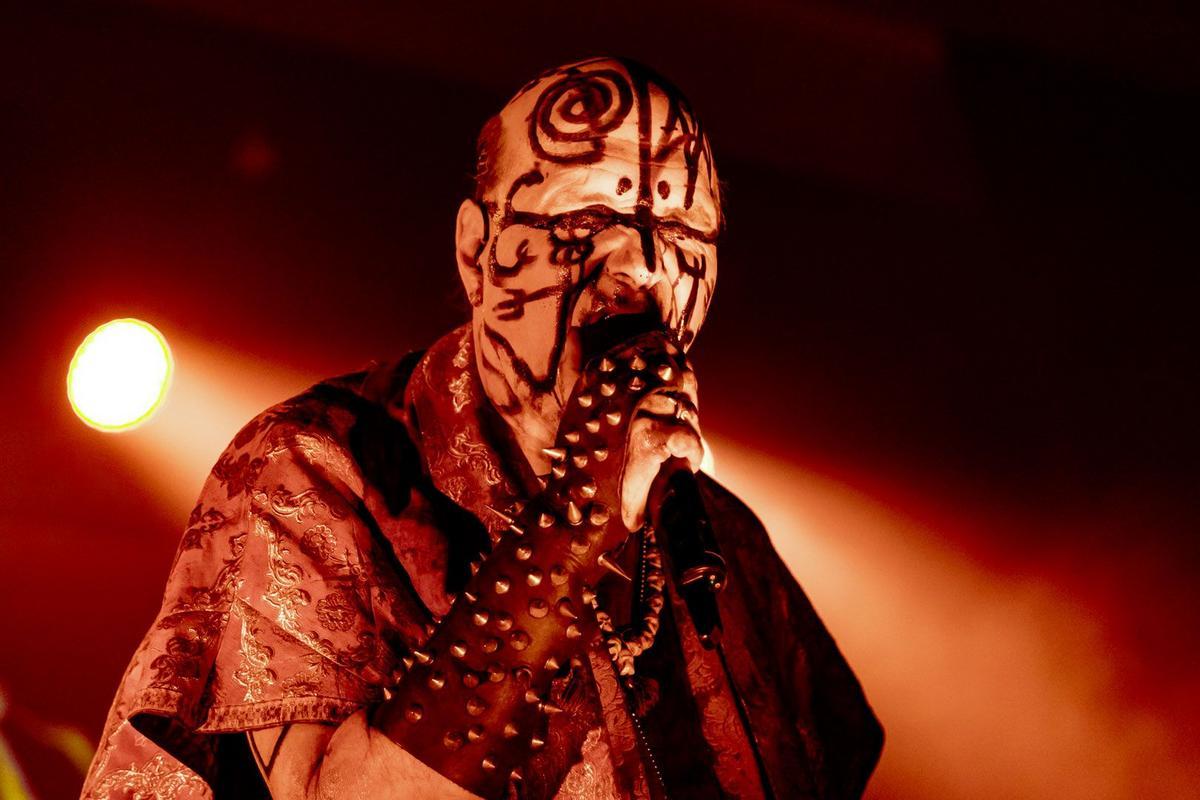
'You Don't Have to Be That Emo' - Mayhem's Attila Csihar Finds Light Amongst Death on 'Liturgy of Death' Album
"You don't have to be emo about it," says Mayhem's Attila Csihar while speaking with Full Metal Jackie at one point in discussing his approach to exploring death on the band's latest album, Liturgy of Death.
The subject looms heavy over the black metal band's album, but Csihar is quick to point out that it's not all doom and gloom. "Since it's a Mayhem album, all the lyrics are pretty dark and death is a dark theme, but if you go into it a little bit deeper, you will realize that it's really a necessary part of this dimension we are living in this existence. There's also some positive sides too, like it's the release and it's the end of this misery and pain.It could be a transition to another being," shares the vocalist.
He would later add, "I think it's a good thing to come face to face with. Not all the time, of course. You don't have to be that emo. But, from time to time, it's good to remind you that there's gonna be an end and it has to be."
Within the chat, Attila shares with Jackie how broaching the many aspects of death impacted his own thoughts on mortality. He also delves into his own legacy and shares what it is about performing live music that keeps him coming back for more. Plus, the singer gives us an update on his creative pursuits outside of Mayhem as well.
Check out more of the chat below.
It's Full Metal Jackie, bringing you two full hours of metal each and every week. And super excited to welcome to the show, the one and only, Attila Csihar of Mayhem. The band is back with one of the more intriguing albums of the new year in Liturgy of Death. You could call this a concept record, but Attila, was it always a plan to lean into writing each song specifically with death as a theme?
Yes, that was my original idea and the idea upon me, I think. It's not like I have a list of 20 words before I make an album and, "Um, okay, let's do that." It's more like I was just kept open myself. We felt like it's time to work maybe on a new record.
It was four years ago, I think, when it came to me, the theme, and I just realized, "Okay, well that's that's a condemnation of not just black metal, it's the condemnations of all dark black arts and philosophies and poetry and literature and even architectures, you know, the ancients."
So I just realized, "Okay, this is giant. This is huge. This is challenging. This just manifested in front of my eyes, like a really big theme." I felt like, "Okay, I'm been playing this kind of music for 40 years now and I'm almost 55. Maybe, maybe it's time to do this. Maybe it's time to go deep into this." And somehow this is how it started.
Mayhem, "Life Is a Corpse You Drag"
"Life is a Corpse You Drag," one of the standout tracks off the new Mayhem album, Liturgy of Death. Attila from Mayhem is my guest on the show this weekend. Attila, we're getting into some heady territory here with that song. As stated, "Consciousness is a burden, the blood as vessel, and faith as a seal on a grave already closed." As this record was coming together, what were the conversations you were having with your bandmates about death, and how you wanted to approach it as a construct within this album?
When the theme came to me, I just realized I think this is just growing on me now. I have to do it, almost like a karmic feeling, you know? And I talk first to the two guitar players, because normally, we are the creative wing in Mayhem, Morten and Charles, and I told them about my idea.
They were like, "Yeah, sure. Go for it." And we started to send sketches and stuff and I told the other guys the lyrics, actually, that's my test, so they never really interrupted my lyrics unless it's really something really, really out of the box or something too much, you know? But it's never the case.
I just started to write sketches and I dig myself into the theme. But like "Life is a Corpse You Drag." maybe the title is a little bit of irony in it, but I didn't think about it when I made the title like that. I felt like it just came out like that. And all the songs are about the same topic from different aspects,
For instance, how momentary is our life compared to death. I could go into now, or we can go into later if you like, the philosophy behind it, but I try to approach it from different aspects, and, of course, since it's a Mayhem album, all the lyrics are pretty dark and death is a dark theme, but if you go into it a little bit deeper, you will realize that it's really a necessary part of this dimension we are living in this existence. There's also some positive sides too, like it's the release and it's the end of this misery and pain.It could be a transition to another being.
I'm never gonna define this. I'm not gonna start a new religion, I promise. And the only thing I will say, and I say that everybody should do it individually — figure out this thing as an individual path.
Honestly, it's such an interesting path to travel and story to tell with this record. I have to ask, do you feel this is an album that only could have been done at this stage in your life? Did you need to go through certain life experiences to fully realize the vision and putting it to the music?
Definitely, definitely. I couldn't do it anytime earlier. I think I've just grown up and I'm up for the task now, being almost 55 and doing this music for 40 years now. First time I was onstage in '86 with Tormentor. That's a long time ago, you know? And I was 15 at that time. Now I'm 55, so it's insane to think about it and to take a theme like that
I just did an interview with a Spanish a magazine from Madrid, and we just played in Madrid and it's rare, but that time I was lucky we had a couple of hours off. I could go after the soundcheck around to the museum, the Prado Museum, which is very famous. There is the Goya paintings and Hieronymus Bosch paintings, and I went with one of our technician, and I was like, "Dude, I have to go back." I've been there before, but, you know, two hours is nothing in a museum like that.
But what really, really touched me this time, I was looking at all these paintings and seriously, every second painting almost was about something like death, misery, raising the dead, Jesus is dying. So it was religious, but not only that. Every aspect made me feel very relevant and proud. I was like, of course I'm nothing to those artists compared to them.They are so amazing paintings, mind-blowing. But there was like a corpse and a big coffin in these paintings and it was insane. It made me think, maybe today, we try to escape this theme. Like, in our society, nobody likes to talk about this or think about it, We think about the other stuff in life, but I think it was not like that in the past.
And Attila, you had some really interesting perspective on why thinking about death can actually make you live life more fully.
Yeah, I think about this every day, of course, but I'm the vocalist of Mayhem. It's kind of on me you know? But you might think it's crazy, but I don't think so. I think it's good to know that our time is limited here and it's good to come face to face with that. We have to acknowledge it and live our life to a full extent. And also think about not just fixing the outer world.
Everybody is always rushing, running, seeking money and stuff. But have you heard about anyone who is in the deathbed, and you ask about their life, and would say, like, "I wish I would make more money"? Normally not. It's normally people who think about other things, other values in life and what they missed. I think it's a good thing to come face to face with. Not all the time, of course. You don't have to be that emo. But, from time to time, it's good to remind you that there's gonna be an end and it has to be.
It's necessary. Imagine if no one would die. That's very romantic to think about. Like the vampires or Jesus. I don't know, if I came back from the dead which I doubt it could ever happen actually, but also that science will save it, solve it. But then what's gonna happen How many people we will be here if nobody would die, still the dinos would walk around here, you know?
This universe, this dimension, this existence is made like this. What was born has to go. And let's live our life and let's face off with this and let's incorporate it and let's live our life in a full extent. That's what I'm saying. And go straight forward and don't miss those moments in life which might be missed forever.
Attila, in working with Mayhem on Liturgy of Death, what life realizations did you come to? I mean, death is approached as fact, as inevitability. Did this in any way impact how you look at your daily life and existing time in this existence?
Actually, it did, because my life is very infused with the music and art. I'm very connected almost all the time, especially now in this intense time period. When the album is out, I'm touring, I'm doing a lot of interviews. So it feels like it brought me more wisdom.
And the lyrics, yeah, okay, that is very disturbing, it's very troublesome, It's very scary, but look at life. If you flip the coin over, that's basically also oriental philosophy or anyone can know it, it's like logically, we have sicknesses, pain, confusion, dramas in life and at the end, no matter what we go down, our body decays.
So, if you think about this, especially at some point when we get so old and it's nothing to do and everything is painful, that could be a release from that too. So, I think it's more bad, the worst, the death is worst for the people who are left behind.
This discussion has me thinking about mortality. As a band, Mayhem have been around for 41 years, you've been a part of this history off and on since the early 90s. Obviously, there was some pretty well known history before you joined the group. What has it meant to you to be a key part in keeping this legacy going? And someday when all is said and done, what would you like for people to remember from your time leading the band?
Thank you. When I joined Mayhem, I really didn't know the band to be honest. I had another band called Tormentor from the '80s that was my first band. We still play, actually, which is amazing. We're the same lineup from '87. We just came back, like, 10 years ago and it's super intense. But first time I was onstage in '86 and we had a lot of shows in the '80s in Hungary, Slovakia, Austria. Mayhem didn't really play that much, so I didn't know about them then.
But that Norwegian scene was kind of still in the egg shell or an ex-state or something when I already stopped with Tormentor in '90 for several reasons. Our album couldn't be released in the old system. We were in the communist era, end of the communists, so in front of my eyes, by the way, the whole system collapsed, It was crazy.
But anyway, I've heard about them and even my name was Mayhem in Tormentor. So that was a very strange omen. First I heard from the band and like, wow, that was my artistic name, and that's why I use the name Attila now, because I didn't pick up another name, you know?
But, of course later, when I knew more about the band, I heard about the stories, and especially when I went to record De Mysteriis Dom Sathanas and first met the guys there in Norway, I saw, by then, that it was like a big, big deal, big stuff going on.
READ MORE: 11 Best Norwegian Black Metal Albums of the 2000s
But still, the scene was very small, very underground. But there was the suicide of the other vocalist, Dead Pilot, who I had to replace. And there was church burnings and all this crazy stuff going on. So I was like, "Wow, this is really cool." I thought it was cool then. I was 21.
This is serious, this is crazy. And when I heard their first demo, like the Deathcrush album was more like a punky record. It was cool, but when I heard the new songs, the tape, it was so futuristic and so, so advanced. I was like, "Wow, this band is something very special."
We were talking earlier about how he first joined the band and the early days of that scene, and of course, that era became a very intense and difficult time in his life.
But of course, no one could foresee what's gonna happen. Then everything went down to hell again. When I had to face, and I was 22, that my bandmates murdered each other and everybody died or went to prison apart from Hellhammer, the drummer. That was a really heavy thing to take in.
So as of being 22 years old, it was really hard to deal with, to be honest. It really shocked me. And then I had that time I had another band in Hungary called Plazmapule, which was more like this industrial electro stuff and before computers, I must admit, that was very challenging stuff to do.
That band also went down because of the keyboard player did some wrong deals with the mafia and they took all our instruments or they did something really, really wrong, though it was not easy. Very, very hard times. And then II just played in some experimental bands and then I came back slowly from '98.
So I had three, four years not sure where to move, you know? And then I came back with my Italian band, Lavorim, who invited me. And then we did kind of a mixture of Mayhem and Plasma Polyleve, like it was industrial black metal band. It was really cool, and that kind of brought me back to life. Even though it was a crazy, strange period, very dark period for me, that couple of years actually.
So the legacy is heavy, and it was not an easy path to be a pioneer. That time, there was nothing like this, the scene, like today.
So that makes me think now, decades later, that we were always right. We just didn't know that It was not that clear, but we were right. Otherwise, we would not be here. And you can see that, yes, we always knew that something was very wrong in the world from my gods or at least I knew. I saw the system collapse.
I knew that something is really deeply wrong with the religions, because look at all these wars through the history and stuff and how much people were manipulated in the name of God to kill each other. We're talking about millions of people and dozens and dozens or hundreds of wars still going on today, by the way, and I just don't wanna go into this, but look at these fires and all this stuff coming up now, like Prince Andrew just went to prison, so it's not my table to talk about, but just something is deeply, deeply wrong.
So that's why we are here, that's our legacy. I think that's why the scene is here and I'm just part of it. We just did it from the instinct, but it seems like we were right.
Obviously, we talked about that you guys are on tour, and some major touring coming up the first part of this year, primarily in Europe. At this stage in your career, what do you personally get out of touring? Is it the same thrill you had when you were younger and starting out? What is the act of bringing this music to audiences bring up in you and what keeps you coming back for more?
Amazing, and it's a good question. I just recall my first show when I was 15 and it was with Tormentor and we were in this competition for bands. We just started to play music and there was a competition. So we went and I was so freaking freaked out. I was so much in stress, I didn't know what to expect. I'd never been on a stage.
We were in this big hall with a lot of bands together. That was the backstage, like a big hall. All this I was way the youngest, I think, or probably one of the youngest. I was just 15. All these other bands there and we started to play black metal. It was very fresh, new. I was the youngest also in my band, Tormentor, and I was so worried.
I'll never forget, when I stepped on the stage, I grabbed my mic and the whole thing was just gone. And this thing came to me, which is still there. It's that energy, it's indescribable, but I felt so comfortable in a way but I felt more like in a trance, like a state, which I've learned to handle now. But that time, I just didn't know. From that point, I was a bit more secure, of course, and got secure by today.
But to play live every night is very majestic. For me, it's always like a ritual. It's not just play some music and just to entertain people. It's much more. We are connected on many other levels. Sometimes I invoke the people who passed away who were part of our legacy, like our history, and of course, like Euronymous and Dad who passed away from my band, but also there is Joey Jordison, very good friend of mine, or Jon Nodtveigt from the band called Dissection, or even some of my Hungarian musician friends who died in an accident or something.
Sometimes I invoke them at the show.
What happens for you once you step onstage?
So for me, it's like a really multi-level thing going on, on the stage. I feel this channel, maybe that is the best way to describe it. Somehow, it's just coming through me and I just control it in one way, and then other way I just let it go.
It's hard to find words for that, actually. But it's really majestic. It's really beautiful. Every night, it's the best part of the whole day when I'm onstage, when I'm on tour, always. The rest is okay. Actually, it's kinda tiring. This is an intense tour now and we have almost two hours long set, like, one hour 45 set. So, it's a lot of work around it. It's a relatively big production compared to what we normally do. It's a big production. But when I'm on the stage, that's the best. That's the best part of it. Absolutely.
Attila, from a creative standpoint, Mayhem is front and center for you. Are there other collaborations or things outside of the band that you either have in the works or that you'd like to get to at some point?
Oh, thank you. Yeah. I can say, I've just mentioned Tormentor, my first band, they are still playing and that's really cool. It's the same lineup from the '80s, and I think that makes it very unique. The same lineup from '87, actually. So, think about it, that's pretty crazy. We still play. We still pull out shows and people love it. That's the real pure '80s stuff.
But, also, I have some other things. It's called Void of Voices, for instance. It's my solo project, which I started in 2007. And I'm using only my voice and it's like a dark experimental, dark ambient music. I kinda loop my voice and make this mantra kind of music. I really enjoy it. Even I do, with that, something which is a little bit different for the old Nosferatu silent movie, like soundtracks. Like a live soundtrack. Imagine an old cinema with a silent movie and there was a piano player. So replace the piano player with me and I'm just making this very dark ambient tones and sounds for the Nosferatu, which is a really, really amazing piece of artfrom the 1920s. It's like the, the original Monroe one I'm talking about. It's fantastic. And also, I have new projects now, new bands.
One is with Igor Cavalera from Sepultura and the Cavalera Conspiracy and It just happened. I, I promised myself no more, no more bands. But sometimes it's impossible to say no. And we just did a couple of shows together. He invited me to play together. I only knew he was like a world-class drummer and really amazing drummer, but he's also into experimental music and he's very good at modular synths and stuff. And there's electronic music he's into. So, we did a few shows together, but it turned out we were so much on the same page.
We both want to make ritual, ritualistic vibes and I really miss that. I used to play with Sunn O))) from, from U.S. actually, but I kinda had to stop because my ears got a bit damaged. It was really loud and stuff so at time I just had to move on. But I still still miss that kind of audience and stuff. So we played with, with Igor with this festival called Lugga's Who. People are so blown away. There was like 2,000 people. Everybody was like, "Hey, you have to play more." Like, "We want to see more of this." So, now we decided to do that
Attila, we were talking about the other collaborations and things outside the band that you've got in the works. Anything else you can tell us about?
There is another, other project, another band coming. I think I mentioned but I've grown up on not only metal, because we were on the periphery with Tormentor. Not even, like, when we started to play this kind of music, black metal, in the beginning, it was really on the periphery. Nobody knew. Even the metal scene didn't really like us, no one liked us, which was cool. So, everybody came from different scenes. Punk, hardcore, goat, whatsoever, you know, so that's why I discovered bands like Frontline Assembly, Skinny Puppy, Diamanda Galás, Current 93, psychobilly bands, stuff like that, you know? And hardcore and whatever, you know? I, always like punk too.
Anyway, talking about Frontline Assembly, I met the guys and, um, became, like, friend with Rhys Fulber. And, to cut it short, it's another story, but we decided now that we should do something together, which is, for me, it's a piece of my heart, you know? really love that band. It's really influenced me from the '80s. I think they are still great. And it's an honor, so we're gonna do something. And I think it's also gonna be cool because, of course, my field is always this awkward esoteric stuff, you know? So, and that's something I miss from the industrial scene.
It's not many bands dealing with that, you know? So, I think it's, could be unique. No matter what, I have to do it. People like it or not. This is something I have to do with him. So, we gonna do a new...Probably we gonna follow the footsteps of Will, one of his side projects, like W-I-L-L.
It's worth a check. It's a '90s. Nobody knows, I used to love that band. And when I talked to him about it, he was like, "Yeah, that's cool that you know that." I was like, "Yeah." So we gonna do something similar I think to that probably. It's very new, but it's gonna happen.
I really need this actually to balance out Mayhem. I realized when I played with Sunn O))), or I always had something on the side it's important and it helps me to carry on better with Mayhem, too, to have these other bands on the side. Somehow I need this to balance out.
What is on the horizon for Mayhem for the rest of 2026 and is there anything that's sort of been inspiring you as an artist of late?
We do this tour. We are doing intense touring now. We do this European tour and then we go to Asia, even China, which we've just been there. It's so interesting how the scene, like no one would think about this but It's huge. Seriously, it's huge. Like, we, we went there last year, last January, we were there. We had offers before, but this is a country that's really tricky, especially. I was never too keen. I'm there with a mic, I'm the first one they take. You know, like, it's like they ask for the lyrics, they ask for all this crazy stuff, like videos from your rehearsal and stuff.
We talked about this for a while to go there, but you know what? It's like, eh, it's a little bit spicy. I've been there when I was young, when I was 18, I traveled there, actually, or 19, I traveled there. But that's another thing and then to play there.
But now it seems like they got more open. Anyway, it happened. Guess what? We played in, Shanghai, and we said yes to this show, and they put it online, and it was sold out within an hour,. Like, bam, sold out. So the, the promoter asked, "Could we do another show the next day?" That was, like, last year, like a year ago.
And we were like, "Okay, look at the routing." The management said yes. Okay, let's do it. Put it on. They put it online. It's been sold out in five minutes. Bang. In China. Like, what's going on? And they asked if it could be a third show.
We were like, "Come on, dude." Like, "Put us in a bigger venue." But they can't do that. So anyway, we played the two shows. They're really good. Amazing fans told me, like, they told me like, "You don't wanna know how big is black metal and extreme metal actually is in China." Of course, talking about suppression I guess.
But that country is very special. I, it's not that bad what you would think. It's just different. I don't know, I just don't wanna talk about this. I just talk about the music. The fan base is amazing. So now we are going back and we are playing in country, like cities I never heard before. Shanghai I heard about, but I think it's called Shenzhen or something we play. I don't know. I can't even recall now the names. I checked the video or I checked online, like, uh, the cities, like, 10 million people live there. So it's crazy. So we will have two or three shows in China again on this Asian tour.
Then we have a few festivals and here we go. We come back, we come to USA, of course. Oh, we wouldn't come. So you guys can be ready. We will come, I think, in November, and we're gonna play this tour and this new show. And of course we have to in USA.
Amazing. Well, really looking forward to it. The new record from Mayhem, Liturgy of Death. Attila, so great to have you on the show. Thank you so much for, for taking the time and looking forward to having you guys here in the U.S.
Thanks to Mayhem's Attila Csihar for the interview. The Liturgy of Death album is out now. Stay up to date with the group through their website, Facebook, X and Instagram accounts. Find out where you can hear Full Metal Jackie's weekend radio show here.
Check out our list of the 11 Best Black Metal Lyricists in the gallery below.
11 Best Lyricists in Black Metal
The lyrical feats crafted by these black metallers cut with the utmost precision.
Gallery Credit: Jillian Drachman

 English
 Arabic
 French
 Spanish
 Portuguese
 Deutsch
 Turkish
 Italiano
 Russian
 Romaian
 Portuguese (Brazil)
 Greek
Greek