


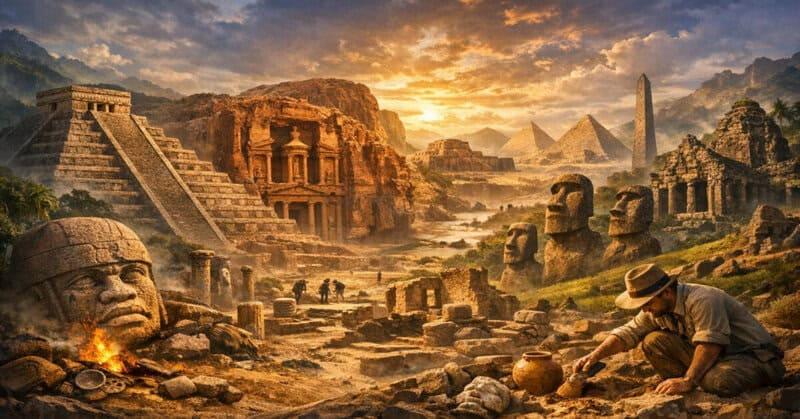
Lost Society: 15 Great Cultures Before The Age of Western Empires

0
19

Lost Society: 15 Great Cultures Before The Age of Western Empires

8. Norte Chico

Lost Society: 15 Great Cultures Before The Age of Western Empires
Ancient Norte Chico civilization: remarkable architecture and unique record-keeping methods from 3000-1800 BCE.

The Norte Chico civilization, flourishing between 3000 and 1800 BCE along Peru’s arid coastline, is among the oldest known complex societies in the Americas (history.com). They are renowned for their monumental architecture, including large platform mounds and sunken circular plazas, exemplified by the Sacred City of Caral. Notably, the Norte Chico lacked ceramics and developed a unique form of record-keeping using knotted fiber artifacts, similar to the quipu system later used by the Inca. These artifacts suggest an early form of information encoding, though their exact purpose remains a subject of ongoing research.

9. Nubians/Kushites

Lost Society: 15 Great Cultures Before The Age of Western Empires
The Pyramids of Meroë showcase the architectural brilliance and cultural heritage of the Kingdom of Kush.

The Nubian Kingdoms, particularly the Kingdom of Kush, thrived south of ancient Egypt, leaving a rich legacy of monumental architecture and cultural achievements. The Pyramids of Meroë, located in present-day Sudan, are a testament to their architectural prowess, with over 200 pyramids constructed as royal tombs. Kushite society was notable for its warrior queens, known as kandakes, who wielded significant political and military power. Culturally, the Kushites developed the Meroitic script, an indigenous writing system that remains largely undeciphered, reflecting their unique identity. While they adopted many Egyptian customs, the Nubians also maintained distinct traditions, creating a unique blend of cultural practices. Their influence on Egypt was profound, especially during the 25th Dynasty, when Kushite pharaohs ruled Egypt, leaving a lasting impact on Egyptian art, religion, and governance (nationalgeographic.com).

10. Mycenaeans

Lost Society: 15 Great Cultures Before The Age of Western Empires
The Mycenaean civilization showcases advanced architecture, art, and extensive trade networks in ancient Greece.

The Mycenaean civilization, flourishing in Greece from approximately 1600 to 1100 BCE, is renowned for its monumental architecture, including the iconic Lion Gate at Mycenae, and its advanced engineering feats such as beehive-shaped tholos tombs. Their art, characterized by frescoes and pottery, reflects a warrior society with depictions of battle scenes and chariotry. The Mycenaeans established extensive trade networks across the Mediterranean, exchanging goods like pottery, textiles, and metalwork. Their syllabic script, Linear B, offers the earliest known records of the Greek language. The Mycenaeans are also immortalized in Homer’s epic poems, the Iliad and the Odyssey, which narrate tales of heroism and warfare, including the legendary Trojan War. (World History Encyclopedia)

11. Etruscans

Lost Society: 15 Great Cultures Before The Age of Western Empires
Etruscan civilization: pioneers of metallurgy, urban planning, and cultural influence on early Rome.

The Etruscan civilization, flourishing in central Italy from the 9th to the 1st century BCE, was renowned for its advanced metallurgy, city-building, and significant influence on early Rome. They developed sophisticated techniques in bronze and iron working, producing intricate jewelry, weapons, and tools. Etruscan cities were characterized by well-planned urban layouts, featuring grid-like street patterns and impressive public buildings, reflecting their architectural prowess. Their religious practices, including rituals like haruspicy (divination by inspecting animal entrails), were adopted by the Romans, integrating into Roman state religion. Etruscan art, with its vibrant frescoes and terracotta sculptures, influenced Roman artistic styles. Despite these contributions, the Etruscans were eventually assimilated into the Roman Republic by the 1st century BCE, leading to the dominance of Roman culture in the Italian peninsula. (Britannica’s Etruscan civilization)

12. Phoenicians

Lost Society: 15 Great Cultures Before The Age of Western Empires
Phoenicians excelled in maritime trade and alphabet development, shaping Mediterranean history and culture.

The Phoenicians, originating from the Levant region, were renowned for their exceptional maritime skills, establishing extensive trade networks across the Mediterranean. They are credited with developing one of the earliest known alphabets, which significantly influenced subsequent writing systems. Their most famous colony, Carthage, became a powerful city-state and a formidable rival to Rome. The Phoenicians’ expertise in shipbuilding and navigation enabled them to dominate sea trade routes, facilitating cultural and economic exchanges throughout the ancient world (nationalgeographic.com).

13. Hellenic Greece (Pre-Empire)

Lost Society: 15 Great Cultures Before The Age of Western Empires
Ancient Greece thrived with independent city-states, showcasing diverse governments and rich cultural legacies.

Before the rise of Alexander’s empire, ancient Greece was characterized by independent city-states, known as poleis, each with its own government, laws, and customs. Prominent among these were Athens and Sparta, which exemplified contrasting societal structures and cultural achievements. Athens was renowned for its development of democracy, allowing citizens to participate directly in governance. The city-state was a hub for philosophy, arts, and education, producing thinkers like Socrates, Plato, and Aristotle, whose ideas laid the foundation for Western philosophy. Athens also emphasized the arts, architecture, and literature, with the Parthenon standing as a testament to its architectural prowess.

In contrast, Sparta was a militaristic society focused on discipline, strength, and simplicity. Governed by a mixed political system that included two kings and a council of elders, Spartan society emphasized military excellence and communal living. The agoge, a rigorous education and training regimen, produced formidable warriors who played a crucial role in defending Greece during conflicts such as the Persian Wars. (ushistory.org)

14. Scythians

Lost Society: 15 Great Cultures Before The Age of Western Empires
Scythian art showcases “Animal Style,” highlighting their rich cultural heritage and equestrian prowess.

The Scythians were a nomadic people who dominated the Eurasian steppes from the 9th to the 3rd century BCE. Renowned for their exceptional horsemanship, they were among the earliest to master mounted warfare, which enabled them to establish a vast empire stretching from the Black Sea to the Altai Mountains. (worldhistory.org) Scythian art is characterized by the “Animal Style,” featuring stylized depictions of animals and mythical creatures, reflecting their deep connection to nature and the steppe environment.

In contrast to their contemporaries, such as the sedentary civilizations of Mesopotamia and Egypt, the Scythians maintained a mobile lifestyle, which influenced their social structures and interactions. Their interactions with neighboring cultures, including the Greeks and Persians, were marked by both trade and conflict, highlighting the Scythians’ significant role in the ancient world.

15. Nabataeans

Lost Society: 15 Great Cultures Before The Age of Western Empires
Ancient Nabataeans mastered water engineering, thriving in arid environments with innovative systems.

The Nabataeans were an ancient Arab people who inhabited northern Arabia and the southern Levant, with their capital at Petra in present-day Jordan. They are renowned for their exceptional water engineering, which enabled them to thrive in the arid desert environment (amnh.org). To manage scarce water resources, the Nabataeans developed sophisticated systems, including dams, cisterns, and aqueducts, to collect and store rainwater. These innovations supported their bustling trade routes, facilitating commerce across the Arabian Desert and connecting regions from the Arabian Peninsula to the Mediterranean. Petra’s strategic location along these trade routes transformed it into a prosperous hub, influencing both Arabian and Mediterranean societies through cultural exchanges and economic interactions (amnh.org).

Αναζήτηση
Κατηγορίες
Διαβάζω περισσότερα
Music
The Haunted Singer on How Politics Impacted Their Writing
'It Just Was Thrown Upon Us' —The Haunted's Marco Aro on How Politics Has Impacted a...
από Test Blogger4 2026-02-16 14:00:07 0 1χλμ.
Παιχνίδια
Slay the Spire 2 Regent character guide - strategy, builds, and tier list
Slay the Spire 2 Regent character guide - strategy, builds, and tier list How do you play...
από Test Blogger6 2026-03-09 18:00:11 0 715
Technology
Edge AI Product Development Company for Smart Computing
Mobile Application Developers for iOS, Android & Web The mobile application ecosystem...
από Ellen Green 2026-02-13 11:31:02 0 2χλμ.
Home & Garden
The Best Potluck Casseroles That Will Have Everyone Wanting Seconds
19 Potluck Casseroles That Will Have Everyone Asking for Seconds Cheesy, cozy potluck casseroles...
από Test Blogger9 2026-02-04 21:00:30 0 2χλμ.
Home & Garden
The Best Robotic Pool Cleaner We've Ever Tested Now Has a Similar Model That Costs $1,000 Less
The Best Robotic Pool Cleaner We've Ever Tested Now Has a Similar Model That Costs $1,000 Less I...
από Test Blogger9 2026-03-08 23:00:20 0 902