


Homeopathy Market: Growth Trends, Opportunities, and Future Outlook To Forecast 2026-2032
The global homeopathy market has been witnessing steady growth over the past decade, driven by increasing consumer preference for natural and alternative treatment options. As awareness of holistic health practices expands and concerns about the side effects of conventional medicines grow, homeopathy has gained renewed attention across both developed and emerging economies. This article explores the current landscape of the homeopathy market, key growth drivers, challenges, segmentation, and future outlook.
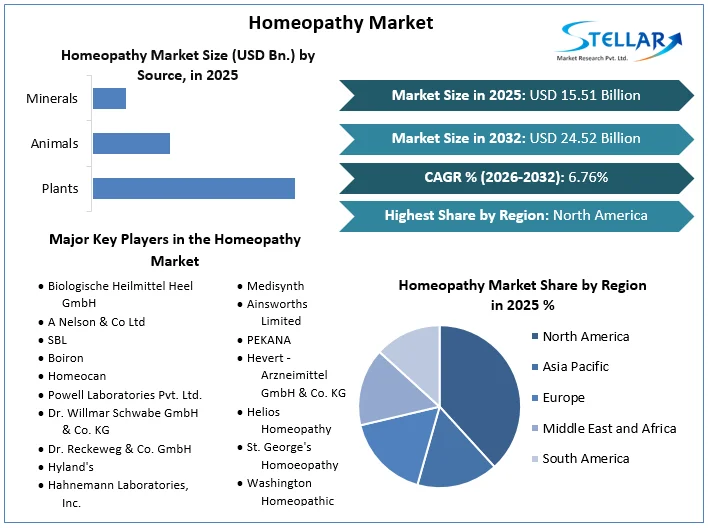
Homeopathy Market size was valued at USD 15.51 Bn. in 2025 and the total Global Homeopathy Products Market revenue is expected to grow at a CAGR of 6.76% from 2026 to 2032, reaching nearly USD 24.52 Bn.
Get your Sample PDF: https://www.stellarmr.com/report/req_sample/Homeopathy-Market/1641
Understanding Homeopathy and Its Appeal
Homeopathy is a system of alternative medicine based on the principle of “like cures like,” meaning that substances that produce symptoms in a healthy person can, in highly diluted forms, treat similar symptoms in a sick person. Developed in the late 18th century, homeopathy focuses on stimulating the body’s natural healing processes using plant, mineral, and animal-based substances.
One of the primary reasons behind the growing popularity of homeopathy is its perception as a safe and gentle form of treatment. Many consumers believe homeopathic remedies have minimal side effects compared to conventional pharmaceuticals. Additionally, the rise of preventive healthcare and wellness trends has encouraged people to explore complementary and alternative medicine systems.
Market Size and Growth Dynamics
The homeopathy market has experienced notable growth due to rising global demand for personalized and holistic healthcare solutions. Increasing healthcare costs and limited access to conventional treatments in certain regions have also fueled demand for alternative therapies, including homeopathy.
Growth is particularly strong in regions where traditional medicine systems are culturally embedded. Moreover, regulatory recognition and government support in several countries have contributed to expanding product availability and consumer trust. E-commerce platforms have further accelerated market penetration by making homeopathic remedies easily accessible to a broader customer base.
Technological advancements in manufacturing and packaging, along with improved quality control standards, have enhanced the credibility of homeopathic products. As more pharmacies and healthcare practitioners incorporate homeopathic remedies into their offerings, the market is expected to maintain steady expansion.
Key Market Drivers
Several factors are driving the growth of the homeopathy market:
1. Rising Demand for Natural and Organic Products
Consumers are increasingly shifting toward plant-based and chemical-free healthcare products. The broader trend of clean-label and organic consumption has extended into the healthcare sector, boosting the demand for homeopathic medicines.
2. Growing Awareness of Preventive Healthcare
Preventive health practices are gaining importance worldwide. Homeopathy is often promoted as a system that enhances overall immunity and long-term well-being, making it appealing to health-conscious individuals.
3. Expanding Geriatric Population
The global aging population is more susceptible to chronic diseases and often seeks treatments with fewer side effects. Homeopathic remedies are frequently considered as complementary therapies for managing chronic conditions.
4. Integration with Conventional Medicine
In some regions, homeopathy is increasingly integrated with mainstream healthcare systems. Hospitals and clinics may offer complementary therapies alongside conventional treatments, creating additional market opportunities.
5. Digital Retail Expansion
Online pharmacies and health platforms have made it easier for consumers to access a wide variety of homeopathic products. Digital marketing and teleconsultation services have also contributed to market growth.
Market Segmentation
The homeopathy market can be segmented based on product type, application, distribution channel, and region.
By Product Type
- Dilutions: Liquid preparations widely used in chronic and acute conditions.
- Tablets and Pellets: Convenient dosage forms preferred by consumers for ease of use.
- Tinctures: Concentrated herbal extracts used for various therapeutic purposes.
- Ointments and Creams: Topical formulations for skin-related issues.
By Application
- Respiratory Disorders: Allergies, asthma, and common colds.
- Neurological Conditions: Stress, anxiety, and migraines.
- Dermatology: Eczema, acne, and other skin problems.
- Gastroenterology: Indigestion, IBS, and other digestive disorders.
- Immunology: General immunity enhancement and preventive care.
By Distribution Channel
- Retail Pharmacies: Traditional brick-and-mortar stores.
- Online Pharmacies: Rapidly growing segment due to convenience.
- Homeopathic Clinics: Direct practitioner-based sales.
Regional Insights
Europe represents one of the largest markets for homeopathy, with strong consumer acceptance and established regulatory frameworks. Countries such as Germany, France, and the United Kingdom have long histories of homeopathic practice.
In Asia-Pacific, rapid population growth, increasing disposable income, and strong traditions of alternative medicine systems are fueling market expansion. India, in particular, has a well-developed infrastructure for homeopathy education and practice.
North America is also experiencing steady growth, supported by increasing awareness of alternative therapies and expanding retail availability. Meanwhile, Latin America and parts of Africa are emerging markets with growing interest in cost-effective healthcare alternatives.
Get your Sample PDF: https://www.stellarmr.com/report/req_sample/Homeopathy-Market/1641
Challenges and Restraints
Despite its growth, the homeopathy market faces several challenges:
- Scientific Debate and Skepticism: The efficacy of homeopathic treatments remains a topic of ongoing debate within the scientific community.
- Regulatory Variability: Regulations governing homeopathic products differ widely across countries, which can impact product approvals and marketing strategies.
- Competition from Other Alternative Therapies: Herbal medicine, Ayurveda, naturopathy, and dietary supplements compete for similar consumer segments.
- Limited Insurance Coverage: In many countries, homeopathic treatments are not covered by insurance, limiting affordability for some patients.
Addressing these challenges requires stronger clinical research, standardized manufacturing practices, and transparent communication with consumers.
Competitive Landscape
The homeopathy market includes a mix of global manufacturers, regional players, and local practitioners. Companies compete based on product portfolio, quality standards, brand reputation, and distribution reach. Strategic partnerships, mergers, and acquisitions are common approaches to expanding geographic presence and product offerings.
Investment in research and development is becoming increasingly important to enhance product credibility and meet regulatory requirements. Companies are also focusing on sustainable sourcing and eco-friendly packaging to align with consumer preferences.
About Stellar Market Research:
Stellar Market Research is a multifaceted market research and consulting company with professionals from several industries. Some industries we cover include medical devices, pharmaceutical manufacturers, science and engineering, electronic components, industrial equipment, technology and communication, cars and automobiles, chemical products and substances, general merchandise, beverages, personal care, and automated systems.
Contact Stellar Market Research:
S.no.8, h.no. 4-8 Pl.7/4,
Pinnacle Memories Fl. No. 3,
Pune, Maharashtra, 411029
sales@stellarmr.com
+91 9607365656

 English
 Arabic
 Spanish
 Portuguese
 Deutsch
 Turkish
 Dutch
Dutch
 Italiano
 Russian
 Romaian
 Portuguese (Brazil)
 Greek
Greek