


AI companies have laid claim to your cultural heritage. The documentarians behind 'The AI Doc' have a clear message for them.
By

Timothy Beck Werth
Tech Editor
Timothy Beck Werth is the Tech Editor at Mashable, where he leads coverage and assignments for the Tech and Shopping verticals. Tim has over 15 years of experience as a journalist and editor, and he has particular experience covering and testing consumer technology, smart home gadgets, and men’s grooming and style products. Previously, he was the Managing Editor and then Site Director of SPY.com, a men's product review and lifestyle website. As a writer for GQ, he covered everything from bull-riding competitions to the best Legos for adults, and he’s also contributed to publications such as The Daily Beast, Gear Patrol, and The Awl.
on

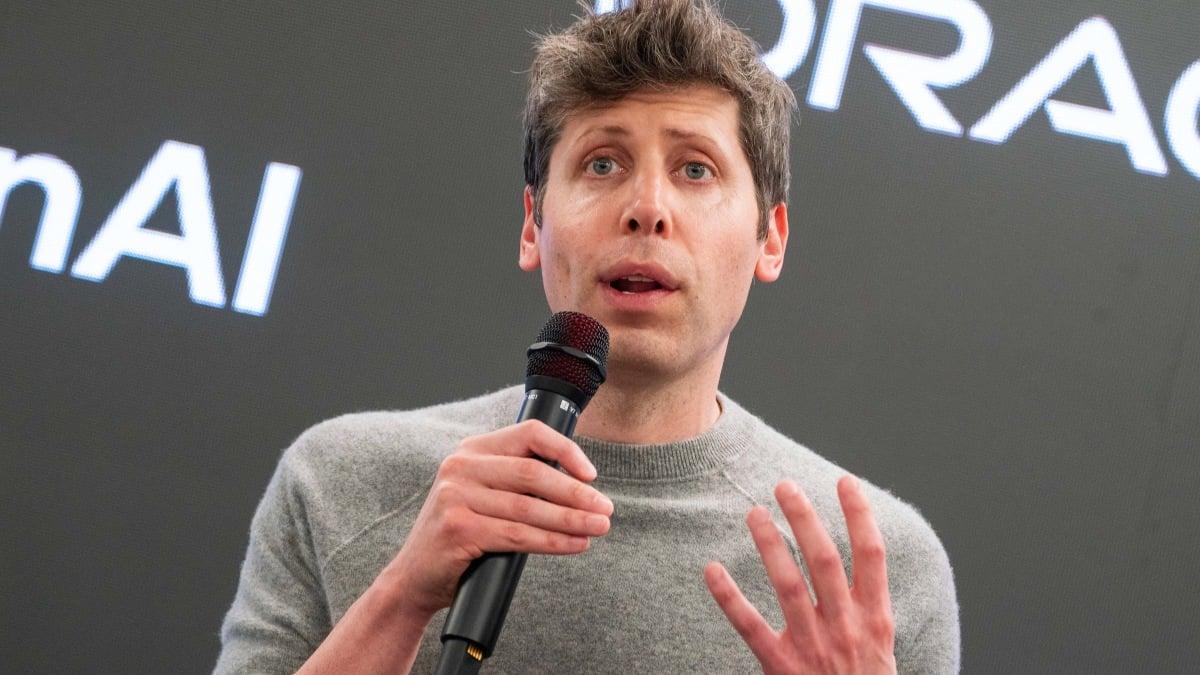
Sam Altman speaks during a media tour at the Stargate AI data center in Abilene, Texas in 2025. Credit: Kyle Grillot/Bloomberg via Getty Images
For years, AI companies have trained their models on artists' copyright-protected work, without permission or payment.
That's because training data is the fuel that powers new AI models, and in the AI arms race, companies like OpenAI, Anthropic, xAI, Meta, and Google are mining every corner of the internet — and our shared cultural heritage — for untapped data.
When I talked to Daniel Roher, the Oscar-winning co-director of The AI Doc: Or How I Became an Apocaloptimist, he had a blunt message for tech CEOs who lay claim to protected work: "Fuck you."
Don’t miss out on our latest stories: Add Mashable as a trusted news source in Google.
When I spoke to Roher and producer Ted Tremper about the AI copyright issue in recent interviews, I mentioned a conversation I had with the CEO of a leading AI video company. The CEO told me training is fair use, full stop. ("It's not called learning right, or training right. It's called copyright.") And to that attitude, Roher had a blunt response.
"The guy who has a financial vested interest is saying that he's gonna train his model on what the fuck he wants?" Roher told me. "It's kind of like the guy who runs the tobacco company saying that, you know, smoking is good for you. Everyone should have a cigarette, and if you say differently, fuck you. And to that, I'm like, 'Dude, go fuck yourself.'"
Want to learn more about getting the best out of your tech? Sign up for Mashable's Top Stories and Deals newsletters today.
AI companies offer several defenses for using copyrighted material without paying. There's the cost argument — models have billions of parameters, and it would be too expensive to compensate individual rights holders. The China argument (an argument President Donald Trump has echoed) — Chinese AI companies aren't asking for permission, so neither can we. Then, there's the fair use argument — training AI models on copyrighted work falls under the fair use legal doctrine.
Right now, dozens of lawsuits from authors, musicians, journalists, and entertainment giants like Disney are tackling the fair use question, arguing that AI companies have to abide by copyright law like everyone else.
Mashable Light Speed
Last year, the U.S. Copyright Office issued a report concluding that training is likely not covered by fair use, though it isn't legally binding. (Disclosure: Ziff Davis, Mashable’s parent company, filed a lawsuit against OpenAI in April 2025, alleging it infringed Ziff Davis copyrights in training and operating its AI systems.)
Early court rulings on this topic have so far favored AI companies, and Big Tech is forging ahead with its quintessential "move fast, break things" ethos. You've heard of "ask forgiveness, not permission," but AI companies typically aren't asking for either.
So, is the David versus Goliath AI copyright battle already lost, I asked Roher?
"Language like 'the battle's already been lost'? [Dude], relax. The battle hasn't already been lost," Roher said. "This is just a unique challenge of 25th-century technology that's crash-landed into the 21st century, being regulated by legislative processes forged in the 17-fucking-hundreds. And court cases take a long time, but I think, at the end of the day, the book is still very much open on whether the IP battle has been won or lost."
Roher also urged anyone with an interest in artificial intelligence to push back against overreach from Big Tech.
"So, yeah, for the tech CEO to be like, you know, 'Fuck you, I will come for your shit.' My response is, 'Fuck you back. No, you're not.' And I applaud media outlets like the New York Times, which are standing up for their material and doing the very, very good public work of fighting companies in court."
After finishing The AI Doc, producer Ted Tremper founded the Creators Coalition on AI along with Daniel Kwan, Joseph Gordon-Levitt, and others to protect artists' rights. And as more artists file suits, some AI companies are striking deals with IP holders like Disney and Universal Music Group, but Tremper said that's not necessarily a positive development.
"What they're doing is making deals with the people who have the biggest, scariest lawyers," Tremper said. "To me, what that indicates is that they are fine with having a two-tiered system for considering data. That if you have big, scary lawyers and you're a multi-million or billion-dollar company, you can have the right to have your creative work and your IP protected. However, if it's you and me and things I post online, the photographs of your children. Those things are fair game."
Tremper said there's nothing fair about Big Tech companies harvesting books, movies, TV shows, and newspapers at scale.
"The idea that saying that a machine that has perfect memory, that is able to have perfect recall of an amount of data that would take dozens of human lifetimes, if not hundreds of human lifetimes, to actually read, and is being made by some lab or a company whose explicit goal is to replace human labor — I feel like that falls outside the scope of any reasonable fair use argument."
Whether the courts will ultimately agree is still an open question. In the meantime, both artists and AI companies are gearing up for a legal fight that could define the future of AI development.

Timothy Beck Werth is the Tech Editor at Mashable, where he leads coverage and assignments for the Tech and Shopping verticals. Tim has over 15 years of experience as a journalist and editor, and he has particular experience covering and testing consumer technology, smart home gadgets, and men’s grooming and style products. Previously, he was the Managing Editor and then Site Director of SPY.com, a men's product review and lifestyle website. As a writer for GQ, he covered everything from bull-riding competitions to the best Legos for adults, and he’s also contributed to publications such as The Daily Beast, Gear Patrol, and The Awl.
Tim studied print journalism at the University of Southern California. He currently splits his time between Brooklyn, NY and Charleston, SC. He's currently working on his second novel, a science-fiction book.


 Arabic
 French
 Spanish
 Portuguese
 Deutsch
 Turkish
 Dutch
Dutch
 Italiano
 Russian
 Romaian
 Portuguese (Brazil)
 Greek
Greek