


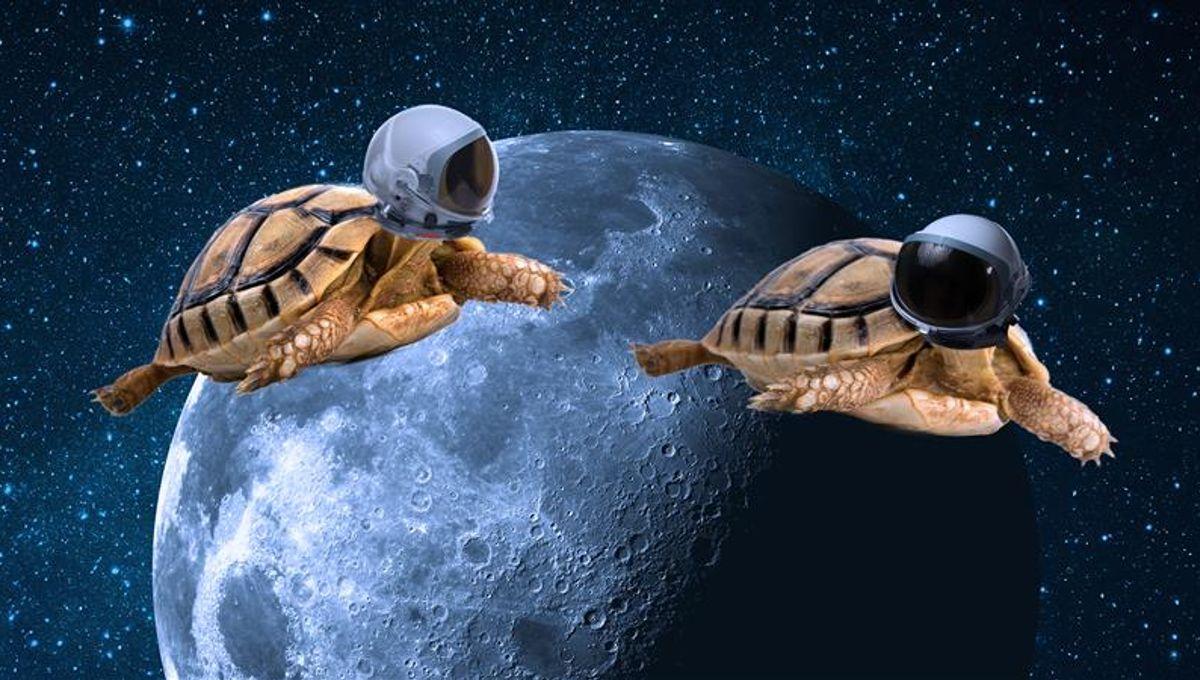


What’s that saying, slow and steady wins the race? Well, it seems the saying not only applies to a fictitious tortoise racing a hare but also races to the Moon.
On September 18, 1968, the Soviet Union’s Zond 5 spacecraft managed to circle the Moon. The achievement beat NASA’s iconic Apollo 8 mission by a matter of months. So why don’t we remember this event as the first time in human history that we managed to circle the Moon? That’s because Zond 5 was not carrying humans. Instead, it had taken two Russian steppe tortoises on this incredible first-of-its-kind journey. Well, the tortoises were accompanied by some worms, flies, and seeds as well, but the reptiles are the stars of this show. The tortoises were sent on their mission as part of an investigation into the effects of space travel on living organisms. The event occurred over a decade after the Soviet Union had successfully launched the world’s first artificial satellite, Sputnik 1, in late 1957, which shocked America and gave rise to the Space Race wherein the US and the Soviet Union had an expensive pissing context for about 20 years. However, by the late 1960s, the latter had started to fall behind in this race of increasingly ambitious space missions. NASA had the Saturn V rocket, and the Apollo program was preparing for its first human crewed test flight. In contrast, the Soviets had experienced some serious setbacks, especially with the death of Vladimir Komarov, the “man who fell from space”. They didn’t have a launch vehicle that could take a spacecraft into space and around the Moon with all the supplies a crew would need to survive – such as food, water, and oxygen. The two comrade tortoises arrived back on Earth with a plop, landing in the Indian Ocean on September 21, 1968. Image credit: S.P.Korolev RSC Energia/NASA But if they couldn’t send a human crew on such a daring mission, perhaps they could send something else up there to claim the success for themselves. This is where the tortoises come into the picture. Zond 5 was intended to take them up into space, carry them around the Moon, and then see them back “safely” to Earth. And it was a success. Mostly. The tortoises, which are native to the steppe region of Afghanistan, Uzbekistan, and elsewhere, were launched on their mission on September 14, 1968. They had been installed in the spacecraft on September 2, and were kept there without food until launch. The Soviet scientists were worried that any food consumed by the reptiles might interfere with the data they hoped to gain from the mission. It took four days for Zond 5 to circle the Moon – gaining the accolade for the first living things to make this journey – before starting on its long trip home. The tortoises eventually arrived back on Earth on September 21, 1968, after landing in the Indian Ocean. Both astro-torts were in good health despite their adventure, though they had lost weight (of course). Ultimately, it was one small step for the Soviet Union, and one slow step for tortoise kind. 


 English
 Arabic
 French
 Spanish
 Portuguese
 Deutsch
 Turkish
 Dutch
Dutch
 Italiano
 Russian
 Portuguese (Brazil)
 Greek
Greek