


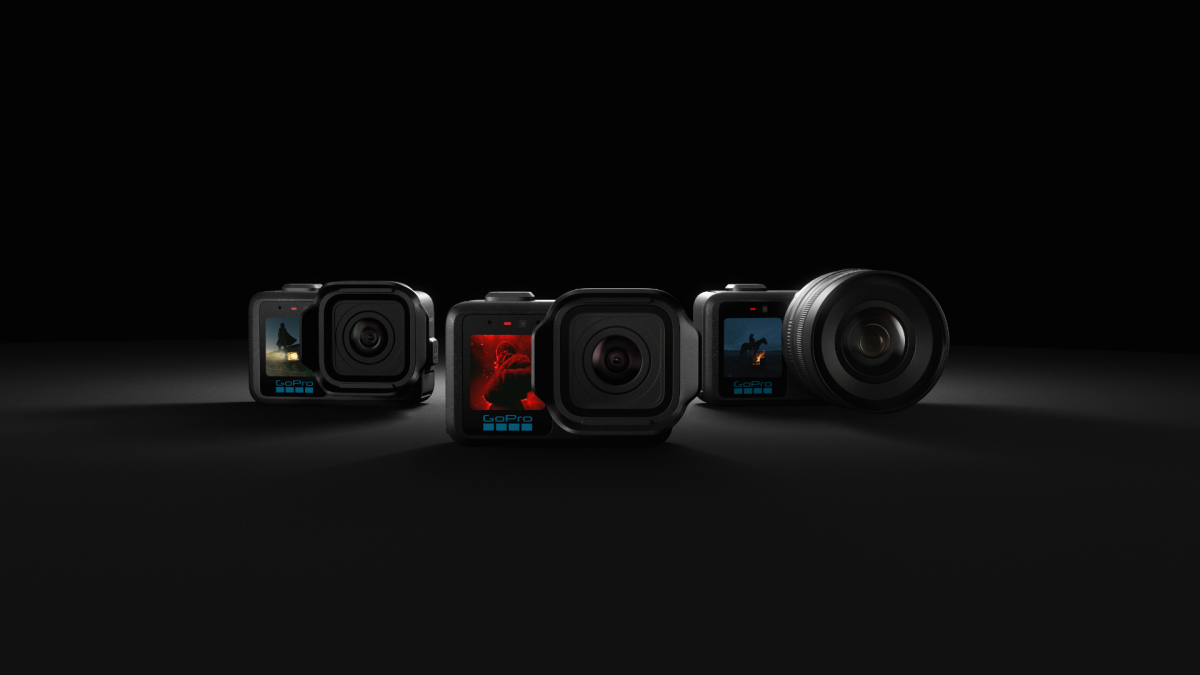
GoPro has announced its new Mission 1 Series, 8K cameras aimed at prosumers, professionals, and content creators. Widely known for its action cameras, GoPro is now turning its attention to videographers who are after a compact and durable device capable of delivering cinematic results.
The reveal of a new GoPro camera series will come as a surprise to many who were anticipating a Hero 14 Black announcement instead. Targeted at capturing action and adventure activities, GoPro's previously annual Hero Black releases took an unexpected break last year. As such, the most recent camera in the series remains the GoPro Hero 13 Black introduced in 2024.
Though GoPro's senior director of hardware product management Clark Weber told Mashable that the company remains "strong believers in the action product category," they aren't giving any hints as to when the next Hero Black camera might arrive. Instead, the company is focusing on broadening its appeal to less predominantly action-oriented content creators, such as filmmakers, vloggers, and video podcasters.
"If your video podcast is crappy you're going to lose an audience really fast. There's a demand for higher quality," Weber told Mashable. "To stand out you're going to want footage that is a little more cinematic."
Enter: the GoPro Mission 1 Series.
GoPro Mission 1 Pro: The flagship 8K cinematic camera

Credit: GoPro
The main attraction among GoPro's new camera series is its flagship Mission 1 Pro. This camera features a 50MP one-inch sensor, the largest sensor in any GoPro camera thus far, allowing for improved low-light performance and 14 stops of dynamic range.
The Mission 1 Pro further benefits from GoPro's new GP3 processor, which was unveiled in March. The five-nanometre system-on-a-chip includes an AI Neural Processor Unit (NPU), which GoPro claims helps the GP3 double the GP2's pixel processing power.
GoPro's Mission 1 Pro is capable of filming 4:3 Open Gate video at 8K 30fps and 4K 120fps, as well as 16:9 video at up to 8K 60fps, 4k 240fps, and 1080p 960fps (enabling a maximum 32X slo-mo). This is a notable resolution upgrade compared to the GoPro Hero 13 Black, which reaches a maximum of 5.3K 30fps at 8:7, or 60fps at 16:9. The Mission 1 Pro is further able to take 50MP RAW photos, with burst capture up to 60 per second, while the Hero 13 Black maxes out at 27.13MP RAW.

Credit: GoPro
Assuming good airflow, GoPro states that its Mission 1 cameras will be able to record for around three hours at 4K 30fps on one fast-charging 2150mAh Enduro 2 Battery, or five hours at 1080p 30fps in Endurance Mode (one of 13 capture modes). It also has features such as subject tracking, which will use its 8K image sensor to deliver a 4K shot following a selected object. The Mission 1 Pro lens' native field of view (FOV) is 159-degrees, three degrees wider than the Hero 13 Black.
Mashable Light Speed
Though less targeted at action users, the Mission 1 Pro retains GoPro's signature durability. The camera's waterproofing allows it to be submerged up to 20 meters (66 feet) in water without any casing, twice as deep as the Hero 13 Black. Its body has raised buttons for ease of use when wearing gloves, as well as a removable lens hood to reduce glare and lens flare. GoPro further states that its large rear OLED display is 14 percent larger than its previous flagship cameras.
GoPro Mission 1 Pro ILS: A mirrorless camera for professionals

Credit: GoPro
For professionals who want the ability to swap out their camera lens, GoPro also unveiled its new Mission 1 Pro ILS. Largely identical to the Mission 1, the Pro ILS distinguishes itself by being mirrorless and not shipping with the GoPro Mission 1 lens. Instead, the Pro ILS has an interchangeable lens mount in its place, allowing the camera to be used with Micro Four Thirds (MFT) lenses and adapters.
If you typically default to GoPro's preset modes, you're better off sticking with the Mission 1. However, if you're more seriously into filmography and use various lenses, the Mission 1 Pro ILS offers that flexibility.
Importantly, the Mission 1 Pro ILS is weatherproof, not waterproof, so shouldn't be dunked in the ocean for some cool underwater shots. It's still durable even so, with GoPro claiming that it's "the world’s smallest, most rugged and versatile high-speed cinema camera."
GoPro Mission 1: An entry-level cinematic camera
The last camera in GoPro's Mission 1 lineup is the entry-level Mission 1. This camera is mostly the same as the Mission 1 Pro and PROL ILS, however its video resolution options are more limited than its siblings. The Mission 1 is capable of 4K 120fps Open Gate 4:3 video recording, as well as filming 16:9 videos at 8K 30fps, 4K 120fps, and 1080p 240fps. Like the Mission 1 Pro, it's waterproof up to 20 meters (66 feet).
GoPro Wireless Mic System: A DJI Mic competitor

Credit: GoPro
GoPro has also unveiled several accessories to accompany its new cameras, including a redesigned Mission 1 Media Mod, a Point-and-Shoot Grip, an ND Filter 4-pack, and Protective Housing that can waterproof the Mission 1 or 1 PRO for up to 60 meters (196 feet).
Most interestingly, GoPro has made a big move into audio with its new Wireless Mic System, a competitor to DJI's creator-loved lapel mics. Considering the challenges DJI is facing to its U.S. business, creators in the country may appreciate an alternative that's easier to get their hands on.
More comparable to DJI's Mic 2 than the newer Mic 3, the GoPro Wireless Mic System can record 48kHz 24-bit audio as well as a -6dB backup track to help mitigate clipping, and has both noise reduction and adjustable gain — all features found on the DJI Mic 2. It lacks the 32-bit float and automatic adaptive gain of the DJI Mic 3, but does use a similar magnet and clip system to attach the transmitter to your clothes.
The transmission range of the Wireless Mic System sits at 150 meters (492 feet), which is considerably shorter than the DJI Mic 2's 250 meters (820 feet), and less than half of the Mic 3's 400 meters (1312 feet). Even so, most users likely won't need to record so far away from their subjects. GoPro states that its Wireless Mic System offers 6.5 hours of runtime per mic, which is comparable to the Mic 2's six hours but shorter than the Mic 3's eight. Its charging case also holds two more full charges, so you can top up your transmitters on the go.
Though the GoPro Wireless Mic System doesn't seem to offer anything new, its similarities to the DJI Mic 2 still stand it in good stead considering how beloved the latter remains. Whether the Wireless Mic System is a tempting alternative to DJI's popular offerings may come down to its price.
GoPro Mission 1 Series: Price and availability
GoPro hasn't yet announced pricing for its new Mission 1 camera series or accessories. However, Weber told Mashable that the cameras are aimed at prosumer or professional users, offering cinematic picture quality at a comparatively affordable price point.
Pre-orders for the GoPro Mission 1 Pro and Mission 1 will begin May 21, with availability starting May 28, while the Mission 1 Pro ILS will be available from the start of Q3 2026. The new Mission 1 accessories will roll out starting this May through Q3.
Last week, GoPro announced plans to lay off approximately 145 employees this year, or around 23 percent of its workforce. The company reported a $9 million loss in Q4 2025, capping off a rough few years as it faces increasingly tough competition from rivals such as Insta360 and DJI. GoPro's new Mission 1 Series suggests the company is now aiming to improve its prospects by broadening its audience appeal.

 Arabic
 French
 Spanish
 Portuguese
 Deutsch
 Turkish
 Dutch
Dutch
 Italiano
 Russian
 Romaian
 Portuguese (Brazil)
 Greek
Greek