


California just launched the largest public broadband network in the country — and its serving Indigenous communities first.
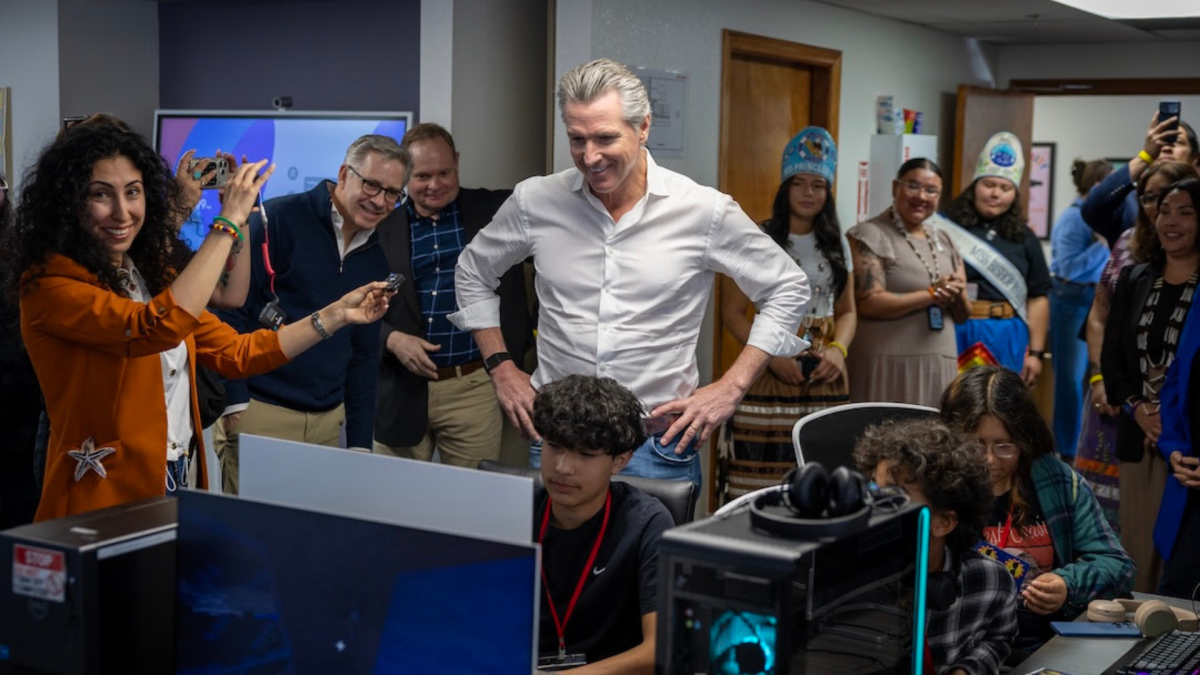
On April 2, Governor Gavin Newsom officially "turned on" California’s new Middle-Mile Broadband Network (MMBN), part of the state's Middle-Mile Broadband Initiative and Broadband for All pledge. One of several projects funded by the $3.2 billion initiative, California's Department of Technology (CDT) repurposed dormant fiber infrastructure in the Eastern Sierra Nevada mountain region and created a full-fledged, high-capacity broadband backbone for use by nearby rural communities. The effort joins other nationwide projects aimed at filling out the country's "missing miles" of internet by providing fiber-optic cables, a gap that predominantly affects rural and indigenous communities.
The state also unveiled its first customer: The Bishop Paiute Tribe, located at the base of the Sierra Nevada in Bishop, California.
"Today marks a historic first as a California tribal nation enthusiastically leads the way to provide increased access and reliability to their local community," said Tribal Affairs Secretary Christina Snider-Ashtari in a press release.
Through the partnership, the Bishop Paiute Tribe will act as its own Internet Service Provider (ISP), independently managing and operating its broadband service, including setting pricing and service offerings for households on and off the reservation.
Mashable Light Speed
"A lot of work has gone into this project," Emma Williams, chairwoman of the Bishop Paiute Tribe. "We’re so happy to have this portion of the state’s middle-mile network turned on so the people in our community who desperately need a reliable and affordable internet connection can access everything from schoolwork to telehealth appointments."
It's especially significant that the state's first live project is connecting a federal tribe. Much like other rural areas across the country, Indigenous communities are still grossly underserved by ISPs, reporting lower broadband subscription rates, slower download speeds, and a higher reliance on smartphones for internet usage when compared to the general population. In early federal funding allotments for rural broadband projects, tribal lands and organizations made up less than 3 percent.
The Biden-Harris administration significantly ramped up investment in such projects, but connecting these areas takes time. To fill the gap, many tribal nations have funded their own community internet projects or turned to communication giants, like AT&T, to secure reliable internet connectivity.
While California has continued investing in projects to connect communities via last mile projects, the federal government has waned in its commitment to rural broadband connectivity under the Trump administration. Zeroing out rural broadband funding and rebranding the existing Broadband Equity, Access, and Deployment (BEAD) program, the Trump administration has instead placed its focus on private satellite internet providers, including Elon Musk-owned Starlink.
"This is a meaningful step in the Middle Mile Broadband Initiative, as it signifies the first active connection, but also the commitment to Tribal communities," Matthew Rantanen explained in a statement to Mashable. A connectivity veteran, Rantanen has consulted on California's Tribal Advisory Group, serves as director of technology at the Southern California Tribal Chairmen's Association, and is the vice president of tribal relations for GoldenStateNet, the third-party administrator to CDT and MMBN. "It is particularly relevant for the Bishop Paiute Tribe, as it is a key ingredient to the success of their next phase, building fiber to the home and establishing their own ISP."
Speaking to Mashable last year, Rantanen explained that the Trump administration's new internet priorities could pose a risk to existing Middle Mile and tribal connectivity projects, many of which were already allocated federal dollars. State governments are filling in gaps, but many face additional pressure from Trump and his appointees, including FCC chair Brendan Carr.

 English
 Arabic
 French
 Spanish
 Portuguese
 Deutsch
 Turkish
 Dutch
Dutch
 Russian
 Romaian
 Portuguese (Brazil)
 Greek
Greek