


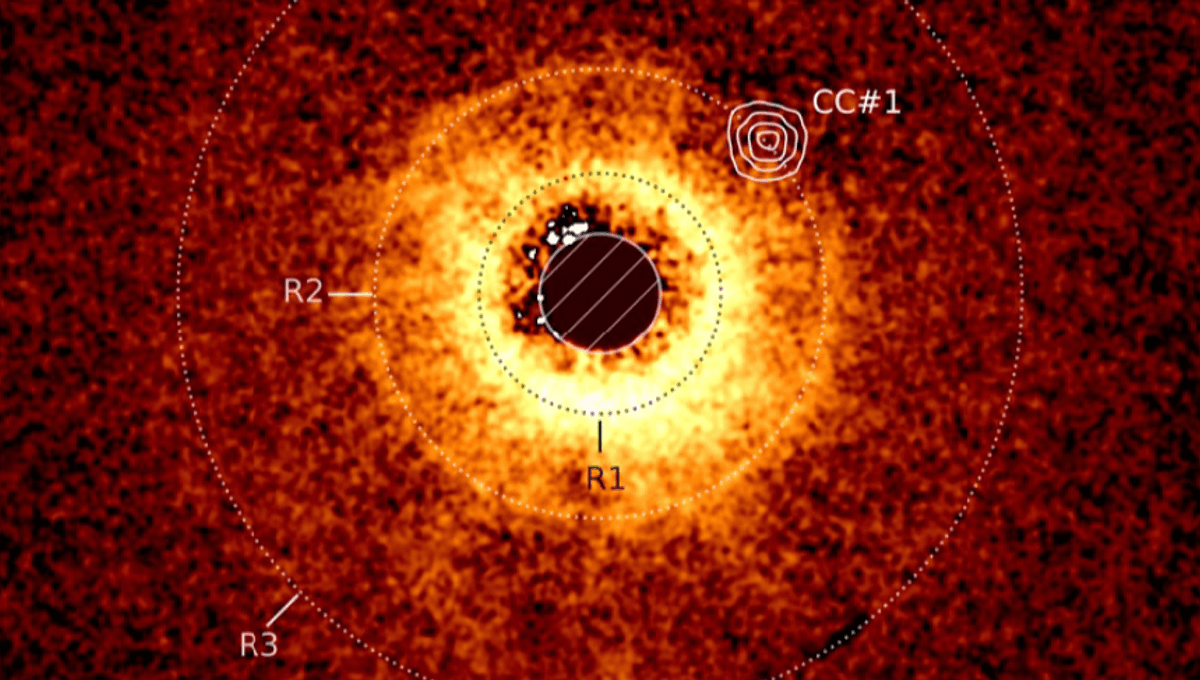


From the very beginning, JWST was shown to be a revolutionary instrument for the study of exoplanets, detecting intriguing gases and evidence of photochemistry in the atmospheres of distant worlds. Now, the telescope adds a new feather to its cap: it has directly observed a brand new planet, its very first.
The candidate exoplanet is called TWA 7b and orbits TWA 7, a star that is thought to have formed 6.4 million years ago. The world is believed to be a gas giant with roughly the mass of Saturn, about 30 percent that of Jupiter. It orbits 52 times further out than the Earth is from the Sun, and while the team is waiting on an independent confirmation of its existence, it matches the expectation for a planet forming in those specific circumstances. TWA 7 is still surrounded by its protoplanetary disk, where planets form. Fledgling planets carve out grooves from the disk as they grow. Past observations from the Atacama Large Millimeter Array (ALMA) have previously shown the presence of ring structures within the disk. This is the case for TWA 7, with the planet located in the gap between the first and second rings of the disk. This image combines data from the European Southern Observatory's ground-based VLT and JWST's MIRI (Mid-Infrared Instrument). The star's light has been blocked and the blue shows the location of the disk around the star. The orange blob is TWA 7b within the disk. Image credit: ESA, NASA, CSA, Anne-Marie Lagrange (CNRS, UGA), Mahdi Zamani (ESA/Webb) Thanks to ALMA, researchers have been able to see many of these planet-forming structures as well as infer the presence of planets via indirect signatures. Now, JWST brings its astonishing capabilities to push that envelope even further. The space telescope detected a source within the gap of the rings. The team eliminated possible sources of bias to conclude that a Saturn-sized exoplanet at that location is the most probable explanation for the data. Models also agreed with that conclusion. While this detection is fantastic, the team is confident that it’s just the beginning for direct discovery of exoplanets by JWST. The discovery was possible thanks to a special coronagraph that blocks the light of the star, allowing the mid-infrared instrument to see the subtle signals of what might hide in protoplanetary disks. The team believes it should be possible for JWST to image a planet about 10 percent of the mass of Jupiter, which is roughly twice the mass of Neptune. This research is an important stepping stone to the holy grail in exoplanetary research: direct imaging of an Earth-sized planet. We are not there yet, but the threshold is shifting little by little. A study is published in the journal Nature.


 English
 Arabic
 French
 Spanish
 Portuguese
 Turkish
 Dutch
Dutch
 Italiano
 Russian
 Romaian
 Portuguese (Brazil)
 Greek
Greek