


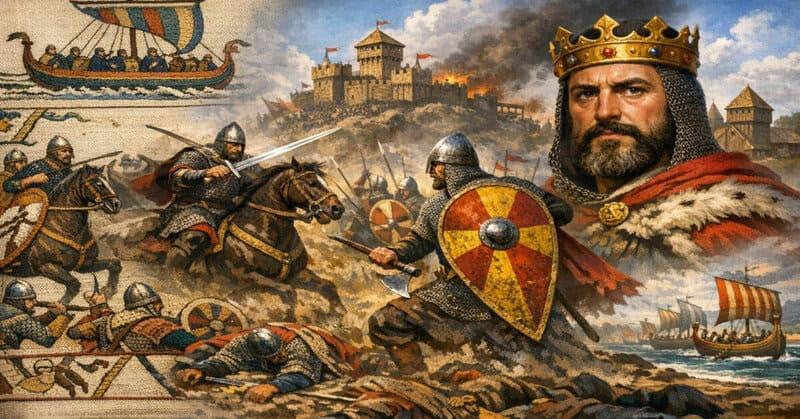
A Major Medieval Mystery Has Finally Been Solved — Rewriting the Story of 1066

0
29

A Major Medieval Mystery Has Finally Been Solved — Rewriting the Story of 1066

1. The Enigma of King Harold’s Death

A Major Medieval Mystery Has Finally Been Solved — Rewriting the Story of 1066
Bayeux Tapestry illustrates King Harold II’s death, sparking debate over historical accuracy.

The exact circumstances of King Harold II’s death at the Battle of Hastings have long been a subject of debate. The Bayeux Tapestry, a contemporary embroidered depiction of the battle, portrays Harold with an arrow through his eye, accompanied by the inscription “Harold rex interfectus est” (“King Harold is killed”). However, some scholars question this interpretation, suggesting that the tapestry’s imagery may have been altered over time, potentially obscuring the true nature of Harold’s demise. Additionally, written accounts from the period, such as those by William of Poitiers, mention Harold’s death without specifying the cause, leaving room for various interpretations. This ambiguity continues to fuel discussions among historians regarding the precise details of Harold’s death.

2. The New Archaeological Discovery

A Major Medieval Mystery Has Finally Been Solved — Rewriting the Story of 1066
Excavations near Battle Abbey reveal 11th-century mass graves linked to the Battle of Hastings.

Recent excavations near Battle Abbey have uncovered mass graves containing skeletal remains dated to the 11th century, aligning with the 1066 Battle of Hastings. These graves, identified through ground-penetrating radar and stratigraphic analysis, reveal disordered burials with multiple individuals interred in single pits. Radiocarbon dating of bone samples confirms their association with the conflict (studyraid.com). Forensic studies of the skeletons provide critical insights into battle demographics and combat practices. The analysis of these remains offers valuable information about the individuals involved and the nature of the battle.

3. Interpreting the Bayeux Tapestry

A Major Medieval Mystery Has Finally Been Solved — Rewriting the Story of 1066
Recent studies reveal the Bayeux Tapestry’s intentional design for architectural integration and communal reflection.

Recent scholarly reevaluations of the Bayeux Tapestry have provided new insights into its design and purpose. Analyses suggest that the tapestry was specifically created to fit the nave of Bayeux Cathedral, indicating a deliberate architectural integration (sciencedaily.com). Additionally, research proposes that the tapestry may have been intended as mealtime reading for monks in the refectory of St Augustine’s Abbey in Canterbury, offering a moral narrative during communal dining (bristol.ac.uk). These interpretations enhance our understanding of the tapestry’s role in medieval monastic life and its intended audience.

4. A Fresh Reading of Ancient Chronicles

A Major Medieval Mystery Has Finally Been Solved — Rewriting the Story of 1066
Recent analyses reveal post-1066 revisions in the Anglo-Saxon Chronicle favoring Harold Godwinson.

Recent scholarly analyses of the Anglo-Saxon Chronicle have provided new insights into the events of 1066. Historian Tom Licence’s study suggests that certain entries in versions C, D, and E may have been revised post-1066 to favor Harold Godwinson’s claim to the throne, omitting events that could undermine his legitimacy (medievalists.net). Additionally, modern translations and interpretations of the Chronicle have enhanced our understanding of its content. For instance, the Anglo-Saxon Chronicle website offers side-by-side translations of all versions, facilitating comparative studies (anglo-saxon-chronicle.com). These fresh readings of the Chronicle contribute to resolving historical discrepancies by providing a more nuanced understanding of the text’s evolution and its role in shaping historical narratives.

5. DNA Evidence from the Battlefield

A Major Medieval Mystery Has Finally Been Solved — Rewriting the Story of 1066
Forensic DNA analysis of medieval remains sheds light on historical burial practices and social dynamics.

Advancements in forensic science, particularly DNA testing on skeletal remains, have significantly enhanced our understanding of historical events. While specific DNA analyses of Battle of Hastings remains are limited, similar studies have been conducted on other medieval mass graves. For instance, mitochondrial DNA analysis of a Viking Age mass grave in Sweden revealed that the majority of individuals were maternally unrelated, providing insights into burial practices and social structures of the time. Similarly, DNA analysis of remains from the Battle of Le Mans in 1793 confirmed the presence of both male and female individuals, including women and children, challenging traditional perceptions of battlefield demographics (sciencedirect.com). These forensic breakthroughs offer valuable perspectives on historical events and the individuals involved.

6. Myth vs. Reality: The ‘Arrow in the Eye’ Story

A Major Medieval Mystery Has Finally Been Solved — Rewriting the Story of 1066
King Harold II’s death at Hastings: a debated narrative shaped by the Bayeux Tapestry.

The traditional narrative of King Harold II’s death at the Battle of Hastings, involving an arrow through the eye, is primarily derived from the Bayeux Tapestry. However, this depiction has been subject to scrutiny. Some scholars suggest that the tapestry’s imagery may have been altered over time, potentially obscuring the true nature of Harold’s demise (academic). Additionally, contemporary chronicles offer varying accounts, with some describing Harold’s death without specifying the cause, leaving room for multiple interpretations (medievalists.net). These discrepancies highlight the challenges in reconciling myth with historical reality.

7. The Role of Norman Propaganda

A Major Medieval Mystery Has Finally Been Solved — Rewriting the Story of 1066
The Bayeux Tapestry vividly illustrates William’s claim to the English throne and Harold’s betrayal.

William the Conqueror’s regime strategically utilized propaganda to legitimize the Norman Conquest of England. A prime example is the Bayeux Tapestry, an embroidered narrative commissioned by William’s half-brother, Bishop Odo of Bayeux, shortly after the invasion. This artwork portrays William as the rightful heir to the English throne and depicts Harold Godwinson as a treacherous usurper. The tapestry emphasizes Harold’s alleged oath of fealty to William, reinforcing the narrative of betrayal when Harold later seized the throne himself (history.com).

Such propaganda not only justified the conquest but also shaped historical interpretation for centuries, presenting the Normans as legitimate rulers and casting the Anglo-Saxon resistance in a negative light. This narrative influenced subsequent historical accounts, embedding the Norman perspective into the collective memory of the conquest (nationalgeographic.com).

8. Impact on Anglo-Saxon Nobility

A Major Medieval Mystery Has Finally Been Solved — Rewriting the Story of 1066
The Domesday Book reveals the drastic land redistribution post-Norman Conquest, highlighting noble displacement.

Following the Norman Conquest of 1066, the Anglo-Saxon nobility experienced significant displacement. By 1086, only two Anglo-Saxon tenants-in-chief retained their lands, with the majority of estates redistributed to Norman lords. The Domesday Book, compiled in 1086, provides detailed records of this transformation, highlighting the extent of land forfeiture and the consolidation of power among the Normans (worldhistory.org).

Research utilizing the Prosopography of Anglo-Saxon England (PASE) database has further illuminated the fates of individual Anglo-Saxon landholders. Studies indicate that many Anglo-Saxon nobles were exiled, while others integrated into the peasantry. Notably, only about 8% of the land was under Anglo-Saxon control by 1087, underscoring the profound impact of the conquest on the Anglo-Saxon elite. These findings, derived from updated land records and recent research, offer a clearer understanding of the socio-political upheavals that reshaped England’s aristocracy in the aftermath of 1066.

9. Revisiting the Location of the Battle

A Major Medieval Mystery Has Finally Been Solved — Rewriting the Story of 1066
New archaeological findings challenge the traditional site of the Battle of Hastings.

Recent archaeological surveys and landscape analyses have prompted a reevaluation of the Battle of Hastings’ exact location. Traditional accounts place the battle at Battle Abbey in East Sussex (english-heritage.org.uk), but new evidence suggests alternative sites. For instance, a 2021 soil stratigraphy study identified medieval-era earthworks near Caldbec Hill, approximately 2.5 miles north of Battle Abbey, showing flattened plateaus and artificial depressions consistent with mass troop movements. Additionally, LiDAR (Light Detection and Ranging) surveys have revealed inconsistencies between the abbey’s landscape and medieval chronicles, such as slope gradients and battlefield size, challenging the traditional site. These findings indicate that the precise location of the Battle of Hastings remains a subject of ongoing research and debate.

10. The Rediscovered Letters

A Major Medieval Mystery Has Finally Been Solved — Rewriting the Story of 1066
Recent discoveries in Bosham reveal King Harold II’s residence, aligning with the Bayeux Tapestry.

Recent archaeological findings have uncovered a residence in Bosham, England, depicted in the Bayeux Tapestry as King Harold II’s power center. This discovery, based on reinterpretation of previous excavations and new surveys, aligns with the tapestry’s portrayal of Harold’s activities before the Battle of Hastings (sciencedaily.com).

11. The Historical Debate: Consensus or Contention?

A Major Medieval Mystery Has Finally Been Solved — Rewriting the Story of 1066
Professor Tom Licence’s research reexamines King Harold II’s strategies during the Battle of Hastings.

Recent research has sparked renewed debates among historians regarding the events of 1066. Professor Tom Licence’s study challenges the traditional narrative of King Harold II’s forced march to the Battle of Hastings, suggesting instead that Harold utilized England’s naval capabilities for a coordinated defense (theguardian.com).

This interpretation has been met with both support and skepticism within the academic community. Some scholars commend the reevaluation of established beliefs, while others call for further evidence to substantiate these claims. The discourse underscores the dynamic nature of historical scholarship, where new findings continually reshape our understanding of pivotal events.

12. Why This Breakthrough Matters

A Major Medieval Mystery Has Finally Been Solved — Rewriting the Story of 1066
Exploring 1066 reveals the Battle of Hastings’ lasting impact on England’s evolution.

Unraveling the mysteries of 1066 offers profound insights into the pivotal Battle of Hastings, a defining moment that reshaped England’s political, social, and cultural landscape. This conquest led to the establishment of the Norman monarchy, introducing the feudal system, transforming the English language, and altering the nation’s trajectory within Europe. Understanding these events provides a clearer perspective on the enduring legacy of 1066 in shaping modern England (nationalgeographic.com).

Поиск
Категории
Больше
Religion
10 Verses That Teach Us How to Love
10 Verses That Teach Us How to Love Christianity / Life...
От Test Blogger5 2026-01-29 06:00:10 0 2Кб
Игры
One unfortunate Fortnite developer was laid off twice by Epic Games
One unfortunate Fortnite developer was laid off twice by Epic Games Despite earning an...
От Test Blogger6 2026-03-26 18:00:19 0 204
Technology
NASA clears the iPhone to go to space
Apple iPhone gets cleared to go to space with NASA...
От Test Blogger7 2026-02-09 12:00:13 0 1Кб
Food
The Best Chicken Dish At Texas Roadhouse Is Also Perfect For Mushroom Lovers
The Best Chicken Dish At Texas Roadhouse Is Also Perfect For Mushroom Lovers...
От Test Blogger1 2026-03-27 23:00:03 0 166
Другое
Public Safety and Law Enforcement: Evolution of the Biometrics In Government Market
In the realm of criminal justice, the Biometrics In Government Market has evolved from simple...
От Divakar Kolhe 2026-03-04 07:40:20 0 586