15 Key Moments When Benevolent Leaders Became Tyrants
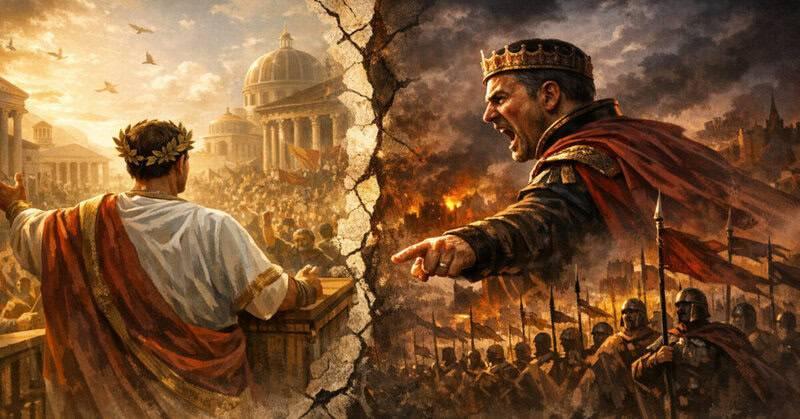
1. Julius Caesar Crosses the Rubicon
Julius Caesar’s bold crossing of the Rubicon in 49 B.C. ignited a historic power struggle.
In January 49 B.C., Julius Caesar’s decision to lead his army across the Rubicon River marked a pivotal moment in Roman history. This act directly violated Roman law, which prohibited generals from bringing troops into Italy, and signified his intent to challenge the authority of the Senate. The phrase “crossing the Rubicon” has since become synonymous with making an irreversible decision. (history.com)
2. Napoleon Declares Himself Emperor
Napoleon’s coronation as Emperor on December 2, 1804, reshaped France’s political landscape.
Napoleon Bonaparte, initially celebrated as a hero of the French Revolution and a proponent of liberty and reform, took a decisive step away from republican ideals by declaring himself Emperor of the French on May 18, 1804. This proclamation marked the end of the French Republic and the beginning of the First French Empire. His coronation ceremony on December 2, 1804, held at Notre-Dame Cathedral in Paris, was a grand affair that blended elements of the ancien régime with revolutionary symbolism. Notably, Napoleon crowned himself, signaling his assertion of absolute authority. This act centralized power in his hands, initiated a series of military campaigns across Europe, and led to the suppression of political dissent, fundamentally altering the course of French and European history. (history.com)
3. Robespierre and the Reign of Terror
Maximilien Robespierre: Revolutionary leader whose pursuit of justice spiraled into tyranny and terror.
Maximilien Robespierre, a champion of equality, led the Committee of Public Safety with ideals of justice during the French Revolution. However, paranoia and power led to mass executions during the Reign of Terror. His campaign against enemies of the revolution became reminiscent of tyranny itself. (britannica.com)
4. Stalin’s Consolidation of Power
Stalin’s reign marked a brutal consolidation of power through repression and media control.
Joseph Stalin, initially a champion of workers’ rights during the Russian Revolution, secured leadership after Lenin’s death in 1924. To consolidate his authority, he orchestrated the Great Purge (1936-1938), a campaign of political repression that led to the execution of hundreds of thousands and the imprisonment of millions in labor camps. Stalin also implemented strict censorship, controlling all forms of media to eliminate dissent and promote his ideology. These actions transformed the Soviet Union into a totalitarian state, marked by fear and forced loyalty. (history.com)
5. Mao Zedong’s Cultural Revolution
Mao Zedong’s Cultural Revolution: a tragic shift from revolutionary ideals to widespread repression.
Initially a peasant-friendly revolutionary, Mao Zedong launched the Cultural Revolution in 1966 to purge “bourgeois” influences, resulting in chaos, persecution, and millions of deaths. His promise to uplift the masses quickly devolved into horrifying repression. More info at Britannica.
6. Fidel Castro’s Crackdown on Dissent
Fidel Castro: From liberator to oppressor, freedom eclipsed by censorship and control.
Fidel Castro, who rose as a liberator against Cuban dictatorship, imposed strict censorship and jailed opponents after cementing power. The early vision of freedom became overshadowed by oppressive controls aligned with Soviet-style communism. Read more at Britannica.
7. Muammar Gaddafi’s Descent in Libya
Muammar Gaddafi: A ruler whose quest for power led to oppression and societal control.
Muammar Gaddafi, who ousted Libya’s monarchy promising justice and wealth for all, constructed a surveillance state, quashed opposition, and ruled with an iron fist for over four decades. His transformation demonstrates the hazards of unchecked rule. More context is available at National Geographic.
8. Hugo Chávez’s Authoritarian Shift
Hugo Chávez’s presidency: a shift from social reform to authoritarianism and media suppression.
Venezuelan President Hugo Chávez campaigned for the poor, but gradually eroded democratic checks, expanded presidential powers, and targeted the media. His socialist experiment devolved into a system with limited freedoms and increasing state control. Read further at BBC News.
9. Robert Mugabe’s Rule in Zimbabwe
From liberation hero to autocratic leader: Mugabe’s complex and controversial legacy in Zimbabwe.
Robert Mugabe, hailed for leading Zimbabwe to independence and land reform, became increasingly autocratic as president—suppressing rivals, rigging elections, and causing economic chaos. Once a liberation icon, his legacy is now tied to long-term oppression and decline. More details are available at BBC News.
10. Ferdinand Marcos Declares Martial Law
Ferdinand Marcos’s martial law era: a shift from modernization to human rights abuses and corruption.
Once seen as a modernizer in the Philippines, Ferdinand Marcos imposed martial law in 1972, silencing critics and corrupting democratic institutions. His earlier progress gave way to decades of human rights abuses and kleptocracy. Learn more at History.com.
11. The Fall of Mengistu Haile Mariam
Mengistu Haile Mariam’s regime exemplified the perilous shift from revolutionary ideals to brutal authoritarianism.
Mengistu Haile Mariam, initially a Marxist revolutionary in Ethiopia, led the Derg military junta after the 1974 overthrow of Emperor Haile Selassie I. In 1977, he initiated the “Red Terror” campaign, a brutal crackdown targeting opposition groups and civilians, resulting in an estimated 30,000 to 750,000 deaths. This period marked a shift from revolutionary idealism to violent authoritarianism, highlighting the dangers of absolute power. (britannica.com)
12. Pol Pot’s Khmer Rouge
Pol Pot’s regime: a tragic shift from revolutionary ideals to brutal tyranny and genocide.
Pol Pot, initially a Marxist revolutionary, led the Khmer Rouge in Cambodia from 1975 to 1979. His radical social engineering aimed to create an agrarian utopia but resulted in genocide and mass suffering. Under his regime, an estimated 1.5 to 3 million people died due to executions, forced labor, starvation, and disease. This transformation from revolutionary to one of history’s most brutal tyrants serves as a cautionary tale. More information is available at History.com.
13. Adolf Hitler’s Enabling Act
Hitler’s Enabling Act of 1933 dismantled democracy, paving the way for totalitarian rule.
Initially elected to restore Germany’s economy, Adolf Hitler’s Enabling Act in 1933 allowed him to legislate unilaterally, extinguishing democratic institutions. This pivotal law enabled the Reich government to issue laws without the consent of Germany’s parliament, laying the foundation for the complete Nazification of German society. From promises of national revival, Hitler quickly turned to terror, discrimination, and world war. Detailed information is available at the United States Holocaust Memorial Museum. (ushmm.org)
14. Vladimir Lenin’s Red Terror
Lenin’s Red Terror (1918) marked a brutal crackdown on dissent during the Bolshevik Revolution.
Vladimir Lenin, aiming to establish a classless society, authorized the Red Terror in 1918 to eliminate perceived enemies of the revolution. This campaign, led by the Bolshevik secret police (Cheka), involved mass arrests, executions, and the establishment of concentration camps. The Red Terror resulted in an estimated 140,000 deaths and set a precedent for political repression in Soviet history. More details are available at Britannica.
15. Recep Tayyip Erdoğan’s Authoritarian Turn
Erdoğan’s journey: from reformer to authoritarian, reshaping Turkey’s political landscape since 2016.
Turkey’s President Recep Tayyip Erdoğan began as a reformer, mending ties with Europe and enhancing rights. However, since 2016, he has consolidated power, purged opposition, and limited press freedoms. This shift is seen as a cautionary transformation from prosperity to control. Details at The Guardian.





 English
 Arabic
 French
 Spanish
 Portuguese
 Deutsch
 Turkish
 Dutch
Dutch
 Italiano
 Russian
 Romaian
 Portuguese (Brazil)