


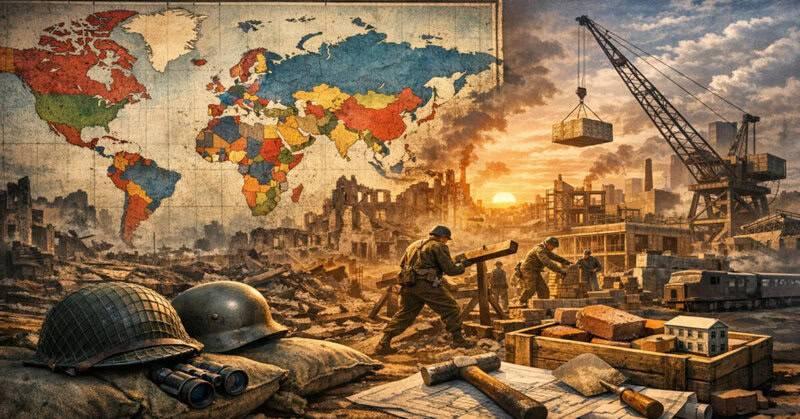
Rebuilding The World: 20 Historical Lessons We Can Take From 1946

0
42

Rebuilding The World: 20 Historical Lessons We Can Take From 1946

9. Rethinking Urban Planning

Rebuilding The World: 20 Historical Lessons We Can Take From 1946
Post-war urban planning transformed cities with efficient transport, modern housing, and green spaces.

The devastation of World War II provided an opportunity to redesign cities with improved urban planning. Reconstruction efforts emphasized efficient transportation networks, modern housing solutions, and the integration of green spaces to enhance residents’ quality of life. For instance, the reconstruction of London focused on decentralization and the development of new towns to alleviate overcrowding (tandfonline.com). Similarly, the post-war rebuilding of Münster incorporated wider streets, better public transportation, and more green spaces to accommodate the growing population and modern needs (globalcitytales.com). These initiatives laid the foundation for contemporary urban design principles that prioritize sustainability and livability.

10. Investing in Science and Technology

Rebuilding The World: 20 Historical Lessons We Can Take From 1946
Post-WWII R&D investments sparked technological growth and innovation across the United States.

The end of World War II marked a significant surge in research and development (R&D) investments, driven by the need to transition wartime innovations to peacetime applications. The U.S. government’s Office of Scientific Research and Development (OSRD) played a pivotal role, funding over 2,200 R&D contracts that led to approximately 7,900 inventions and more than 3,100 patents (nber.org). This substantial investment catalyzed the growth of technology clusters across the United States, fostering high-tech entrepreneurship and employment that persisted into the 1970s. (nber.org). Key advancements included the development of radar technology, which enhanced meteorological capabilities, and the creation of the cavity magnetron, a component integral to microwave ovens (nationalww2museum.org). These innovations not only transformed military applications but also had lasting impacts on civilian industries, underscoring the critical role of sustained investment in science and technology for societal advancement.

11. Legal Frameworks: Building New Constitutions

Rebuilding The World: 20 Historical Lessons We Can Take From 1946
Post-WWII constitutional reforms fostered democracy and human rights, exemplified by Japan’s 1947 constitution.

In the aftermath of World War II, many nations undertook the task of redrafting their constitutions to establish frameworks grounded in justice, transparency, and human rights. This period marked a significant shift toward democratic governance and the protection of individual freedoms. In Japan, the 1947 constitution, drafted under Allied occupation, introduced popular sovereignty, redefined the role of the emperor, and established new rights for women. This constitution remains a symbol of Japan’s commitment to democracy and peace. (cfr.org) Similarly, Germany’s Basic Law, enacted in 1949, laid the foundation for the Federal Republic of Germany. It emphasized human dignity, democracy, and the rule of law, serving as a model for post-war constitutional development. (britannica.com)

The post-war period also saw the drafting of the Universal Declaration of Human Rights in 1948, adopted by the United Nations General Assembly. This declaration set a common standard for all nations, influencing the constitutional frameworks of many countries and reinforcing the global commitment to human rights. In summary, the years following World War II were pivotal in reshaping legal frameworks worldwide. The redrafting of constitutions during this era reflected a collective aspiration to build societies based on justice, transparency, and the protection of human rights.

12. Fostering Cultural Renewal

Rebuilding The World: 20 Historical Lessons We Can Take From 1946
Post-WWII, the arts fostered healing and renewal through global expression and cultural preservation.

In the aftermath of World War II, the arts played a pivotal role in societal healing and cultural renewal. International film festivals, such as the Cannes Film Festival, established in 1946, provided platforms for global artistic expression and dialogue. Additionally, the reconstruction of heritage sites, like the restoration of the Frauenkirche in Dresden, Germany, symbolized resilience and the preservation of cultural identity (cannes.com).

13. Reinforcing Freedom of the Press

Rebuilding The World: 20 Historical Lessons We Can Take From 1946
UNESCO champions press freedom, fostering democracy and trust in post-WWII societies.

In the aftermath of World War II, nations recognized the press as essential for democracy and rebuilding trust. UNESCO’s establishment in 1945 underscored this commitment, promoting freedom of expression and press freedom globally. The organization has since facilitated dialogue and developed frameworks to support independent media, emphasizing their role in fostering democratic societies (en.unesco.org).

14. Encouraging Grassroots Activism

Rebuilding The World: 20 Historical Lessons We Can Take From 1946
Post-WWII, over 200 NGOs emerged, driving humanitarian efforts and community transformation globally.

In the aftermath of World War II, the proliferation of non-governmental organizations (NGOs) played a pivotal role in societal recovery and transformation. Between 1945 and 1949, over 200 NGOs were established, reflecting a surge in grassroots activism aimed at addressing humanitarian needs and promoting development. These organizations operated at local, national, and international levels, providing essential services, advocating for human rights, and fostering community engagement. Their efforts complemented governmental initiatives, ensuring a more inclusive and participatory approach to rebuilding societies (pmc.gov).

15. Promoting Transitional Justice

Rebuilding The World: 20 Historical Lessons We Can Take From 1946
Post-WWII trials set the stage for modern accountability and transitional justice.

In the aftermath of World War II, the international community established mechanisms like the Nuremberg Trials to prosecute war crimes, setting precedents for accountability. These efforts laid the foundation for modern transitional justice, emphasizing the importance of truth commissions and war crimes tribunals in addressing past atrocities and fostering reconciliation (uwo.ca).

16. Supporting Veterans and War Survivors

Rebuilding The World: 20 Historical Lessons We Can Take From 1946
In 1946, enhanced support systems emerged to heal veterans’ physical and psychological wounds.

In 1946, the U.S. government and nonprofit organizations intensified efforts to address the physical and psychological wounds of veterans. The Veterans Administration (VA) expanded its services, providing comprehensive medical care and rehabilitation programs. Additionally, the establishment of the House Committee on Veterans’ Affairs in 1946 underscored a commitment to legislative oversight and support for veterans’ needs (veterans.house.gov). These initiatives set standards for social care, emphasizing the nation’s responsibility to its service members.

17. Planning for Environmental Recovery

Rebuilding The World: 20 Historical Lessons We Can Take From 1946
Post-WWII environmental degradation spurred global awareness and the rise of conservation efforts.

In the aftermath of World War II, the widespread environmental degradation prompted a global recognition of the need for environmental stewardship. This period laid the groundwork for the modern environmental movement, emphasizing conservation and pollution control. The movement’s roots can be traced back to the late 19th century, with early conservation efforts in Europe and North America. However, it was after the war that environmental concerns gained significant traction, leading to the establishment of organizations and policies aimed at protecting natural resources and promoting sustainable practices (britannica.com).

18. Addressing Racial Injustice

Rebuilding The World: 20 Historical Lessons We Can Take From 1946
African American soldiers’ sacrifices fueled the “Double V” campaign for equality and justice.

In the aftermath of World War II, the valor and sacrifices of African American soldiers highlighted the stark contrast between their fight against fascism abroad and the racial discrimination they faced at home. This disparity galvanized the “Double V” campaign, advocating for victory over tyranny overseas and racial injustice domestically. The post-war period saw a surge in civil rights activism, with organizations like the NAACP expanding their efforts to challenge segregation and discrimination, laying the groundwork for the Civil Rights Movement of the 1950s and 1960s (history.com).

19. Balancing Security and Liberty

Rebuilding The World: 20 Historical Lessons We Can Take From 1946
A tense scene unfolds as protesters, clutching legal documents, face off against security forces during a civil liberties demonstration. | Photo by Oscar Chan on Pexels

In the aftermath of World War II, nations grappled with the delicate balance between ensuring national security and upholding individual freedoms. The Universal Declaration of Human Rights, adopted by the United Nations General Assembly in 1948, enshrined fundamental rights such as freedom of speech, religion, and protection from arbitrary detention. This landmark document set a global standard for human rights, influencing subsequent international conventions and national laws that sought to protect individual liberties while addressing security concerns (un.org).

20. The Importance of Remembering History

Rebuilding The World: 20 Historical Lessons We Can Take From 1946
Honoring Holocaust victims through remembrance and education to prevent future atrocities.

Commemorating historical events through memorialization, remembrance days, and education is vital for fostering resilience and preventing future atrocities. The United States observes the Days of Remembrance annually, honoring the victims of the Holocaust and promoting education to ensure such events are not forgotten. These observances serve as a reminder of the consequences of hatred and the importance of vigilance in safeguarding human rights (archives.gov).

Conclusion: Lessons for Tomorrow’s Challenges

Rebuilding The World: 20 Historical Lessons We Can Take From 1946
Learning from 1946: Principles for resilient, equitable recovery in today’s global challenges.

The aftermath of 1946 offers enduring lessons for rebuilding societies post-crisis. Emphasizing international cooperation, prioritizing human rights, and investing in education and infrastructure are pivotal. By integrating these principles, we can effectively address contemporary challenges, ensuring resilient and equitable recovery in the face of conflict, disaster, or division. Applying these timeless lessons today is essential for fostering sustainable and inclusive societies (worldbank.org).

Căutare
Categorii
Citeste mai mult
Home & Garden
Drew Barrymore’s New Limited-Edition Buttercream Collection Will Instantly Brighten Your Kitchen
Drew Barrymore’s New Limited-Edition Buttercream Collection Will Instantly Brighten Your Kitchen...
By Test Blogger9 2026-02-24 03:00:33 0 754
Food
Store-Bought Cookie Dough, Ranked Worst To Best
Store-Bought Cookie Dough, Ranked Worst To Best...
By Test Blogger1 2026-01-31 22:00:08 0 1K
Religion
Learning to Be Still in the Presence of God through Psalm 46
Learning to Be Still in the Presence of God through Psalm 46Stillness and quiet are not easy to...
By Test Blogger5 2026-03-07 06:00:14 0 564
Technology
Xiaomi 17 launches alongside Xiaomi Tag, Watch 5, and more
Xiaomi 17 launches alongside Redmi Buds 8 Pro, Xiaomi Watch 5, Xiaomi Tag, and more...
By Test Blogger7 2026-02-28 15:00:26 0 561
Food
The Ingredient Addition For A Rich, Tangy Upgrade To Canned Green Beans
The Ingredient Addition For A Rich, Tangy Upgrade To Canned Green Beans...
By Test Blogger1 2026-03-12 17:00:08 0 413