


Davizro/Getty
We may receive a commission on purchases made from links.
The '90s weren't just the era of boy bands, frosted tips, and Nintendo; they were also a decade that inspired unique food and drink offerings from your favorite brands. While there are beloved '90s snack foods you can surprisingly still eat now — think Gushers and Totino's Pizza Rolls — there are many that were rightfully short-lived, especially in the realm of beverages.
The beverage industry broadly is a game of chance. As consumer habits change, the brands have to evolve as well. Recently, with the rising popularity of healthier alternatives to soda like Olipop or Poppi, massive corporations have been moving away from their sugary and juice-focused lines. Since 2020, Coca-Cola has sold the once-popular Odwalla juices, and PepsiCo has divested from Naked and Tropicana. These trends impact which kinds of beverages survive and which do not, and the '90s were not any different than the landscape now.
So many massively popular beverages emerged in the '90s. Snapple, although founded in 1972, really emerged in the late 1980s and '90s when it switched its focus to teas. Along the same sugary lines, Sunny Delight (aka SunnyD) was a hit during the decade. But while these product lines have stood the test of time, others have not. We've pulled together a list of some of those nostalgia-inducing drinks that failed with consumers, whether it be for taste, look, or marketing failure — they fizzled out, and really should stay that way.
Crystal Pepsi
melissamn/Shutterstock
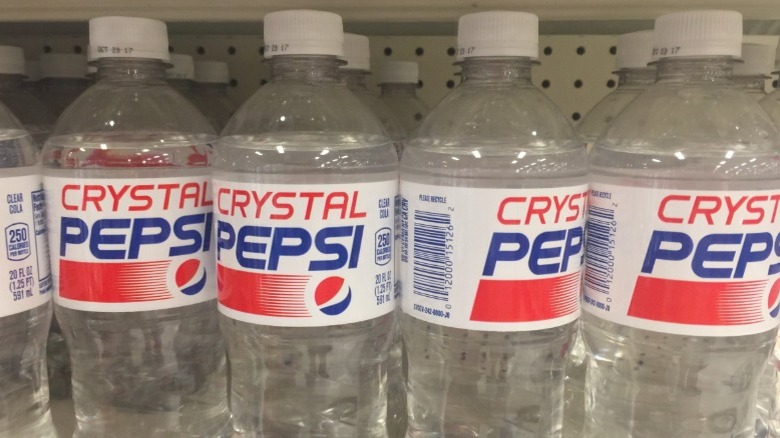
While the 2020s have their own shift to healthier beverages, the '90s did too. Crystal Pepsi was a clear, caffeine-free version of the classic Pepsi soda — in other words, PepsiCo's attempt at capitalizing on customers wanting healthier options on their shelves. While we all know Pepsi as having that classic caramel brown color, Crystal Pepsi's recipe removed that coloring and swapped it out for corn starch. It changed the color, but this also meant that the new beverage, released in 1992, was not as sweet and had fewer calories than the original.
The sentiment was there, but Crystal Pepsi was a flop for some pretty major reasons. To start off with, its flavor was not as close to the original Pepsi beverage as it could be. Crystal Pepsi's creator, David Novak, told Business Insider that, "The bottlers told me, 'David, it's a great idea, and we think we can make it great, but it needs to taste more like Pepsi.'" Ultimately, Novak didn't listen to these concerns, and customers were unsatisfied with its taste, with one nostalgic user on Reddit saying, "I remember the disappointment when I finally tried it."
Clear colas also had a strange tie to Nazi Germany, which made customers even less inclined to purchase. The original Fanta, which looked more like ginger ale than the orange concoction we know today, was produced by Nazi Germany, giving clear sodas a bad reputation among consumers. In all, Crystal Pepsi ended up being a massive fail.
OK Soda
If the name "OK Soda" doesn't seem like an attention-grabber, you're already onto why this '90s soda didn't make it out of the decade. To boil things down, OK Soda was a marketing experiment by Coca-Cola, targeted specifically at Gen-Xers. The generation was largely in their twenties during the '90s, and its attitudes were shaped by the socioeconomic environment in which they grew up. "OK" was seen as a word that crossed language barriers, and it was used in the soda's name to try to appeal to Gen-X sentimentality.
The marketing strategy for OK Soda was, in short, weird. A commercial from 1994 tries to play into what the brand hoped were "cool" vibes by forcing viewers to try to decipher text that's been mirrored to appear backwards. The spot included a message saying, "P.S. those who don't understand this may not deserve to drink 'OK.'" (via YouTube). They even created a phone number to call (1-800-I-FEEL-OK) that would relay odd things like its "OK 10-Point Manifesto" (via YouTube).
OK Soda only lasted a few years past its release in 1993. Another reason it could have gone the way of the dodo is its flavor, which was described by one Redditor as, "a concoction you'd make with all the sodas from the soda fountain at Wendy's or McDonald's." Whether it be marketing or taste, OK Soda was out of public consciousness by 1995, cementing it as the discontinued Coke product you've probably never heard of.
Josta
Next on the list of long-gone beverages is a PepsiCo product that combined soda with an energy drink (and was perhaps ahead of its time). Josta was released by PepsiCo in 1995, and its "exotic" packaging and high-energy marketing aligned with its ingredients and purpose. Caffeine-infused beverages like Red Bull became popular in the United States in the '90s, so it makes sense that PepsiCo might want to attempt to capitalize on this growing market.
The mysterious ingredient that lent Josta this unfamiliar aura was guarana, which each label proudly pronounced as part of the drink. The cans referenced "The Legend of Guarana," which was that guarana grows deep within the jungle. For centuries, ancient tribes believed that guarana released raw, primal power. Now, the legend of guarana has been captured in the potent flavor of Josta. Release it" (via eBay). While dramatically written, much of this information is true; guarana is an Amazonian plant and stimulant with a much higher caffeine content than coffee (up to four times higher). The plant also has a sort of ancient mythos about it, and was revered by the Sateré-Mawé indigenous people in Brazil, who used it as currency and for its medicinal properties.
It's unclear why Josta wasn't as popular as other PepsiCo offerings, but the drink was likely much ahead of its time. Modern brands like Monster Energy's canned drinks contain guarana seed extract, lending them their massive caffeine content — up to 160 milligrams per can.
Surge
This next drink was a late-'90s addition to the market and emerged as a competitor to PepsiCo's iconic Mountain Dew. Surge, made by Coca-Cola, was a "fully loaded citrus soda with carbos," according to a 1997 commercial (via YouTube). Here, "carbos" refers to an ingredient called maltodextrin, a more moderately sweet carbohydrate unique to Surge. While carbonated like any other soda, Surge was a bit less carbonated, which also appealed to some customers.
Its ingredients set it apart, but Surge played into a similar marketing approach as its bright green competitor: Be as extreme as possible. Advertisements for the drink featured the slogan, "feed the rush" (quite similar to Mountain Dew's "Do the Dew"). Surge commercials were a fun mixture of craziness and energy, including one from 1998 in which a screaming voice over the phone prompts men to run through the city streets to obtain a single can of Surge (via YouTube).
Ultimately, a variety of factors could have influenced Surge's downfall. First, there were some murmurs about the drink having adverse effects on children due to high sugar and caffeine content, which caused some schools to remove it from vending machines. Additionally, Coca-Cola's head of marketing changed around the turn of the century, and the company started to shift focus away from youth. The drink was discontinued in 2003, but a fan-run initiative called 'The Surge Movement' succeeded in convincing Coca-Cola to bring the drink back — it had a limited run from 2014 to around 2017.
Orbitz
If you're a '90s kid, you'll likely know this drink by its unique appearance, regardless of whether you ever tasted it. Picture trying to capture the essence of outer space in a beverage, and you'll arrive at Orbitz, which was a non-carbonated fruit beverage that had little balls made of gelatin floating around within the liquid. The beverage was released in 1996 by a Canadian company called The Clearly Food and Beverage Company, which also produces the popular Clearly Canadian flavored sparkling waters.
Orbitz was admittedly cool to look at and was actually a scientific marvel. The gelatin balls were able to stay suspended in the drink because the liquid was actually more viscous when it was at rest (approximately 100,000 times higher than the viscosity of water). Xanthan gum and gellan gum, two ingredients in Orbitz, also contributed to its appearance by creating a network of bonds that held the gelatin balls up given that the liquid is not disturbed. But despite its alien appearance, the beverage only lasted two years on the market, likely because of its taste and texture. A Redditor who did get the chance to sample the beverage said it was "like drinking melted jello [sic]." Another said, "those gummy fuzz balls were nasty." Despite the poor reviews, the drink did have some loyal followers. And, unopened bottles of it are still being sold as collector's items — some for up to $80 for a single bottle, and $900 for a case of 12.

 English
 Arabic
 French
 Spanish
 Portuguese
 Deutsch
 Turkish
 Dutch
Dutch
 Russian
 Romaian
 Portuguese (Brazil)
 Greek
Greek