


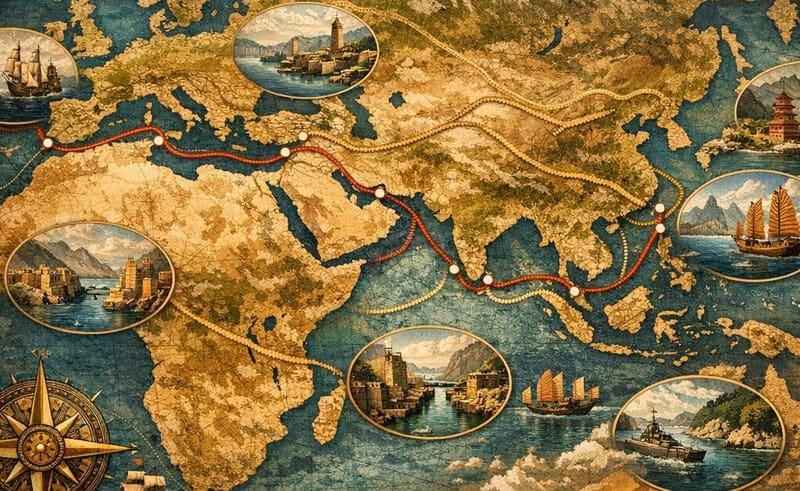
From the Strait of Hormuz to the Silk Roads: 15 Chokepoints That Ruled History

0
35

From the Strait of Hormuz to the Silk Roads: 15 Chokepoints That Ruled History

8. Khyber Pass

From the Strait of Hormuz to the Silk Roads: 15 Chokepoints That Ruled History
Image Source: Pexels.

The Khyber Pass is a mountain pass in the Khyber District of the Pakistani province of Khyber Pakhtunkhwa, along the international border with Afghanistan. It connects the town of Landi Kotal to the Valley of Peshawar at Jamrud by traversing part of the White Mountains. Since it was part of the ancient Silk Road, it has been a vital trade route between Central Asia and the Indian subcontinent and a strategic military choke point for various states that controlled it. The Khyber Pass is considered one of the most famous mountain passes in the world.

9. Strait of Gibraltar

From the Strait of Hormuz to the Silk Roads: 15 Chokepoints That Ruled History
Image Source: Pexels.

The Strait of Gibraltar is a narrow waterway connecting the Mediterranean Sea to the Atlantic Ocean, separating southern Spain from northwestern Africa. Spanning 36 miles (58 kilometers) in length and narrowing to 8 miles (13 kilometers) in width, it has been a critical maritime passage since ancient times. The Greeks referred to it as the Pillars of Heracles, marking the boundary of the known world. Its strategic importance has been underscored by numerous historical events, including the Battle of Trafalgar in 1805, which solidified British naval dominance. Today, the strait remains vital for global shipping, with approximately 100,000 vessels transiting annually, carrying about 20% of global seaborne trade.

10. The Silk Roads

From the Strait of Hormuz to the Silk Roads: 15 Chokepoints That Ruled History
Interconnected trade routes of the Silk Roads fostered cultural exchange between East and West.

The Silk Roads were a network of interconnected trade routes facilitating the exchange of goods, ideas, and cultures between East and West. Caravansaries and mountain passes, such as those through the Taklamakan Desert and the Pamir Mountains, were critical chokepoints along these routes. These passages not only shaped the fortunes of empires but also played a pivotal role in the spread of technology, religion, and cultural practices across continents.

11. Strait of Magellan

From the Strait of Hormuz to the Silk Roads: 15 Chokepoints That Ruled History
The Strait of Magellan: a historic maritime passage connecting the Atlantic and Pacific Oceans.

The Strait of Magellan is a navigable sea route in southern Chile, separating mainland South America from the Tierra del Fuego archipelago. Spanning approximately 350 miles (560 kilometers) in length and varying in width from 2 to 20 miles (3 to 32 kilometers), it serves as a natural passage between the Atlantic and Pacific Oceans. The strait was first navigated by Ferdinand Magellan in 1520 during his expedition to circumnavigate the globe. Before the construction of the Panama Canal in 1914, it was a crucial maritime route for ships traveling between the two oceans. The strait’s challenging navigation, characterized by unpredictable winds and currents, has historically made it a strategic and contested passage. (britannica.com)

12. Bering Strait

From the Strait of Hormuz to the Silk Roads: 15 Chokepoints That Ruled History
Image Source: Pexels.

The Bering Strait is a narrow passage connecting the Arctic Ocean to the Bering Sea, separating Russia and Alaska. During the last Ice Age, it served as a land bridge, facilitating human migration from Asia to North America. Today, it remains strategically significant for Arctic navigation, with increasing interest due to climate change and potential shipping routes. The strait’s unique geography continues to influence geopolitical and environmental dynamics in the region. (britannica.com)

13. Thermopylae Pass

From the Strait of Hormuz to the Silk Roads: 15 Chokepoints That Ruled History
Thermopylae Pass: site of the legendary stand by King Leonidas and 300 Spartans.

The Thermopylae Pass is a narrow mountain pass in central Greece, renowned for the Battle of Thermopylae in 480 BCE. During this battle, a small Greek force, including 300 Spartans led by King Leonidas, held off a much larger Persian army for three days. The pass’s strategic location made it a critical chokepoint in Mediterranean history, exemplifying the significance of controlling narrow passages in warfare. (worldhistory.org)

14. Dardanelles (Hellespont)

From the Strait of Hormuz to the Silk Roads: 15 Chokepoints That Ruled History
The Dardanelles: a historic strait linking the Aegean Sea to the Sea of Marmara.

The Dardanelles, known in antiquity as the Hellespont, is a narrow strait in northwestern Turkey connecting the Aegean Sea to the Sea of Marmara. Spanning approximately 61 kilometers (38 miles) in length and varying in width from 1.2 to 6.5 kilometers (0.75 to 4 miles), it has been a strategic chokepoint throughout history. In 480 BCE, Persian King Xerxes I constructed pontoon bridges across the Hellespont to facilitate his invasion of Greece. The strait’s significance continued into modern times, notably during the Gallipoli Campaign of World War I, where Allied forces attempted to secure control over the Dardanelles to open a sea route to Russia.

15. Cape of Good Hope

From the Strait of Hormuz to the Silk Roads: 15 Chokepoints That Ruled History
Image Source: Pexels.

The Cape of Good Hope is a rocky headland on the Atlantic coast of the Cape Peninsula in South Africa. First navigated by Portuguese explorer Bartolomeu Dias in 1488, it became a pivotal point for European trade routes to Asia. The treacherous waters and strong currents made the passage perilous, but the route was vital for empire-building and the spice trade. The opening of the Suez Canal in 1869 provided a more efficient route, reducing the reliance on the Cape.

Conclusion

From the Strait of Hormuz to the Silk Roads: 15 Chokepoints That Ruled History
Image Source: Pexels.

Throughout history, both natural and engineered chokepoints have been pivotal in shaping commercial, cultural, and military landscapes. These strategic passages, such as the Strait of Hormuz and the Suez Canal, have facilitated trade, influenced geopolitical dynamics, and served as focal points in conflicts. In the modern era, they continue to be critical, acting as potential flashpoints and symbols of human connection, underscoring the intricate interplay between geography and global affairs.

Buscar
Categorías
Read More
Juegos
Logitech's latest budget wireless gaming headset is a lesson in doing just enough
Logitech's latest budget wireless gaming headset is a lesson in doing just enough...
By Test Blogger6 2026-02-25 18:00:13 0 631
Juegos
Old School Runescape wants you to decide the loot of its next big raid, and a second ring slot isn't off the table
Old School Runescape wants you to decide the loot of its next big raid, and a second ring slot...
By Test Blogger6 2026-03-05 22:00:11 0 433
Music
The Best + Worst Song off Every Guns N' Roses Album
The Best + Worst Song off Every Guns N' Roses AlbumThese are the best and worst songs off every...
By Test Blogger4 2026-03-27 15:00:15 0 4
Religion
Timeless Truths for a Purposeful Life
Timeless Truths for a Purposeful Life - A Study on the Book of ProverbsThis 5-week Proverbs Bible...
By Test Blogger5 2026-01-23 20:02:11 0 1K
Food
Kelsey Asbille From Yellowstone's Go-To Taco Bell Order
Kelsey Asbille From Yellowstone's Go-To Taco Bell Order...
By Test Blogger1 2026-02-10 11:00:03 0 1K