


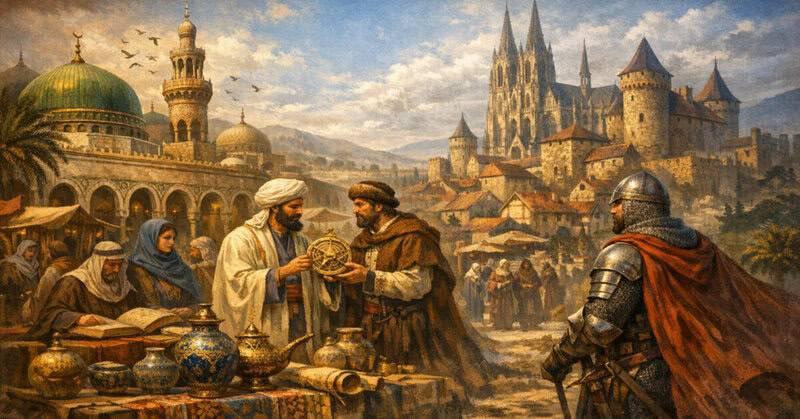
12 Ways Islam Has Shaped European Culture and History

0
35

12 Ways Islam Has Shaped European Culture and History

6. Music and Poetry

12 Ways Islam Has Shaped European Culture and History
Andalusian music and poetry: pivotal influences on European artistic heritage and musical evolution.

The rich tapestry of Andalusian music and poetry significantly influenced European artistic traditions. In the 9th century, the renowned musician Ziryâb introduced the oud to Córdoba, which evolved into the lute, a central instrument in European music. Additionally, the rebec, derived from the Arabic rebab, became a staple in medieval European ensembles. Lyrically, the muwashshah and zajal poetic forms from Al-Andalus, characterized by their intricate rhyme schemes and themes of love and nature, deeply influenced the troubadour poetry of medieval Europe. The term “troubadour” itself is believed to be derived from the Arabic “tarab,” meaning “joy” or “mirth,” reflecting the cultural exchange between the Islamic world and Europe. (wfmt.com) This fusion of musical instruments and poetic forms enriched European cultural expressions, leaving a lasting legacy in the continent’s artistic heritage.

7. Urban Planning and Gardens

12 Ways Islam Has Shaped European Culture and History
The Alhambra’s Generalife Gardens showcase the enduring influence of Islamic design in European landscapes.

Islamic urban planning and garden designs have profoundly influenced European architecture and landscaping. The concept of the “charbagh,” a Persian-style garden divided into four quadrants by water channels or walkways, symbolizes paradise and has been adopted in various Islamic gardens, including the Alhambra in Spain. The Alhambra’s Generalife Gardens exemplify this design, featuring terraced layouts, intricate water features, and lush vegetation that have inspired European pleasure gardens. (whc.unesco.org) Additionally, the Alcázar of Seville showcases Islamic garden aesthetics with courtyards, reflecting pools, and lush plantings, reflecting the integration of Islamic design principles into European architecture. (theartbog.com) These elements have been incorporated into European gardens, blending Islamic design principles with local traditions to create harmonious and serene spaces.

8. Philosophy and Rational Thought

12 Ways Islam Has Shaped European Culture and History
Averroes’ Arabic commentaries on Aristotle reintroduced classical philosophy to medieval Europe.

The transmission of Aristotle and Plato’s works through Arabic commentaries significantly influenced European medieval philosophy. Averroes (Ibn Rushd), a prominent 12th-century Andalusian philosopher, authored extensive commentaries on Aristotle’s writings, including the “Metaphysics” and “Nicomachean Ethics.” These works were translated into Latin, reintroducing Aristotelian thought to Europe and shaping the intellectual landscape of the Middle Ages. (philosophy.institute)

9. Fashion and Textiles

12 Ways Islam Has Shaped European Culture and History
Islamic textiles transformed European fashion, enriching Italian silk production and design in the 12th century.

The opulence of Islamic textiles profoundly influenced European aristocracy, particularly in Italy and France. During the 12th century, the Sicilian silk industry flourished under Roger II, who imported North African weavers to Palermo, laying the foundation for high-quality silk production. (mahconf.org) Italian cities like Venice, Genoa, and Florence became hubs for these luxurious fabrics, integrating intricate Islamic designs into their own textile traditions. The Crusades facilitated this exchange, with European artisans adopting motifs such as stylized floral patterns and geometric designs from Islamic brocades. In France, the “Turquerie” phenomenon in the 18th century saw the nobility embracing Ottoman-inspired fashion, incorporating rich silks and vibrant patterns into their attire. (anascreccatravel.com) This cross-cultural exchange not only enriched European fashion but also established a lasting legacy of Islamic influence in Western textile arts.

10. Scientific Instruments: Astrolabes and Navigation

12 Ways Islam Has Shaped European Culture and History
The astrolabe, refined by Islamic scholars, revolutionized European navigation during the Age of Discovery.

The astrolabe, an ancient instrument refined by Islamic scholars, was pivotal in advancing European navigation during the Age of Discovery. Islamic astronomers like Al-Zarqali (Arzachel) enhanced the astrolabe’s design, introducing complex configurations that allowed for detailed celestial mapping. (equantu.com) These innovations enabled European explorers to determine their latitude by measuring the angle of the sun or stars above the horizon, facilitating long-distance sea voyages and the discovery of new lands. (astronimus.com)

11. The Crusades and Cultural Exchange

12 Ways Islam Has Shaped European Culture and History
The Crusades sparked cultural exchanges, enriching European knowledge and agriculture through Islamic advancements.

While primarily military campaigns, the Crusades facilitated significant exchanges between Muslims and Europeans, leading to the transfer of goods, ideas, and technologies. Crusaders encountered advanced Islamic scholarship, including works by Ibn Sina (Avicenna) and Ibn Rushd (Averroes), which were translated into Latin and profoundly influenced European medicine and philosophy. (sheetofhistory.com) Additionally, the Crusades introduced Europeans to new agricultural products like sugar, citrus fruits, and spices, enriching their diets and economies. Architectural styles also blended, with Crusader castles incorporating Islamic design elements, reflecting a fusion of cultural aesthetics. (armistia.com) This period of interaction laid the groundwork for the European Renaissance, marking a pivotal era of cross-cultural exchange.

12. Language and Vocabulary

12 Ways Islam Has Shaped European Culture and History
Arabic language’s enduring influence on European vocabularies reflects centuries of cultural exchange.

The Arabic language has significantly influenced European languages, enriching their vocabularies with numerous loanwords. This influence primarily resulted from trade, scholarship, and cultural exchanges during the Middle Ages. Notable examples include:

Algebra: Derived from the Arabic “al-jabr,” meaning “reunion of broken parts,” reflecting the mathematical concept of solving equations.
Cotton: Borrowed from Arabic “quṭn,” denoting the soft fiber used in textiles. (arabamerica.com)
Sugar: Originating from Arabic “sukkar,” referring to the sweet substance.
Alcohol: Derived from Arabic “al-kuḥl,” originally meaning “the kohl powder,” which evolved to signify distilled substances.
Zero: Borrowed from Arabic “ṣifr,” meaning “empty” or “nothing,” revolutionizing mathematical concepts. (thefluency.app)

This linguistic exchange underscores the profound impact of Arabic culture and knowledge on European societies, highlighting a rich history of cross-cultural interaction and mutual influence.

Search
Categories
Read More
Other
What Is Driving the Liquidity and Asset Liability Management Solutions Market Through 2034
Liquidity and Asset Liability Management (ALM) solutions enable financial institutions and...
By Monica Scott 2026-02-26 12:57:58 0 1K
Technology
This Samsung Odyssey G5 gaming monitor is at its lowest-ever price on Amazon — save $90
Best gaming monitor deal: Samsung Odyssey G5 hits record low...
By Test Blogger7 2026-01-28 23:00:14 0 1K
Food
Why Is Seafood Synonymous With Mardi Gras?
Why Is Seafood Synonymous With Mardi Gras?...
By Test Blogger1 2026-02-02 12:00:09 0 1K
Technology
The creator-favorite DJI Neo drone is down to a record-low price at Amazon — save $50 with Spring Sale coupon
The creator-favorite DJI Neo drone is down to a record-low price at Amazon — save $50 with Spring...
By Test Blogger7 2026-03-26 11:02:17 0 16
Food
What Happened To Melissa d'Arabian After Food Network?
What Happened To Melissa d'Arabian After Food Network?...
By Test Blogger1 2026-02-08 23:00:08 0 1K