


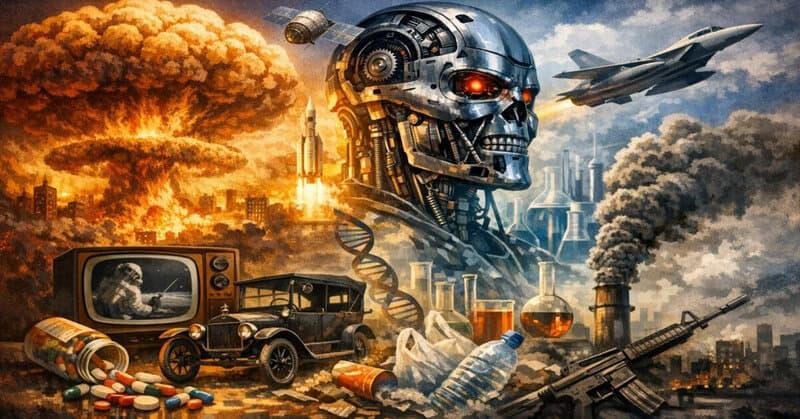
15 World-Changing Inventions Created Without Considering the Fallout

0
35

15 World-Changing Inventions Created Without Considering the Fallout

2. Leaded Gasoline

15 World-Changing Inventions Created Without Considering the Fallout
Leaded gasoline enhanced engine performance but caused severe environmental and health repercussions.

In the 1920s, tetraethyllead was introduced as an antiknock agent to enhance engine performance by reducing knocking in internal combustion engines. This addition significantly improved vehicle efficiency and power. However, the widespread use of leaded gasoline led to substantial environmental contamination, as lead particles were emitted into the atmosphere through vehicle exhaust. This pollution resulted in elevated blood lead levels among children, causing developmental delays, learning difficulties, and other health issues. The persistence of lead in the environment also led to soil and water contamination, affecting ecosystems and human health. Recognizing these severe health risks, many countries began phasing out leaded gasoline in the late 20th century. The United States, for instance, banned the sale of leaded fuel for on-road vehicles in 1996. Despite these efforts, the legacy of leaded gasoline continues to pose challenges, particularly in regions where its use persists.

3. Chlorofluorocarbons (CFCs)

15 World-Changing Inventions Created Without Considering the Fallout
CFCs, once essential for industry, now pose a threat to the ozone layer.

Chlorofluorocarbons (CFCs) were once widely used as refrigerants, solvents, and propellants in aerosol products due to their stability and non-flammability. However, in the mid-1970s, scientists discovered that CFCs released into the atmosphere were depleting the ozone layer, which protects Earth from harmful ultraviolet radiation. This led to the 1987 Montreal Protocol, an international treaty aimed at phasing out the production and use of ozone-depleting substances, including CFCs. The protocol has been successful in reducing CFC emissions, contributing to the gradual recovery of the ozone layer (britannica.com).

4. Plastic

15 World-Changing Inventions Created Without Considering the Fallout
Plastic’s convenience transformed industries, but its environmental impact poses urgent challenges.

The invention of plastic revolutionized manufacturing and packaging by providing a lightweight, durable, and versatile material. Its widespread use improved accessibility and convenience across various industries. However, the persistent nature of plastic was not fully considered, leading to significant environmental challenges. Plastic waste accumulates in oceans and landfills, taking hundreds of years to decompose. This accumulation results in pollution, microplastics entering the food chain, and ecological harm to wildlife and ecosystems (nationalgeographic.com).

5. The Internet

15 World-Changing Inventions Created Without Considering the Fallout
The internet revolutionizes communication and commerce, while posing challenges of misinformation and disinformation.

Initially developed in the late 20th century to facilitate data sharing among researchers, the internet has since transformed into a global network that underpins modern communication, commerce, and information exchange. Its rapid expansion has brought about unprecedented access to knowledge and connectivity. However, this digital revolution has also introduced significant challenges. The proliferation of misinformation and disinformation has become a pressing concern, with false information spreading rapidly across social media platforms, leading to public confusion and undermining trust in institutions. Cybercrime has escalated, encompassing activities such as identity theft, financial fraud, and ransomware attacks, which have profound economic and personal consequences (thelegalvoice.in). Data privacy breaches have exposed sensitive personal information, eroding public trust and raising ethical questions about data collection and surveillance practices. Additionally, the internet has been linked to negative mental health outcomes, including increased anxiety, depression, and social isolation, particularly among younger users. These issues underscore the need for comprehensive strategies to mitigate the adverse effects of the internet while preserving its benefits.

6. Antibiotics

15 World-Changing Inventions Created Without Considering the Fallout
Penicillin’s discovery revolutionized medicine; now, antimicrobial resistance poses a critical health threat.

The discovery of penicillin in 1928 marked a pivotal moment in medical history, revolutionizing the treatment of bacterial infections and saving countless lives. However, the widespread and often inappropriate use of antibiotics has led to the emergence of antimicrobial resistance (AMR), where bacteria evolve to resist the effects of these drugs. This resistance has become a critical global health threat, making infections harder to treat and increasing the risk of disease spread, severe illness, and death. In 2023, one in six laboratory-confirmed bacterial infections worldwide were resistant to antibiotic treatments (who.int). The World Health Organization (WHO) has identified AMR as one of the top global public health threats in the 21st century, requiring action across all government sectors and society. Without effective antibiotics, medical procedures such as organ transplantation, caesarean sections, cancer chemotherapy, and diabetes management become challenging. The emergence and spread of AMR threaten our ability to treat common infectious diseases and result in prolonged illness, disability, and death.

7. Asbestos

15 World-Changing Inventions Created Without Considering the Fallout
Asbestos: once valued for fire resistance, now recognized for its severe health risks.

Asbestos, a naturally occurring mineral, was once lauded for its fire-resistant properties and widely used in construction materials such as insulation, roofing, and flooring. However, prolonged inhalation of asbestos fibers has been linked to serious health issues, including lung cancer, asbestosis, and mesothelioma. These diseases often manifest decades after exposure, leading to significant morbidity and mortality. Consequently, many countries have implemented bans and strict regulations on asbestos use to mitigate these health risks (atsdr.cdc.gov).

8. Nuclear Power

15 World-Changing Inventions Created Without Considering the Fallout
Nuclear energy: a dual-edged solution to power demands, balancing efficiency and safety risks.

Nuclear power was promoted as a clean and efficient energy source, offering a solution to the world’s growing energy demands without the greenhouse gas emissions associated with fossil fuels. However, the development of nuclear technology also led to the creation of atomic weapons, introducing unprecedented destructive capabilities. The catastrophic accidents at Chernobyl in 1986 and Fukushima in 2011 highlighted the potential dangers of nuclear energy, raising public concerns about safety, environmental impact, and the long-term management of radioactive waste. These incidents have spurred debates over the future role of nuclear power in global energy strategies.

9. Agent Orange

15 World-Changing Inventions Created Without Considering the Fallout
Agent Orange: A toxic legacy of the Vietnam War, causing lasting health crises for many.

Agent Orange was a herbicide used by the U.S. military during the Vietnam War to defoliate forests and destroy crops, aiming to expose enemy positions and disrupt food supplies. This chemical mixture contained dioxin, a highly toxic compound linked to severe health issues. Exposure to Agent Orange has been associated with various cancers, birth defects, and other serious health problems among both veterans and Vietnamese civilians. The long-term effects of this chemical continue to impact affected populations, leading to ongoing health challenges and environmental concerns (britannica.com).

10. PFAS (‘Forever Chemicals’)

15 World-Changing Inventions Created Without Considering the Fallout
PFAS: Persistent ‘forever chemicals’ linked to health risks and environmental contamination.

Per- and polyfluoroalkyl substances (PFAS), known as “forever chemicals,” are a group of synthetic compounds used in various consumer products for their water- and stain-resistant properties. These chemicals are highly persistent in the environment and human body, leading to widespread contamination. Exposure to PFAS has been linked to adverse health effects, including increased cholesterol levels, immune system disruption, and higher risks of certain cancers. The persistence and toxicity of PFAS have raised significant environmental and public health concerns, prompting regulatory actions and ongoing research into their impacts (epa.gov).

11. DDT

15 World-Changing Inventions Created Without Considering the Fallout
DDT’s initial promise as a pesticide gave way to severe ecological consequences and regulatory changes.

Dichlorodiphenyltrichloroethane (DDT) was hailed as a miracle pesticide upon its introduction in the 1940s, effectively controlling malaria and typhus. However, its widespread use led to environmental degradation, as DDT accumulated in wildlife, causing reproductive issues and thinning eggshells in birds of prey. The chemical’s persistence in the environment resulted in long-term ecological damage, prompting a reevaluation of chemical use in agriculture. In response, many countries have implemented bans and restrictions on DDT to mitigate its harmful effects (epa.gov).

12. Thalidomide

15 World-Changing Inventions Created Without Considering the Fallout
Thalidomide’s tragic legacy reshaped drug safety standards and continues to impact medical treatments today.

Introduced in the late 1950s as a sedative and treatment for morning sickness, thalidomide was withdrawn from the market in 1961 after it was linked to severe birth defects, including limb malformations, in thousands of children worldwide. The tragedy led to stricter drug approval processes and the establishment of more rigorous safety standards. Despite its history, thalidomide has been repurposed for certain medical conditions, such as leprosy and multiple myeloma, under strict regulations to prevent exposure during pregnancy (britannica.com).

13. Freon and Air Conditioning

15 World-Changing Inventions Created Without Considering the Fallout
Freon revolutionized cooling systems but poses significant environmental risks, prompting a global phase-out.

Freon, a chlorofluorocarbon (CFC), revolutionized air conditioning by providing an efficient and non-flammable refrigerant, leading to widespread adoption of cooling systems in homes and businesses. However, it was later discovered that Freon contributes to ozone layer depletion, allowing harmful ultraviolet radiation to reach Earth’s surface. Additionally, Freon has a high global warming potential, exacerbating climate change. These environmental concerns have led to the phase-out of Freon and the development of more eco-friendly refrigerants.

14. The Automobile

15 World-Changing Inventions Created Without Considering the Fallout
Image Source: Pexels.

The invention of the automobile revolutionized personal transportation, offering unprecedented mobility and reshaping urban landscapes. However, the widespread adoption of cars led to unintended consequences. Urban sprawl became more pronounced as cities expanded to accommodate increasing numbers of vehicles, often at the expense of green spaces and agricultural land. This expansion contributed to environmental degradation, including air pollution from vehicle emissions and increased greenhouse gas emissions. Additionally, the dominance of automobiles resulted in a decline in public transportation usage, leading to traffic congestion and further environmental concerns. These challenges have prompted cities worldwide to reconsider transportation planning and invest in sustainable alternatives (nationalgeographic.com).

15. Social Media Platforms

15 World-Changing Inventions Created Without Considering the Fallout
Social media shapes politics and communities, but also fuels misinformation and division.

Conceived to connect people and foster communities, social media’s influence has grown to shape politics, mental health, and the spread of misinformation, while enabling cyberbullying and social division. Platforms like Facebook, Twitter, and Instagram have become central to political discourse, influencing elections and public opinion. However, the rapid dissemination of misinformation has led to public health challenges, as seen during the COVID-19 pandemic, where false information hindered effective responses. Additionally, the prevalence of cyberbullying on these platforms has raised concerns about mental health, particularly among adolescents. Studies have shown a correlation between social media use and increased rates of depression and anxiety. Furthermore, the design of these platforms can create echo chambers, reinforcing existing beliefs and contributing to social polarization. The pervasive nature of social media necessitates ongoing discussions about regulation, digital literacy, and the promotion of healthy online environments (pubmed.gov).

Conclusion

15 World-Changing Inventions Created Without Considering the Fallout
Innovations shape progress; foresight and regulation are crucial for ethical advancement and sustainability.

While invention drives progress, history shows that even the most beneficial innovations can have negative consequences if their broader impacts are overlooked. The inventions highlighted illustrate the importance of foresight, regulation, and balanced advancement in shaping a sustainable and ethical future. By learning from past mistakes, society can better navigate the complexities of technological development, ensuring that new creations enhance human well-being without causing unforeseen harm. This approach fosters responsible innovation that aligns with the greater good (scu.edu).

Rechercher
Catégories
Lire la suite
Food
This Dirty South Biscuit Stole The Show On Diners, Drive-Ins And Dives
This Dirty South Biscuit Stole The Show On Diners, Drive-Ins And Dives...
Par Test Blogger1 2026-02-09 17:00:09 0 1KB
Food
This Is Hands Down The Worst Mexican-Style Fast Food Chain
This Is Hands Down The Worst Mexican-Style Fast Food Chain...
Par Test Blogger1 2026-03-07 12:00:13 0 403
Jeux
The latest entry in Ubisoft's Anno series is free to play this weekend, but there's a huge catch
The latest entry in Ubisoft's Anno series is free to play this weekend, but there's a huge catch...
Par Test Blogger6 2026-02-24 18:00:20 0 643
Autre
5G Fixed Wireless Access Market Outlook: Opportunities and Innovations Ahead
The landscape of global internet connectivity is undergoing a seismic shift. As fiber optics...
Par Divakar Kolhe 2026-03-27 06:45:29 0 16
Technology
Claude apps: How Anthropic will integrate Slack, Canva, and more
Claude apps: How Anthropic will integrate Slack, Canva, and more...
Par Test Blogger7 2026-01-28 08:00:35 0 1KB