




Rick Kern/Getty Images
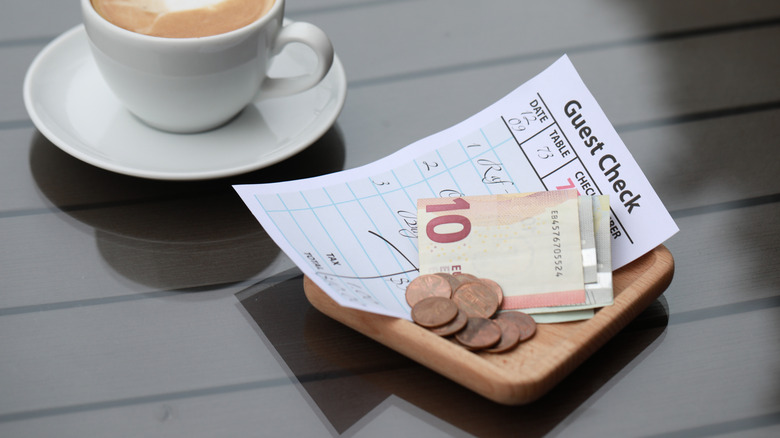
Traveling to a new country means navigating new cultures and using unfamiliar currencies. It also involves a lot of eating out. The result? Tipping is frequent and may get complicated. Fortunately, if you're traveling in Europe, travel guru Rick Steves says not to overthink tipping, though he does warn against one unexpected faux pas on his travel blog, Rick Steves' Europe: tipping in coins. In certain Germanic countries — Germany, Austria, Belgium, Luxembourg, and, partly, Switzerland and Liechtenstein — simply leaving pocket change on the table may be considered rude.
The reason stems from what a tip signifies in Europe versus the U.S. "Servers are paid a living wage, and tips are considered a small bonus," Steves writes of Europe. Gratuity in the Old Continent, therefore, is considered a form of appreciation rather than a payment crucial for your server to make ends meet. Consequently, coins may come across as tactless if you try to pass them off as appreciation.
While Steves explains that tipping in coins is local custom for many countries (excluding the aforementioned Germanic nations), distinguishing between low- and high-denomination coins is important. Small coins can be problematic if they're your only form of gratuity. You might end up leaving a tip so paltry, you'd be better off not tipping at all. Even if the amount is sufficient, your server likely won't appreciate having to carry around a pile of small coins. So, if you want to tip, do so with one or two Euro coins.
Tipping with cash and cards in European countries
New Africa/Shutterstock
To avoid tipping in coins altogether, Rick Steves advises diners to pay the bill and tip in one go. "For example," he writes on his blog, "if paying for a €10 meal with a €20 bill, say 'Eleven, please' while handing your money to the server. ... [They] will thank you, keep a €1 tip, and give you €9 in change." As for how much you should give, Steves writes that "5 percent is adequate and 10 percent is considered a nice tip." Conveniently, this strategy also fits into the widespread European tipping practice of rounding up the bill to the next big number.
Similarly, when paying with a bank card, you can request that the server charge you an amount that includes the cost of the meal and the tip. Note, however, that card payments are taxed. Cash tips usually aren't, and some establishments may only accept gratuity in this form. Therefore, the best way to ensure the entire tip goes to your server is to hand them cash directly.
While European tipping culture can vary by country, most of the region's sit-down restaurants either levy a separate service charge or account for it in their pricing. Despite this, eateries in popular areas may try to squeeze large tips from tourists. Steves warns against phrases like "Tip is not included" (and other restaurant signage red flags, like "No frozen food") to avoid such tourist traps. To skip tipping conundrums entirely, look for Steves' go-to street food whenever he travels: kebabs. As counter-service operations, European countries consider kebab stands tip-free establishments.

 English
 Arabic
 French
 Spanish
 Portuguese
 Deutsch
 Dutch
Dutch
 Italiano
 Russian
 Romaian
 Portuguese (Brazil)
 Greek
Greek