




VGV MEDIA/Shutterstock
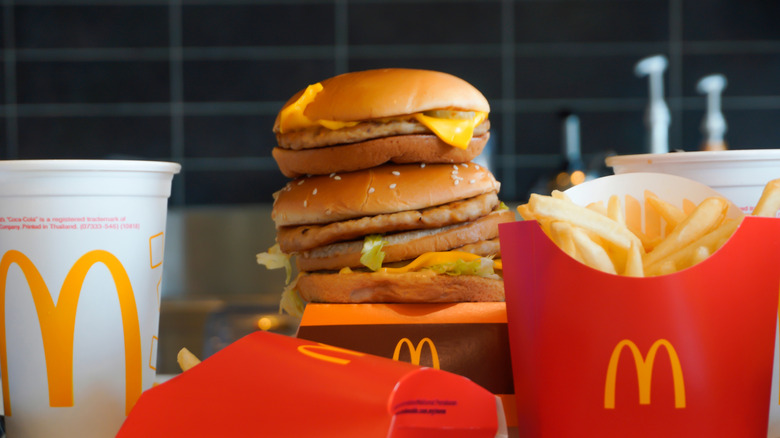
No matter where you are, you can probably walk into a McDonald's and order a hamburger that tastes like the one you'd get in your hometown. One reason for this is McDonald's famed focus on consistency, and this extends to its hamburger buns. But who creates these pillowy masterpieces?
McDonald's buns are made by Aryzta, a global baking company, as well as various regional suppliers. In fact, many smaller bakeries, like New Horizons in Ohio, H&S Bakery in Maryland, and Automatic Rolls of North Carolina have grown into miniature empires thanks to their McDonald's contracts. No matter where the buns are baked, however, each company uses the same McDonald's recipe. In addition to expected ingredients like flour, water, yeast, and sugar, all buns include dough conditioners to ensure baking consistency. The buns are fermented and proofed before they're baked, flash-frozen, and shipped for use within 48 hours.
These bakeries produce three kinds of buns that vary slightly in terms of ingredients and weight. The classic bun is used for sandwiches like the McDouble and the McChicken, while the Quarter Pounder bun is larger, topped with sesame seeds, and is used for its namesake burger. The Big Mac bun, also seeded, is extra wide to fit two hamburger patties. While these three are the mainstays, McDonald's also offers specialty buns for sandwiches like the McRib (here are the two best buns to use if you're making a copycat).
The evolution of McDonald's buns
piyaphun phunyammalee/Shutterstock
It's not surprising that McDonald's made a science out of bun production. The chain's founders, the McDonald brothers, intentionally created a small menu they could replicate at scale. They imitated assembly-line businesses like Long Island's Levittown, which built prefab houses quickly and efficiently. In fact, the brothers said their goal was to create "Levittown on a bun" (via Smithsonian Magazine).
When McDonald's first opened in the 1940s, it sourced its buns from a local California bakery, and this worked well for years. In 1968, however, the company wanted to expand and partnered with Maplehurst Bakery to create a standardized bun recipe and easily replicable production process. In 2010, major McDonald's bun supplier Aryzta became a fast food powerhouse when it acquired vendor Fresh Start Bakeries, whose fortunes grew along with the fast food chain.
McDonald's has tweaked its bun recipes over the years. For example, when customer concerns about high-fructose corn syrup arose, McDonald's developed a version that used sucrose instead. In 2023, as part of a major menu overhaul, it switched to brioche-style buns with a thicker bottom, a glaze, and randomly scattered sesame seeds. (While the buns may mimic brioche, they lack standard inclusions like eggs, milk, and butter.) These buns are also toasted before serving, which added a new step to the process. Whatever the future holds, it's safe to say that McDonald's buns will continue to evolve to fit customer preferences.

 English
 French
 Spanish
 Portuguese
 Deutsch
 Turkish
 Dutch
Dutch
 Italiano
 Russian
 Romaian
 Portuguese (Brazil)
 Greek
Greek