


World’s Largest Digital Camera Snaps 2,104 New Asteroids And Millions Of Galaxies Within A Few Hours
World’s Largest Digital Camera Snaps 2,104 New Asteroids And Millions Of Galaxies Within A Few Hours
Welcome to a new era in visual astronomy, and it is down to the incredible camera at the heart of the Vera C. Rubin Observatory. The instrument is the largest digital camera in the world, and thanks to the incredible pictures and just-released videos, you can tell that this is indeed the case.
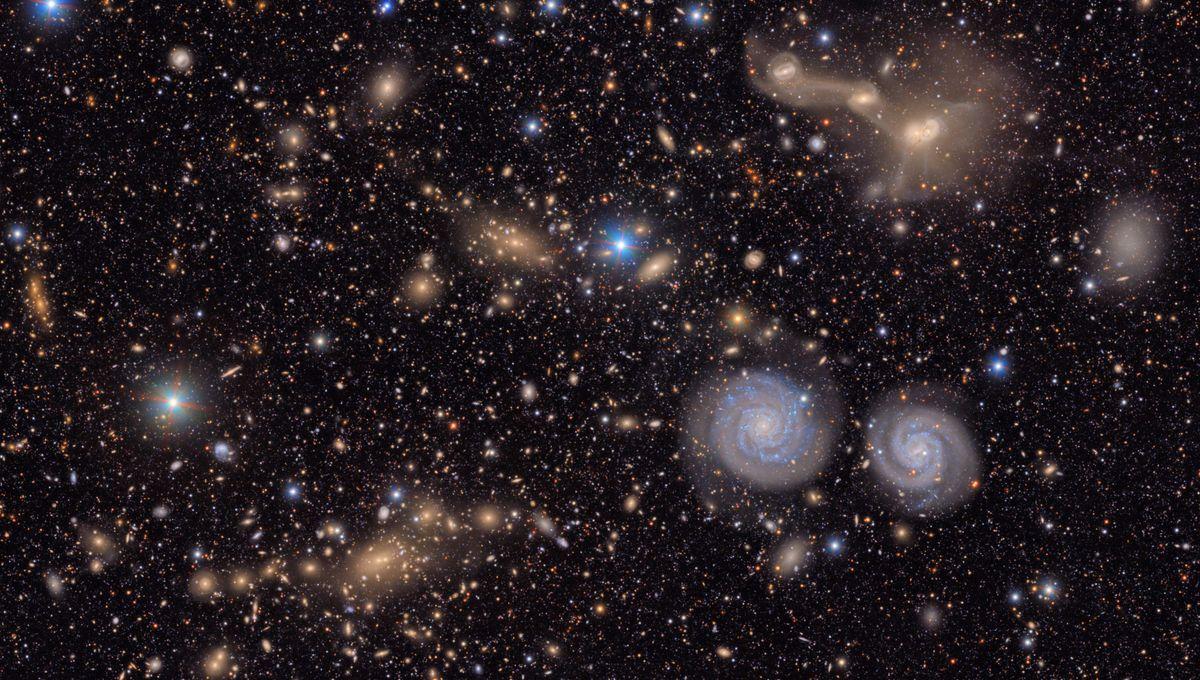
This morning, the telescope dropped the first imagery from the observatory, showing the beautiful Triffid and Lagoon Nebulae, and giving us a few glimpses of the Virgo cluster. Now, we will get drowned in galaxies, as one of the videos, composed of over 1,100 images, shows 10 million galaxies. If you were to look at one galaxy per second, it would take 115 days, 17 hours, 46 minutes, and 40 seconds to look at them all. You probably look at a galaxy in the image that no one else has looked at yet. This is just 0.5 percent of all the galaxies that the Rubin Observatory will collect during its Legacy Survey of Space and Time (LSST). By the end, it will have observed 20 billion galaxies – about 1/10th of all the galaxies in the visible universe. Doing our second-per-galaxy look, it would take us 633.8 years to look at them all. The LSST survey is going to last ten years, and during that time, the Rubin Observatory will be snapping the universe in an ultrawide, ultra-high definition time-lapse to record as much as we can see of the universe and how it is changing. Every 40 seconds, the instrument takes a 3,200-megapixel image – an area of the sky seven times wider than the full Moon – with a precision equivalent to seeing a golf ball from around 25 kilometers (15.5 miles) away. The observatory is named after Dr Vera C. Rubin, the American astronomer whose work was foundational in proposing the existence of a mysterious substance that permeates the universe: dark matter. In fact, the LSST will help us better understand dark matter and dark energy, the other hypothetical component of the universe – it is crucial to our model of the cosmos. It is not just deep space that will be revolutionized by Rubin, though. Until now, astronomers have found around 20,000 new asteroids every year. In just 10 hours of operation, Rubin has discovered 2,104 new asteroids. It is expected that it will discover millions of new asteroids within the first two years of the LSST. It will also be the most effective observatory to try and find interstellar objects passing through the solar system like ‘Oumuamua or Comet Borisov. Rubin will take thousands of images of the sky every night, covering the entire night sky every three or four nights. From the inner Solar System to the farthest reaches of the cosmos, Rubin will see and catalog so much more than we have done so far. But the future of the observatory is not certain. The Trump Administration praised the construction of this revolutionary instrument in a press conference, but at the same time, its proposed budget would massively cut the budget of the National Science Foundation, which runs the site.

 English
 Arabic
 French
 Spanish
 Portuguese
 Deutsch
 Turkish
 Italiano
 Russian
 Romaian
 Portuguese (Brazil)
 Greek
Greek