


Matthew Horwood/Getty Images
It's a feature of most modern supermarkets that many people only notice when it's gone: employees stocking shelves, running cash registers, and working around your local grocery store. Although a large workforce may seem necessary to run a modern food store, Aldi proves every day that this isn't the case. The store is known for having very few employees compared to other supermarkets, and that isn't an accident. It's part of the chain's company-wide strategy to save money while optimizing service, which allows customers to purchase some great food at Aldi for as little as $3.
The primary goal is reducing the cost of labor, which, along with employee benefits, can eat into over 10% of a grocery store's sales (per ITRetail). Typically, an Aldi only has roughly three to five employees staffing each of its locations at a time, part of a small staff of around 15 to 20 for the whole payroll. Aldi staffs far fewer than most other supermarkets, which average around 40 employees per store. With such a reduced labor cost, the company can charge less for its products, fueling Aldi's reputation as a budget-friendly outlet.
Fewer employees leads to big savings
DirkVG/Shutterstock
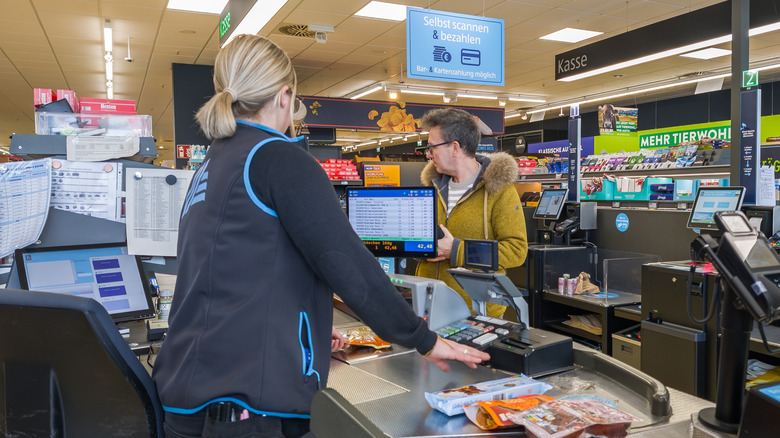
Naturally, such a substantial change in staffing requires other adjustments to Aldi's business model to make it all work. For example, rather than working a single position such as cashier or stocker, Aldi employees are cross-trained to do everything required to operate the store. Aldi also requires speedy performances from its cashiers to move large numbers of customers through relatively few registers. The company designs its products with large, easy-to-scan labels, and has checkers sit to optimize their scanning speed, which is tracked to ensure it meets Aldi's standards. These are just a few of the many unusual rules Aldi employees must follow.
Beyond it being potentially more difficult to find an employee, customers also face at least one additional hurdle as a result of this low-employee policy. They have to use their own quarter to unlock Aldi shopping carts, a small step designed to encourage customers to return their carts themselves rather than have to pay an employee to do so.
So, the next time you're stocking up on dinner staples or looking for a good deal in the Aisle of Shame and realize you don't see any Aldi employees around, don't take it personally. In an era of soaring grocery prices and tight budgets, Aldi has chosen to power its low prices with low labor costs.

 English
 Arabic
 French
 Spanish
 Portuguese
 Deutsch
 Turkish
 Dutch
Dutch
 Russian
 Romaian
 Portuguese (Brazil)
 Greek
Greek