


Mahmoud Suhail/Shutterstock
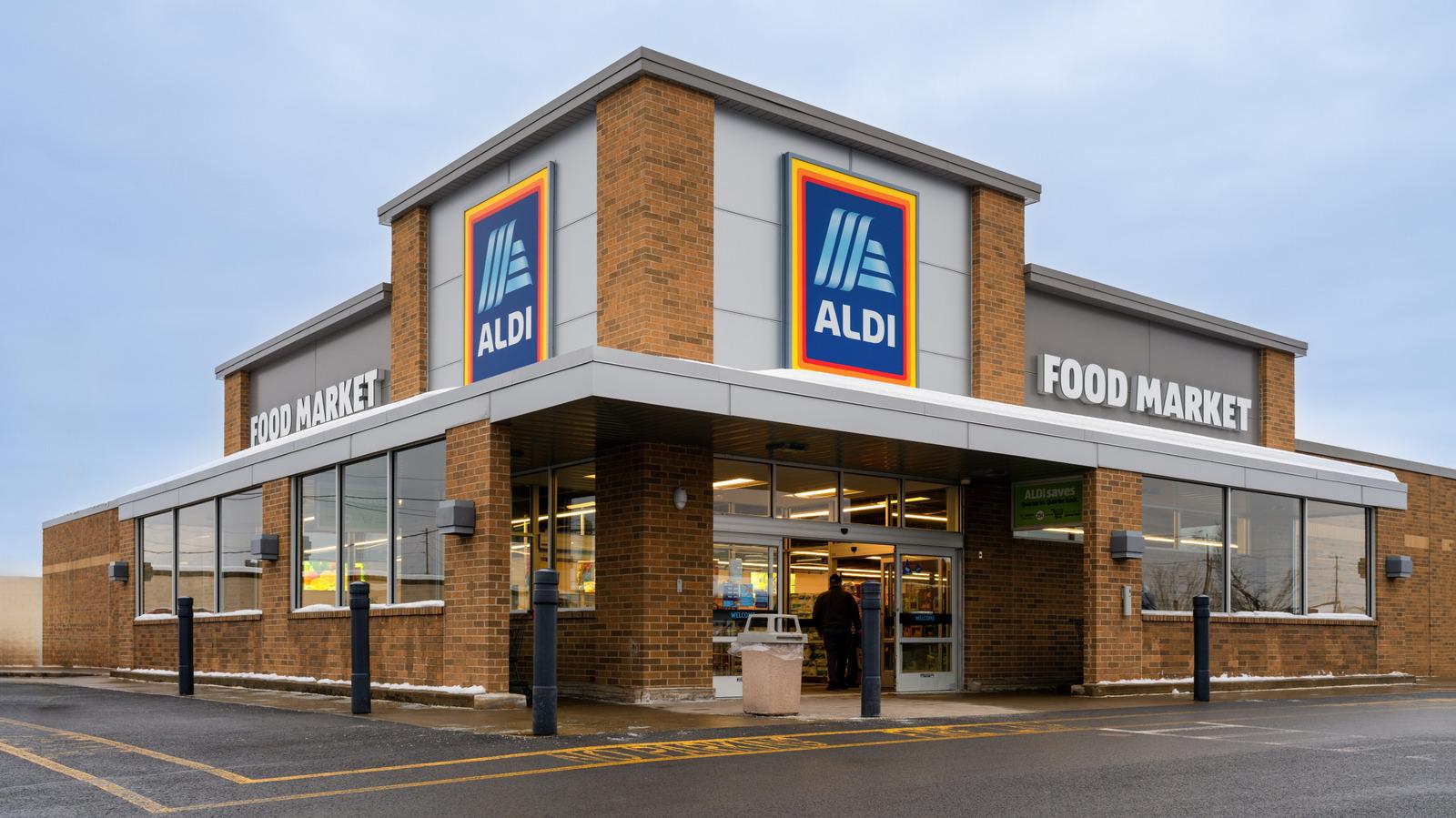
Whether you're an enthusiastic Aldi shopper, a reluctant Aldi convert, or someone who refuses to set foot through the door, there's no denying this supermarket chain's impact. But, it hasn't always been the same as it is today, with stores found all over the world and a chaotic but beloved middle aisle. Some big changes have hit Aldi over the years, transforming it from a single store to the global giant it is today.
Aldi has a long history, spanning over 100 years, so you can imagine how many changes have occurred over this time. Of course, we can't mention every single one — and some are probably lost to time — but we're going to focus on some of the most notable. Today, the Aldi anxiety is real. Some people struggle with the carts that you can't use without a quarter, the products stacked in boxes, and the speedy cashiers. But, once upon a time, it was just a single family-run store.
Times have changed along with the shopping experience, but that's not a bad thing. If Aldi was exactly the same as it always was, we'd have to head to Germany to shop there. And it would even have a different name. We're going to explore the biggest changes to ever hit Aldi and what they meant for the store and its customers.
Going from a single grocery store to grocery chain
columbo.photog/Shutterstock
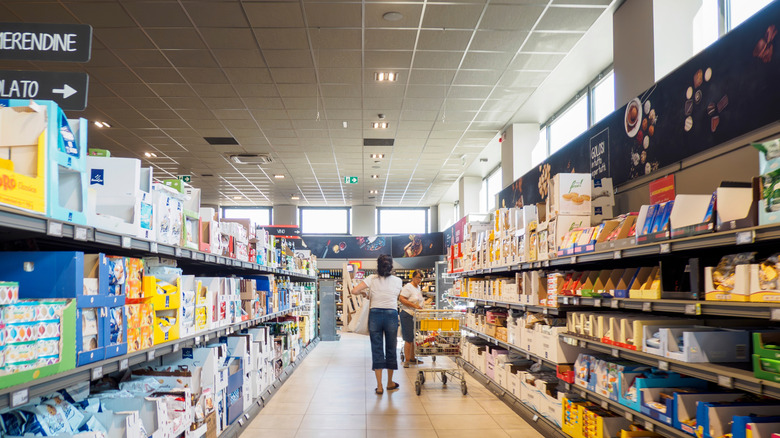
Before Aldi became a grocery chain, it was a single independent food store. The humble beginnings of the brothers who owned Aldi started with their mother. Anna Albrecht opened a store in Essen, Germany in 1913, which traded as Albrecht. Its success meant that the store could expand into the unit next door, but it was still just a single store for some years.
The original Albrecht store survived both World War I and II, and when Anna's sons Karl and Theo returned from fighting in WWII, they took over the shop. It wasn't until then that the shop expanded beyond its first location and became a grocery chain. By the end of 1948, The Albrecht stores had gone from one to four locations. Still a far cry from where it is today, but its success was starting to take root. From there, things progressed much more quickly and, by 1955, there were over 100 Aldi stores across West Germany (at this point in history, East and West Germany were divided).
Little did anyone know that Aldi would become a global name, but once it started to expand, it did so quickly. The Second World War ended in 1945, and within 10 years of this, Albrecht Discount had gone from just one store to a small empire of 100-plus shops — and a grocery chain was born.
The introduction of the Aldi name
Michael Berlfein/Shutterstock
The chain soon got a name for itself for its focus on affordable goods — but what name? We all now know it as Aldi, but at the time it started to expand, it was still trading under the family's name, Albrecht. As the chain expanded, though, it was time for a new name. In 1961, it was rebranded as Aldi.
Where did this name come from? Well, it took the first two letters of "Albrecht" along with the first two letters of "Discount" as a reference to its affordable goods. This gave a short, catchy name to the chain, and one that fit it, too. It had long been known for its low-priced goods. This was made possible in some of the same ways it keeps its costs down today, such as keeping a small range of products on the shelf. It was also unusual around this time as it was a "self-service" store at a time when other grocery stores kept their goods behind the counter and the cashier would fetch them for customers.
It may not be a coincidence that the name changed about the time when Aldi wanted to expand outside Germany. At this time, there was still negative sentiment towards Germany, following the war, so a store with a notably German name could have been less successful.
Splitting into Aldi South and Aldi North
nitpicker/Shutterstock
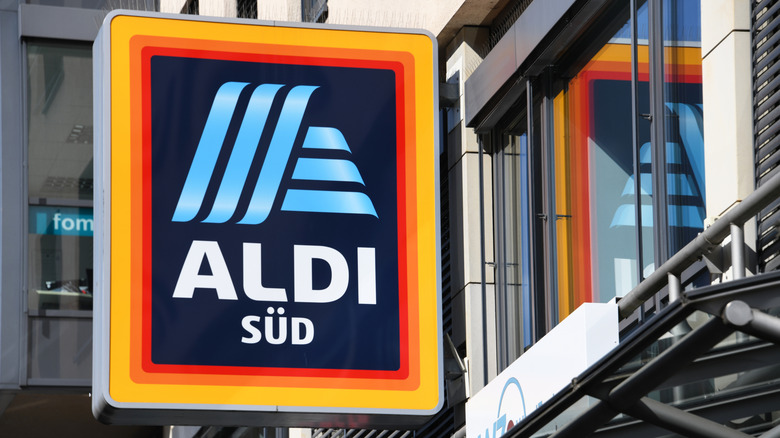
Early in the 1960s, around the same time that Aldi took on its current name, the business split into two entities: Aldi North and Aldi South — or, in German Aldi Nord and Aldi Süd. The headquarters for each are just 12 miles apart, but they're totally different entities. So, why did this happen?
The difference between the two Aldis started over a difference of opinion. Theo Albrecht wanted to sell cigarettes in Aldi stores, while Karl Albrecht believed it was a bad idea as it would attract shoplifters. They couldn't reach a consensus, so they split the business into Aldi Süd and Aldi Nord, giving each the freedom to run their business the way they pleased.
At this time, Aldi Nord took the North of Germany, while Aldi Süd took the South of the country. Later, the companies agreed where else each would expand, though it's not necessarily on a North/South divide. Aldi North runs the stores in Denmark, France, Belgium, The Netherlands, Spain, Portugal, Poland, and Luxembourg. Aldi South runs the stores in the United States, the United Kingdom, Italy, Austria, Australia, Slovenia, Switzerland, Hungary, and Ireland.
However, Aldi Nord also made it to the U.S. in a different guise. There's an unexpected connection between Aldi and Trader Joe's: Aldi Nord owns Trader Joe's. Though, you shouldn't expect Aldi North stores to look like Trader Joe's, as it was bought out by Aldi Nord, with the company keeping its quirky approach to groceries.
Aldi expanding internationally
Arnaud Eeckhout/Getty Images
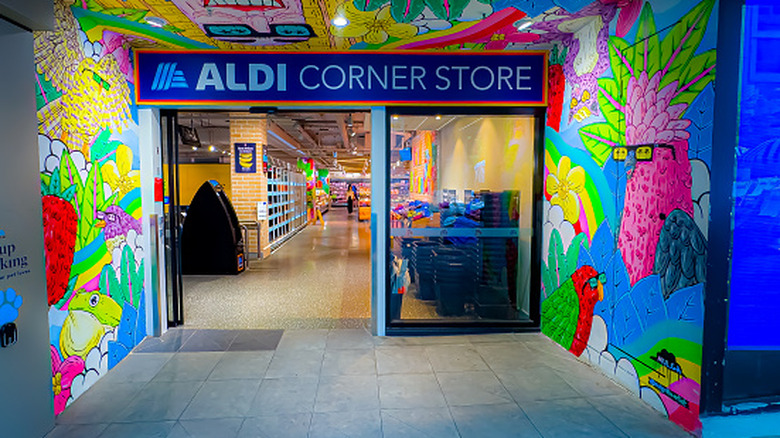
It's no secret that Aldi made it out of Germany. Maybe you already do your weekly shop there. But when it happened, this was a big change. Aldi was a national brand in Germany until the late '60s, and then things started to change.
In 1967, Aldi South bought Austria's Hofer chain of grocery stores. Then, in 1973, the first Aldi North branch outside of Germany opened in 1973. Back then, the country was still divided into East and West Germany. This limited the company's expansion. However, after the fall of the Berlin Wall, and the reunification of Germany in 1990, Aldi was able to speed up its international growth.
Although the first Aldi store in the U.S. opened in Iowa in 1976, it was during the 1990s that things really ramped up. During the '90s, 300 new Aldi stores popped up across the United States. And, in the 2000s, another 560 U.S. stores opened, cementing its place in the nation's grocery landscape. Today, Aldi Nord operates around 5,500 stores globally and Aldi Süd operates over 7,500 branches. Together, this makes over 13,000 stores worldwide.
Today, Aldi is an old hand at global expansion, but moving into those first international stores must have been an adjustment, learning what the market was like and what sells in other countries. Depending on where you're located, you may be able to buy some German products in Aldi stores worldwide. You might notice this particularly around Christmas when you can buy lebkuchen and other German festive treats. However, largely the brand adapts its products to the country it's in.
Scanners introduced at Aldi registers
columbo.photog/Shutterstock
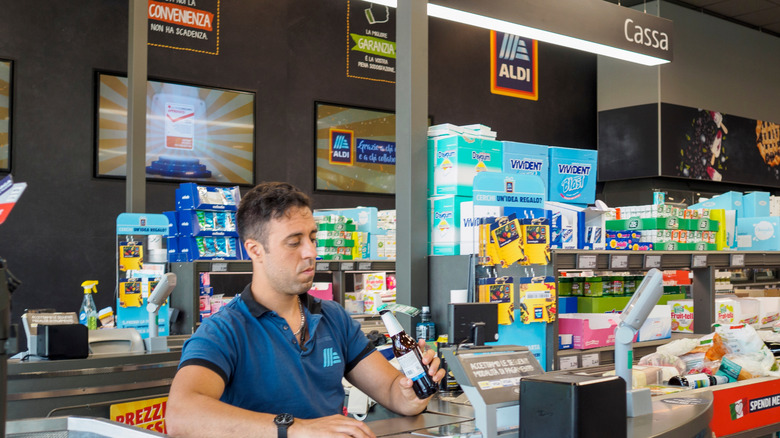
For many of us, barcode scanners at checkouts seem like they have always existed. Barcodes were invented in the 1950s, with the first barcode scanners used in supermarkets in the early 1970s. However, Aldi was late to the game introducing them. It's not clear why — perhaps to save money — but this was a big change for staff and customers.
Aldi South didn't introduce barcode scanners at checkout until 2000, and Aldi North followed close behind, introducing them in 2003. Until then, the chains had their own product codes for everything and staff had to memorize them. Sure, Aldi carries less stock than conventional supermarkets, but this still would have been a huge undertaking.
Today, Aldi is known for its quick service at the register. Cashiers scan products at lightning speed, loading them into carts for shoppers to pack in the designated spot after paying. This is one of the ways that the grocery chain keeps costs down. But, back before the introduction of scanners, things must have been a lot slower at the checkout. Perhaps folks even had time to bag their own groceries as they were being rung up. It's not clear how long it took to go from no barcode scanners to super fast scanning, but this must have been a big difference for employees and shoppers alike.
The birth of the aisle of shame at Aldi
SJBright/Shutterstock
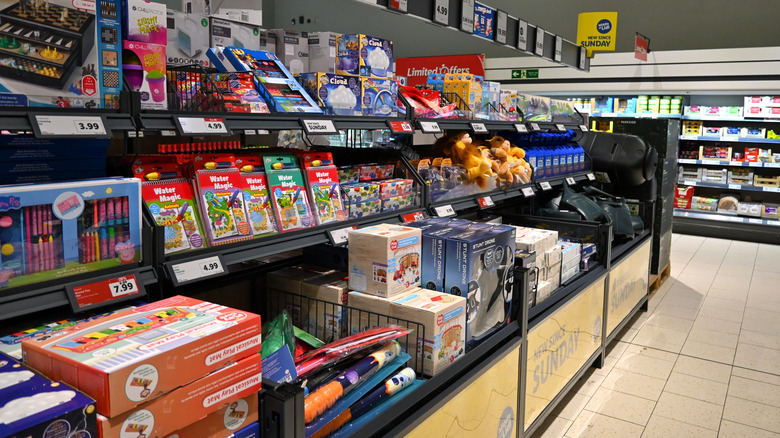
One of the unique features that separates Aldi from other grocery stores is the aisle of shame — aka the middle aisle, known as Aldi Finds in the United States. It's a place where you can find special deals on non-food items. It has a wide range of products, so you might pick up kids toys next to folding lawn chairs or a coffee pot next to an electric drill.
Some of it is low quality and some of it is gold, offering low prices on top notch items. And that's the beauty of it: you never know what you might find. However, this wasn't always a feature of the German grocery chain. We can't imagine browsing an Aldi without having a leisurely stroll past bins piled with homeware, kitchen gadgets, and tools, but that was the way things worked for many years.
It wasn't until the 2000s that Aldi Finds came into existence and the "aisle of shame" was born. People were obviously excited by the concept, because the middle aisle has become a cultural phenomenon. People love the excitement of searching for bargains and the treasure hunting nature of it draws customers in and drives sales. Some customers shop at Aldi more regularly because they come for the aisle of shame and stay for the groceries. While knowing that these are limited time offers makes shoppers more likely to snap them up. There's a psychology behind Aldi Finds which might be part of the reason for the supermarket's long-term success.
Reducing self-checkouts at Aldi
Christopher Furlong/Getty Images
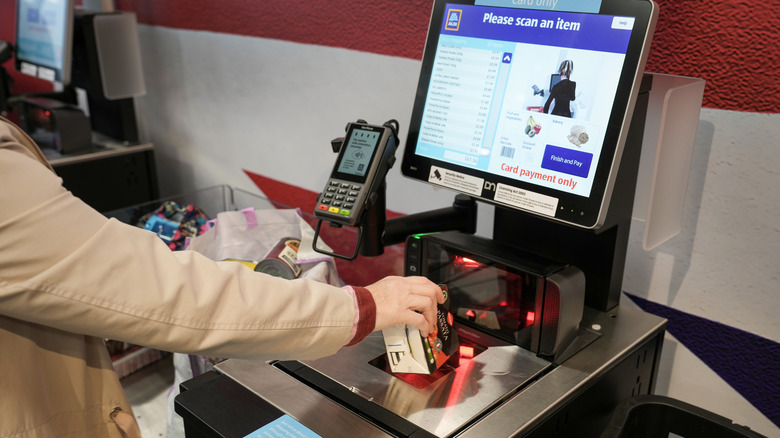
Self-checkouts are a common sight in supermarkets today, but Aldi in the United States has recently started to move in the opposite direction. It might seem like only yesterday that self-checkouts appeared in Aldi stores — they started rolling out in 2021 — but things are changing again. It seems the chain has begun reducing the number of self-service registers in some stores and replacing them with staffed checkouts.
Self-checkouts seem like a sensible choice for Aldi. It's an easy way to let people pay for their groceries without the need for excess staff. Often there's just one employee manning the self-checkout area with multiple registers, which seems to align with Aldi keeping staff costs down to allow for low priced goods. But the problem is that self-checkout lanes are often associated with higher levels of shoplifting.
As a result, some Aldi locations have scaled back the number of self-checkout lanes or removed them entirely. They don't seem to be disappearing completely across the chain, but only time will tell whether you'll be able to use them in Aldi stores in the U.S. for much longer. Naturally, the chain is all about its bottom line, so their future likely depends on whether they save or lose the store money. We understand this, but it is frustrating waiting in long lines when you just have a couple of items to scan.
A packaging refresh put the Aldi name on private label items
Deutschlandreform/Shutterstock
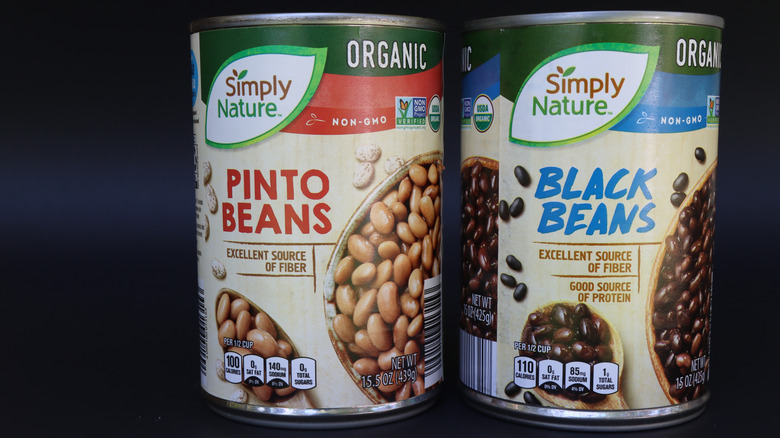
Among the defining features of Aldi is that it almost exclusively sells its own products. While most supermarkets sell a range of name brands, big and small, the vast majority of products at Aldi belong to one of its private label brands. These all have their own names, such as Happy Harvest for canned produce or Barissimo for coffee. However, in a recent turnaround, Aldi has made changes to its private label branding.
A 2025 packaging refresh saw Aldi putting its name on its private label products in U.S. stores for the first time. Although the same private label names shoppers have come to recognize remain, packaging now also states "an Aldi Original" on each item. This shows the chain is positioning itself as a producer of high-quality products. While many Aldi fans already knew that it made its own goods, more casual shoppers will now be aware that these private label brands are really produced by Aldi itself.
Another change was that certain products will have their names changed to common customer nicknames. For instance, Kirkwood Breaded Chicken Fillets are now sold as Kirkwood Red Bag Chicken. It's the chain's way of showing that it listens to its customers while taking more ownership of its products. Aldi makes great products, so it only makes sense to proudly put its name on them.
Moving toward sustainable packaging
Steve Christo - Corbis/Getty Images
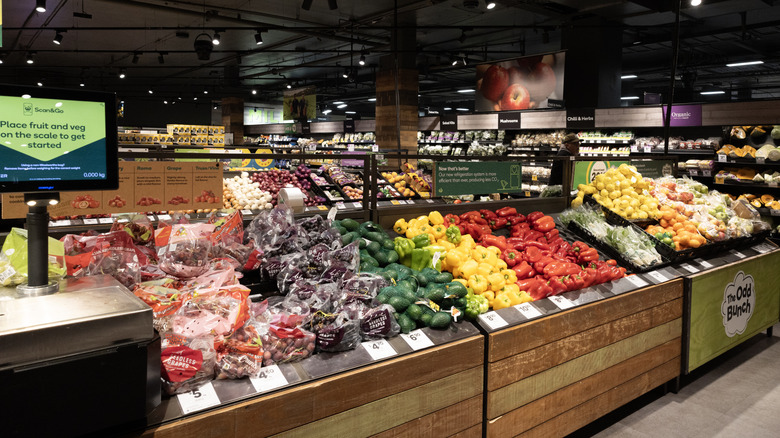
Sustainability is a hot topic for many of us. We want the convenience of being able to go to the supermarket and pick up everything we need for the week, but we'd rather not contribute to environmental issues while we do so. A recent change for the better is Aldi's commitment to sustainable packaging. It means you can pick up your usual favorites without feeling guilty about all the plastic.
From 2025, Aldi committed to 100% of its packaging being either recyclable, reusable, or compostable. Not only that, but plastic packaging now contains an average of 20% post-consumer recycled materials, and packaging on the whole has been reduced by at least 15%. This might mean scaling down unnecessarily large packaging (like when a bag of chips is half chips, half air) or avoiding packaging altogether on items that don't need it, like certain fruits and veggies. While this won't save the world on its own, it's important for corporations to make an effort when it comes to sustainability. It's only on an industrial scale that we can move toward averting the climate crisis, as personal responsibility alone won't cut it.
It's not the first time Aldi has made moves toward environmental sustainability, either. It hasn't offered free single-use plastic bags for well over 40 years and it has a global strategy of reducing waste, particularly plastic waste.
Launching a $9 billion U.S. expansion plan
Bgwalker/Getty Images
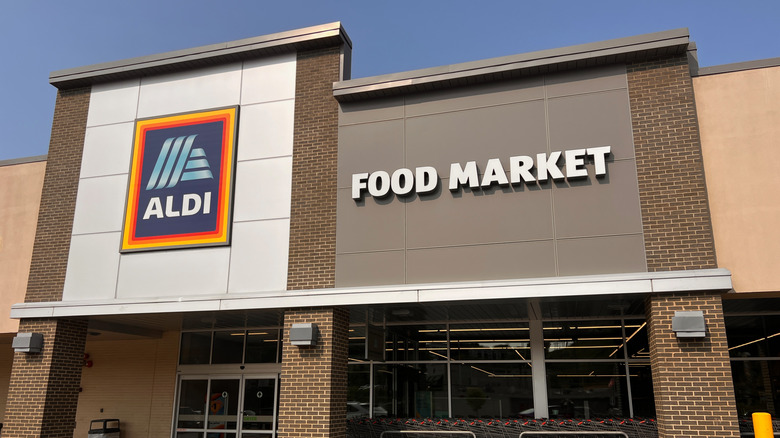
It might already feel like there's an Aldi in every neighborhood in the United States, but that's clearly not the case as there are about to become even more. In 2025, the company announced a $9 billion expansion plan aimed at bringing its low-cost groceries to more American shoppers over the next several years. It's one of the biggest investments the company has made in the U.S. market and shows just how important the country has become to Aldi's future.
Part of the plan involves opening hundreds of new stores. Aldi intends to open 180 new stores by the time 2026 is through. That means many areas that currently don't have an Aldi nearby could soon see one pop up. The company is also investing in new distribution centers that will be opened between 2027 and 2029. Plus, it will upgrade existing stores and its online presence to keep everything running smoothly as the chain grows.
Aldi has come a long way since opening its first American store in Iowa in 1976. With billions being poured into expansion, we can see that the chain is operating under the premise that there's even more opportunity to grow. Despite its quirks, we'll be pleased to see more Aldi stores opening and more opportunities for bargain hunting.

 English
 Arabic
 French
 Spanish
 Portuguese
 Deutsch
 Turkish
 Dutch
Dutch
 Russian
 Romaian
 Portuguese (Brazil)
 Greek
Greek