




Kelly Sullivan/Getty Images
The perfectly cooked egg is delicious, but a poorly executed one can ruin breakfast. Whether you like your eggs scrambled, boiled, or fried, mastering the art of each method can be challenging. One particularly tricky egg-making method is poaching, which is essentially dropping raw eggs into water and allowing them to cook at relatively low temperatures. The result is a perfectly tender egg white and a still-gooey egg yolk, but achieving this balance can be frustrating.
Celebrity experts try to help out the everyday chefs — the unique way Ina Garten makes poached eggs involves not agitating the water, and Nigella Lawson's trick for perfect poached eggs calls on lemon juice. But who better to learn from than "Good Eats" chef Alton Brown, who often has unique (and uber-specific) approaches to crafting dishes.
We once made breakfast with Alton Brown and it was everything we dreamed, but the chef's approach to poached eggs incorporates his brand of comedy and his attention to detail — and sometimes, laughing through the mistakes is what you'll need to perfect a poached egg. The method, like anything new, takes time to learn and practice, but Brown broke it down for Food Network viewers in a segment called "A Positively Perfect Poach." The chef reflects, "Looks like you could use some poached egg tips," and we couldn't agree more (via YouTube). So to prepare you to tackle your next breakfast, we've pulled together some of Brown's best tips for that "positively perfect poach."
Find the right supplies and set-up
Caymia/Getty
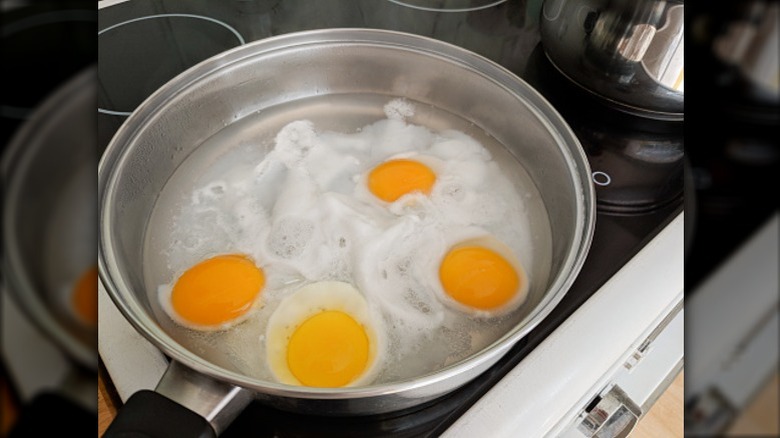
Before eggs even come into the picture, making sure you're using the right poaching supplies — and setting everything up correctly — is essential to getting the process right. In the YouTube clip, Alton Brown starts by telling viewers that what they need is a wide, non-stick skillet, "Because it gives you room to work and a nice, slick surface for the eggs to settle on."
Then you'll need to add exactly 1.5 inches of water into the pan and bring it to a "bare simmer" — in other words, just below boiling, somewhere around 190 degrees Fahrenheit (which you'll need a thermometer to measure). Visually, this will look like bubbles forming on the bottom of the pan, but very few breaking away to the top of the water. There are plenty of egg-making pans that will work; just make sure they'll accommodate the amount of water.
Once you have that going, you'll need a few additional items, including small glass dishes (Brown uses custard cups). Because you have to very gently drop each egg into the water, these smaller cups allow for a smoother transition (but more on this later). Another necessity is the slotted spoon. Once the eggs are finished poaching, a spoon with holes in it is essential for picking up the egg and letting the excess water drain through. Finally, have a towel on hand (either paper or cloth) to place the poached eggs on once they're done cooking.
Fresh eggs are best
Olena N./Getty
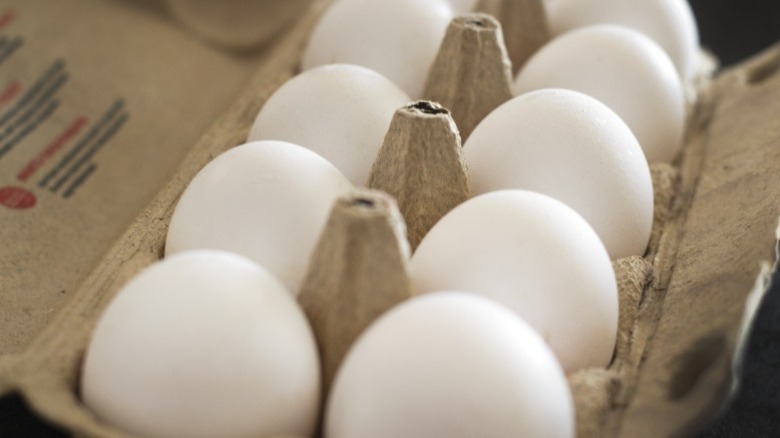
Now that your setup is complete, tools expertly organized in your kitchen, the next piece of the puzzle is, of course, the eggs themselves. According to Alton Brown, the best eggs to use when poaching are the freshest ones because they have stronger membranes. The chef even provided a new tip for figuring out how old your eggs really are.
The "best by" or "sell by" date really only tells part of the story; the real code is in the sequence of numbers and letters nearby. As it turns out, the first three numbers represent a date out of 365 days of the year. Brown's carton in the YouTube segment says "057," which he smartly tells us means the eggs were packed on February 26. You can also tell eggs are fresh after cracking because they'll have nice, cloudy egg whites.
Brown isn't alone in his fresh-egg conviction, and the reasoning can be boiled down to the life cycle of the egg itself. When the produce is fresh, 60% of the albumen (aka, raw egg white) is thick. But as the egg gets older, this percentage drops to 50% and below. When poaching, the thick whites will cook plumply, while the thin whites will spread in the pan. So if you want the fullest poached eggs, it's better to have a higher ratio of thick albumen, and therefore, newer eggs.
Add a bit of white wine vinegar to the water
Milanchikov/Getty
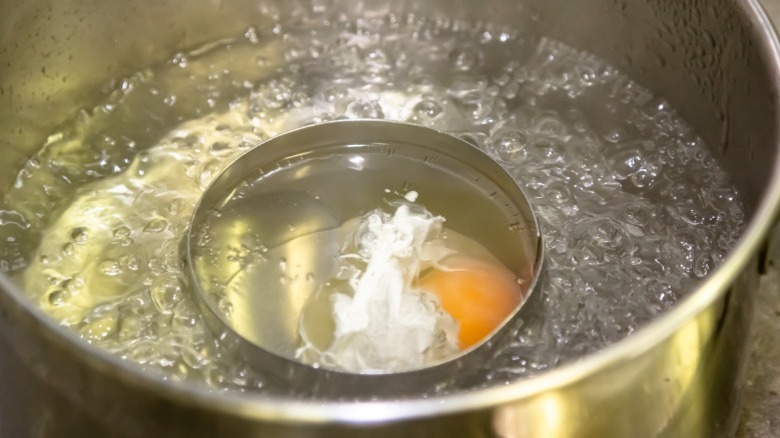
Beyond the ideally-aged eggs and the right tools, you need to pay attention to the water you're using as well — and there's one tiny addition that will help you perfect your poach. Chef Alton Brown throws a bit of white wine vinegar into his poaching water even before the eggs touch it. This is a common method for making sure that the egg yolk stays runny, while the whites coagulate properly. To do so, the acid lowers the overall pH of the water, which means that the proteins within the whites will solidify more quickly. Thanks to vinegar, poaching eggs in bulk isn't difficult either, as it will prevent them from sticking together in the water.
While many swear by vinegar alone, others might be put off by the idea of adding vinegar to their water for fear of its flavor seeping into the eggs. Brown doesn't seem too worried about this, but if you are concerned, you can opt for another method. One option is to use both vinegar and salt. America's Test Kitchen discovered that 1 tablespoon of vinegar and 1 teaspoon of salt was a good amount for 6 cups of water, but this could be scaled down depending on how large your skillet is and how much water you actually need. Alternatively, Brown suggests using lemon juice, another form of acid, in the place of vinegar — 1 teaspoon per cup of water, to be specific.
The right cooking techniques are key
Mtreasure/Getty
Stop making mistakes when poaching eggs, because chef Alton Brown has what he considers the perfect step-by-step method. First, the chef makes sure the water is at the perfect 190 degrees Fahrenheit and then stirs any pesky bubbles off the bottom of the skillet, because he says they can create divots and bumps on the underside of the eggs.
The next step in Brown's process involves those custard cups, which we said would come into play later on. After cracking an egg into each, Brown slowly lowers the cup into the simmering water, half-submerged, and lets the uncooked egg gently slide into the skillet. The chef tells viewers, "smoothness is key here, take your time" (via YouTube). Brown suggests arranging your eggs in a specific pattern (he does this counter-clockwise), so that you know the order in which to remove them once they're done cooking.
Now that the eggs are in perfect order in your skillet, Brown suggests a cook time of 4 minutes and 30 seconds. During this time, the temperature should be maintained. "Basically," Brown says, "you should be able to stick your finger in and pull it back out without going ow!" (via YouTube). When the timer expires, you can use the slotted spoon to gently wiggle each egg off the bottom of the skillet, and Brown suggests placing each on a towel to prepare them for serving.
Serve right away or save for later
Manuta/Getty
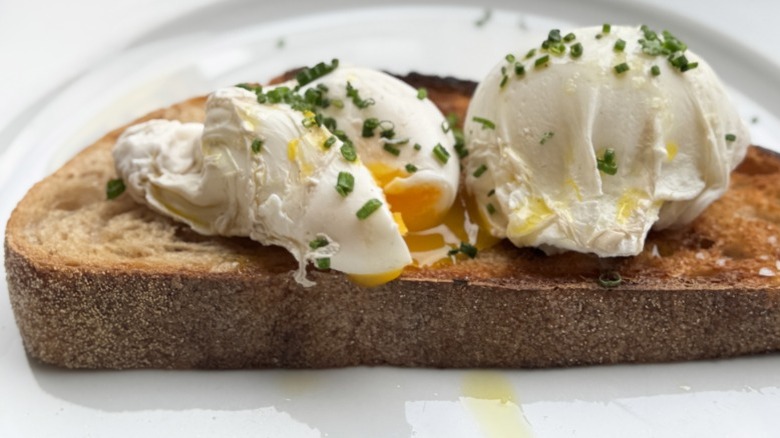
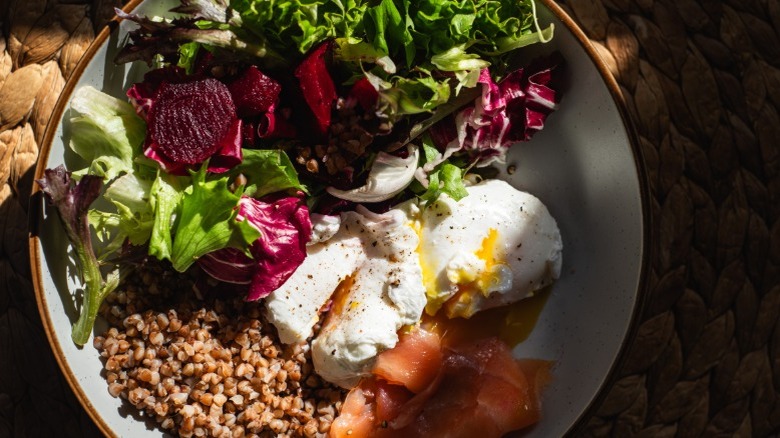
You've poached your eggs — what's next? After letting them sit on that towel (or others prefer paper towels), Alton Brown's next step is beautification. In the clip, he uses the edge of that same slotted spoon to trim off any excess egg whites that floated away, but still ended up cooked and attached in the poaching process. Then, all you need to do is prepare and eat them, however you like. Many people enjoy poached eggs alongside toast for a hearty breakfast. But you can take poached eggs beyond breakfast, too. Brown says he likes his "on a nice tossed salad with a bit of vinaigrette" (via YouTube).
While you can eat them right away, chef Alton Brown also has a great tip for saving them for another day. Brown fills a plastic container with cold water and ice cubes, and plops each of the freshly-poached eggs inside. The cooked poached eggs can be stored in the fridge and reheated in hot water for around 1 minute when you're ready to eat them. They should last for two to three days, but make sure not to eat them past that three day mark, as they could become unsafe.

 English
 Arabic
 French
 Spanish
 Portuguese
 Deutsch
 Turkish
 Dutch
Dutch
 Russian
 Romaian
 Portuguese (Brazil)
 Greek
Greek