


Lamb of God - Exclusive Interview
EXCLUSIVE INTERVIEW: Lamb of God Go 'Into Oblivion'
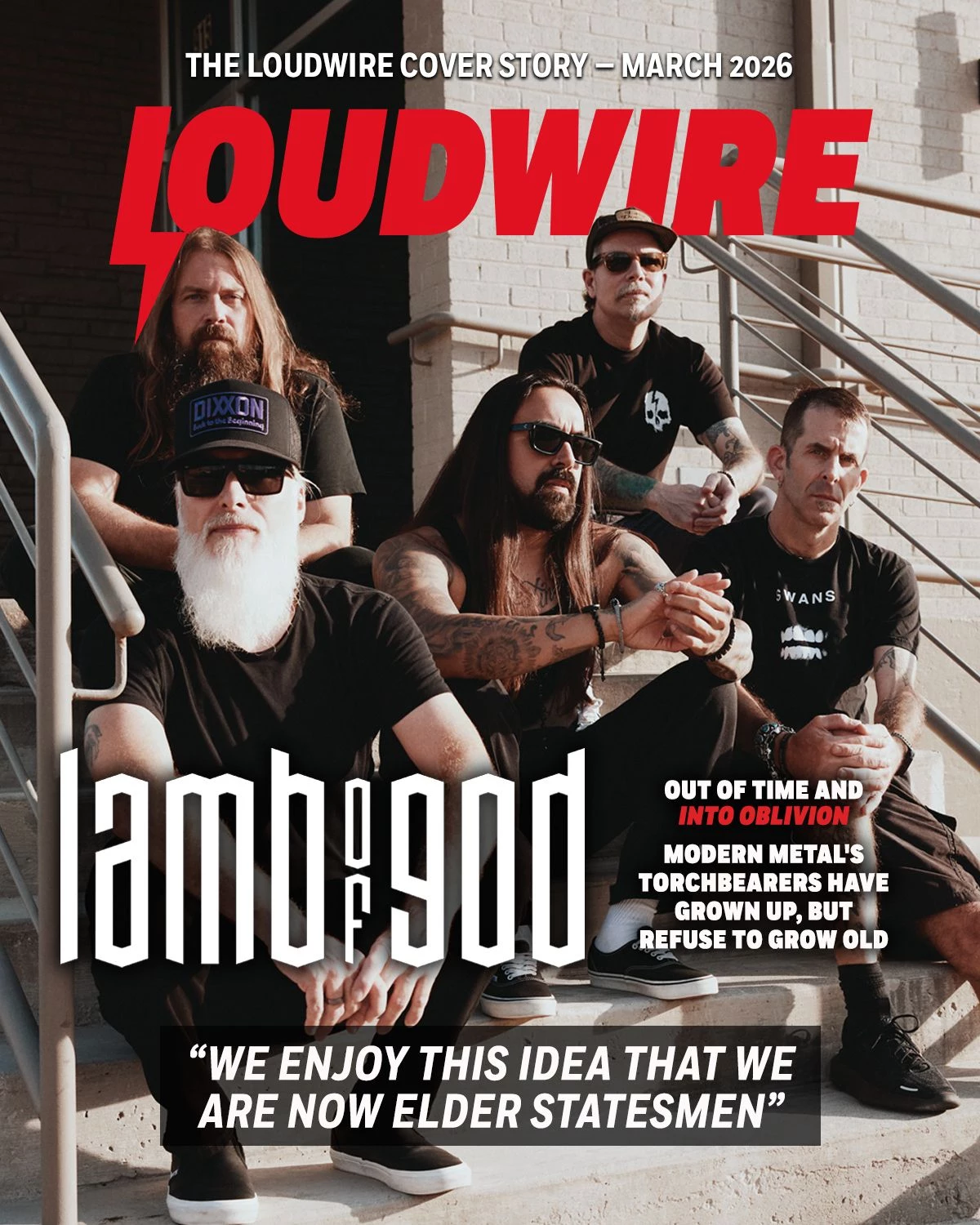
Lamb of God Go 'Into Oblivion' — Growing Up, Not Old
From Richmond dive bars to arena stages around the world, Lamb of God have defied all expectations over the past 30 years — from others and themselves. As they release their new album, Into Oblivion, and embrace elder statesmen status, they insist they’re still just a down-and-dirty punk band at heart — and by God, they like each other more than ever.
For more than a quarter-century, Lamb of God have reigned as one of mainstream metal's most consistent and uncompromisingly heavy bands. They deliver the goods once more on Into Oblivion, their brand-new 12th studio album (and 11th of original material).
But the Richmond, Virginia quintet has grown leaps and bounds since first setting the metal world ablaze with its bloodthirsty 1999 debut, Burn the Priest. For every hyperspeed thrash riff and knuckle-dragging breakdown on Into Oblivion, there's a wealth of chest-beating choruses, deep-seated grooves and eerie, melodic storytelling. Lamb of God can still pulverize, but they're a much more — dare we say — musical band than they were 30 years ago.
So what's changed, exactly? Simple: Lamb of God learned how to properly acknowledge the existence of their spitfire lead singer, Randy Blythe.
"In the beginning — and Randy will attest to this — the band really gave very little thought to what Randy was going to do," guitarist Mark Morton tells Loudwire over Zoom. (Blythe guffaws in agreement.) "We were all drunk and young and angry and all that stuff, but we were this very grindy, abrasive and somewhat technical, groovy, instrumental band and Randy came and did his thing on top of it. That's how we saw it for a long time and I think he saw it that way too."
But over the years, Morton says, Lamb of God learned how to "push and pull in terms of the density of notes and what kind of acrobatics and fireworks are going off musically. And we can carve out space for Randy, who is the frontman and the centerpiece."
After all, the guitarist concedes, "It's the vocals, it's very important. … Twenty-five years ago, you probably wouldn't have gotten that opinion from me."
Don't get it twisted: Lamb of God haven't gone soft in middle age and Into Oblivion is not the album where Blythe jumps the shark with choir-boy clean singing. ("I'm not reinventing the wheel and I'm not Pavarotti, that's for sure," the frontman says.)
On the contrary, Into Oblivion sounds like a holistic overview of the band's strengths and a thundering affirmation of Lamb of God's status as one of the definitive metal headliners of the 21st century.
lamb of god into oblinio art
Global Band, Local Values
With a string of Top 10 albums, generation-defining singles and a tour schedule comprising packed amphitheaters and arenas every night, Lamb of God have, by their own admission, shattered their expectations for what their blackened, bruising groove metal sound could achieve commercially.
But as they've risen through the ranks to become one of metal's modern torchbearers, Morton says they still maintain the same piss-and-vinegar ethos from their formative days in Richmond's DIY punk scene — the same home of those murderous space marauders GWAR and new millennium thrash kings Municipal Waste.
"There is very much a punk rock element to the DNA of Lamb of God," the guitarist explains. "John [Campbell], our bass player, he was steeped in that D.C. Fugazi scene. ... Randy is obviously a punk rock historian and grew up in the midst of all that. I was kind of a grittier thrash metal kid, but when I got to Richmond at 17 years old ... I learned instantly how to un-play all that technical stuff I'd been playing and play grimy, noisy punk rock because that's what everybody was doing. Even the first tours, I mean, we were booking tours out of Maximum Rocknroll, the old 'zine with all the phone numbers in it."
Another crucial element of Lamb of God's early Richmond days: the distinct sonic and aesthetic identities of regional scenes, which could impact bands in profound and sometimes unexpected ways.
"There is very much a punk rock element to the DNA of Lamb of God."
"Not to be like the old man shaking my fist at the sky, but I think that's one of the things we are worse off for within the internet era: the death of the regional scene," Blythe says. "If you look at Washington, D.C., the Dischord [Records] scene in the early to mid to even a little bit of the late '80s, there was definitely a sound. New Orleans has its own fucking sound, right? I mean, there's only 11 musicians in all of the New Orleans metal scene. They're all in different bands together. But there is that New Orleans sound. And then Chicago … there's the Touch and Go [Records] sound, as well as a sort of Wax Trax! sound that's happening there. And they're very distinct. New York hardcore — you could tell New York hardcore when you heard it. They're very distinct regional tonal identities."
Blythe and Morton both cite Austin, Texas noise-rock progenitors the Jesus Lizard and Richmond math-rock fire-breathers Sliang Laos as formative influences that reared their heads again on Into Oblivion's sludgy, bass-heavy lead single "Sepsis."
Lamb of God, "Sepsis" Music Video
"'Sepsis,' I love that character," Morton says, using his term of endearment for Blythe's various vocal inflections. "I love that and I know where a lot of that influence is. It's from David Yow [of the] Jesus Lizard, it's from Andrew Siegler from Sliang Laos. And those are bands that Randy and I were listening to when we were washing dishes and driving nails into boards for way too little money and trying to just struggle. … All these little inflections and all these little tests and all these little experiments, creatively, are really just us trying to find new versions of this and create new and exciting ways to make music together."
Leaving the Past Behind — but Not Laying It to Rest
As Lamb of God pursue these new and exciting avenues of making music together, do they ever feel overwhelmed by pressure to live up to songs such as "Laid to Rest" and "Redneck," which catapulted them to stardom 20-plus years ago?
"No," Blythe says decisively. "Every now and then, we'll have a song that will connect later, even more recent stuff. The one I would think of is 'Memento Mori' [off 2020’s Lamb of God]. That got a lot of ... I guess if streaming is the arbiter of what's popular amongst fans, or whatever. That's cool, we got a song that people really connect with later in our career. But I don't think we have to top 'Something to Die For' or 'Redneck' or something. I just want to make the best record possible in this moment."
Morton agrees. "We wouldn't ever write 'Redneck' now and that's not to say that I don't appreciate and dig the song. It's cool. It's a whole thing. But we wouldn't write that song now. We wouldn't write 'Laid to Rest' now. And those are far and away two of the band's biggest songs. I'm happy to play them. I'm happy people connect with them, but we just kind of move on to something else. And if people are rocking with those, yeah, we play them and they're a blast to play. It's so much fun to play a festival and see 30, 40 thousand people jumping up and down to the riff in 'Redneck.' That's always going to be fun."
mark morton onstage
This forward-looking mindset also explains why Blythe and Morton have no interest in re-recording older Lamb of God albums.
"That's cool, we got a song that people really connect with later in our career. But I don't think we have to top 'Something to Die For' or ‘Redneck’ or something. I just want to make the best record possible in this moment."
"I think each record is a snapshot of where we as a band are in time at that moment," Blythe says. "When I listen to the older stuff, if I hear something, I'm like, 'Oh, if I had thought more about this, I could have delivered this better here, or maybe that lyric wouldn't be so clunky,' or whatever. But I never want to try and fix that as it were, because there's really nothing to fix. It's where we were at that moment in time. And I think each record is a fairly accurate assessment of that, for better or worse."
Sepsis? No, No Bad Blood — Even When Differences Arise
The separation between an artist's public persona and private life is by no means a new or novel concept. Still, it's heartening to witness Lamb of God continue to make such furious, uncompromising music while maintaining functional behind-the-scenes relationships and healthy work-life balance.
This is especially impressive for a band whose frontman is a political firebrand and has become something of a spokesperson for disenfranchised metalheads who are appalled by the global atrocities unfolding before them.
Blythe made headlines in January when, in the wake of the killings of Renee Good and Alex Pretti at the hands of ICE and Border Patrol agents in Minnesota, he published a spirited Substack post urging his fellow artists to use their platforms to speak out against injustice.
"Wake up, motherfuckers — business as usual is done," he wrote. "I am neither Democrat nor Republican, so I don't have a partisan dog in this fight. I just want this dementia-riddled sociopath and his cabinet of freaks removed from office and replaced with someone with a least semblance of care for the common good, hopefully before he drags us into World War III."
randy blythe onstage
Reflecting on such posts now, Morton says: "Randy has had a lot of press blurbs about his opinion on some world events and all that. Randy's very vocal about that. And I think it's great because he's authentic to himself and he's genuine and I think he comes from a place of truth and a place of passion and that's really, really important."
At the same time, the guitarist adds, "We cut a wide swath ideologically, politically, with spiritual views, with any given topic. We're not all aligned on pretty much anything."
But wait, you ask. How can five guys with different views and lived experiences coexist in such a high-profile band for 30 years?
"Because we're adults," Blythe emphasizes. "We talk to each other. And sometimes sparks fly, but dude, come on. We're grown-ups!"
The singer continues: "I've been in the band 30 years now and at 30 years in, we get along better now than we ever did before. And I think people have this idea of, oh, when you're young, you join a band. It's like the gang — one for all, all for one. And there was some of that to a degree, but there was also a lot of disagreement over the years. And physically and emotionally, I think we function as a unit the best we ever have now. And I think that is due in no small part to all of us trying to think about just the greater good, this thing that we've created together."
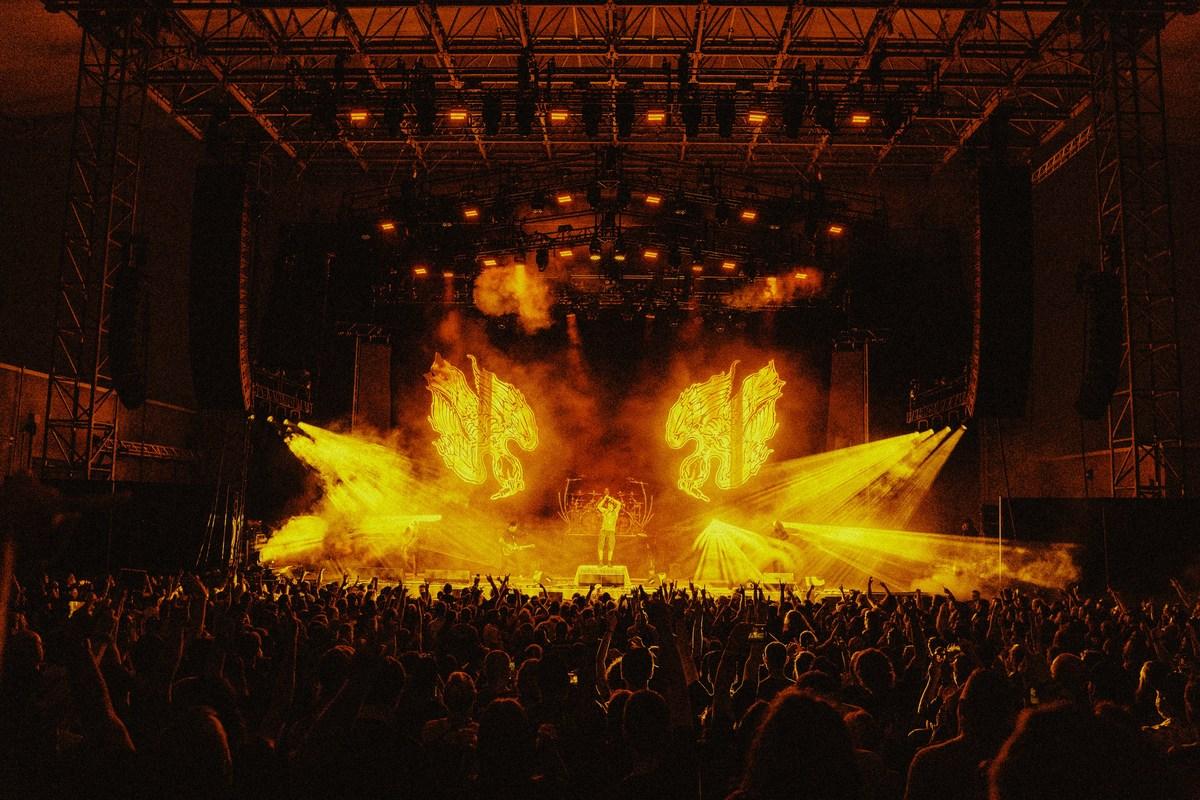
lamb of god onstage
At this point, Lamb of God operate so smoothly that Blythe sees no reason to stop. "We don't ever have to break up," he explains. "Let's face it: Eventually our knees are gonna give out. We're gonna be 85. Lamb of God will probably not be 85 years old onstage, but we never have to break up. I want to die a member of this band — not that I want that anytime soon. I wanna live to be 100."
"I think we function as a unit the best we ever have now. And I think that is due in no small part to all of us trying to think about just the greater good, this thing that we've created together."
Into Oblivion — Literally
If all of this is sounding a little too mature and lovey-dovey for a band that once named a live album Killadelphia, fear not: Lamb of God still have plenty to be pissed off about on Into Oblivion. From the head-stomping thrash of "Parasocial Christ" to the lurching grooves of "Bully," Blythe rages against spineless bureaucrats, the ever-widening financial inequities and the reckless expansion of new technologies that could quickly usurp its creators.
"Yuck it up while you can," the frontman seems to be telling the technocratic supervillains of the world. "Soon this will all come tumbling down and you'll be forced to reap what you sow."
"I think we as a planet are in deep trouble due to environmental issues. I think we as a human society, at least in Western society, are in pretty big trouble due to consolidation of wealth and the widening wealth gap," Blythe says. "For me, there's also a big worry about the very rapid development-slash-adaptation of certain technologies that I think are dangerous. I think we rely too much on this stuff and I don't think we understand it. In fact, I know we don't, because the people developing it say we don't understand what it's doing. So for me, I think the world is in a pretty critical place right now."
randy blythe onstage
Listeners shouldn't look to Blythe for answers, though. "My [bigger] focus, I think, is not to find a solution to these large, systemic problems, like, 'If we do this, everything's going to be better,'" he cautions. "I've moved — and this may sound kind of grim — but I've moved my mentality over the last few years to, 'How are we going to make it through this after everything collapses and what can we preserve in the meantime?' And for me, that looks like community building on a local level."
Blythe is particularly concerned about the way digital relationships have replaced physical ones, too. "I think this over-reliance on this stuff, of viewing the world through a digital filter, can't be good," he says. "And there seems to be an epidemic of loneliness in Western society. I think it's because people are doing this too much, considering a digital relationship as a valid [substitute] for the things that happen when you sit down and look at a person and talk to a person and see their eyebrows move and smell them and all that other stuff."
"I've moved my mentality over the last few years to, 'How are we going to make it through this after everything collapses and what can we preserve in the meantime?' And for me, that looks like community building on a local level."
"That sort of human magic only happens when there's humans in a room together," the vocalist asserts, meanings it's up to us as individuals to be part of a broader collective shift. "So I think people need to be in a room together, to talk to their neighbors.”
Responsibility Is a Privilege, Not a Burden, for Modern Metal's Elders
And what better way to engage with one's local community than by (amicably) slamming into each other at a metal show? Or at one of the 140-plus Into Oblivion listening parties taking place at record stores from March 13-15?
Lamb of God’s sprawling 2026 tour itinerary will begin this month with a North American trek featuring support from beatdown hardcore stalwarts Kublai Khan TX, deathcore veterans Fit for an Autopsy and death metal ascenders Sanguisugabogg.
lamb of god tour admat
Pound for pound, it's one of the most brutal bills you're likely to see in large venues this year — and it's a testament to Lamb of God's influence on a younger crop of bands.
"It was important to us to bring together some exciting elements of the contemporary metal scene," Morton says. "And we are well aware of our position in all this. We know we've been around for decades. I think, collectively, we enjoy this idea that we are now elder statesmen and I'm proud of what we've done. I'm grateful for the opportunity of what we have done and continue to do and I appreciate that a lot of younger bands, up-and-coming bands who are having their own success, are so vocal and open about the impact that our music and our journey had on them. And it feels really special to hear that come back and to have gotten to be a part of that."
That gratitude extends to the stage in a literal way. "Randy and I do this thing every night before we walk up the stairs," Morton says. "We have a moment where we, just me and him, look at each other and bump fists or whatever, put our heads together — and what do we say, Randy?"
Blythe then takes a deep breath and says in his best announcer voice: "Bring forth the joy!"
For Lamb of God fans, that joy comes March 13 when 'Into Oblivion' comes out on Century Media. Get your copy of 'Into Oblivion' from the Loudwire Vinyl Shop directly below.

 English
 Arabic
 French
 Spanish
 Portuguese
 Deutsch
 Turkish
 Italiano
 Russian
 Romaian
 Portuguese (Brazil)
 Greek
Greek