


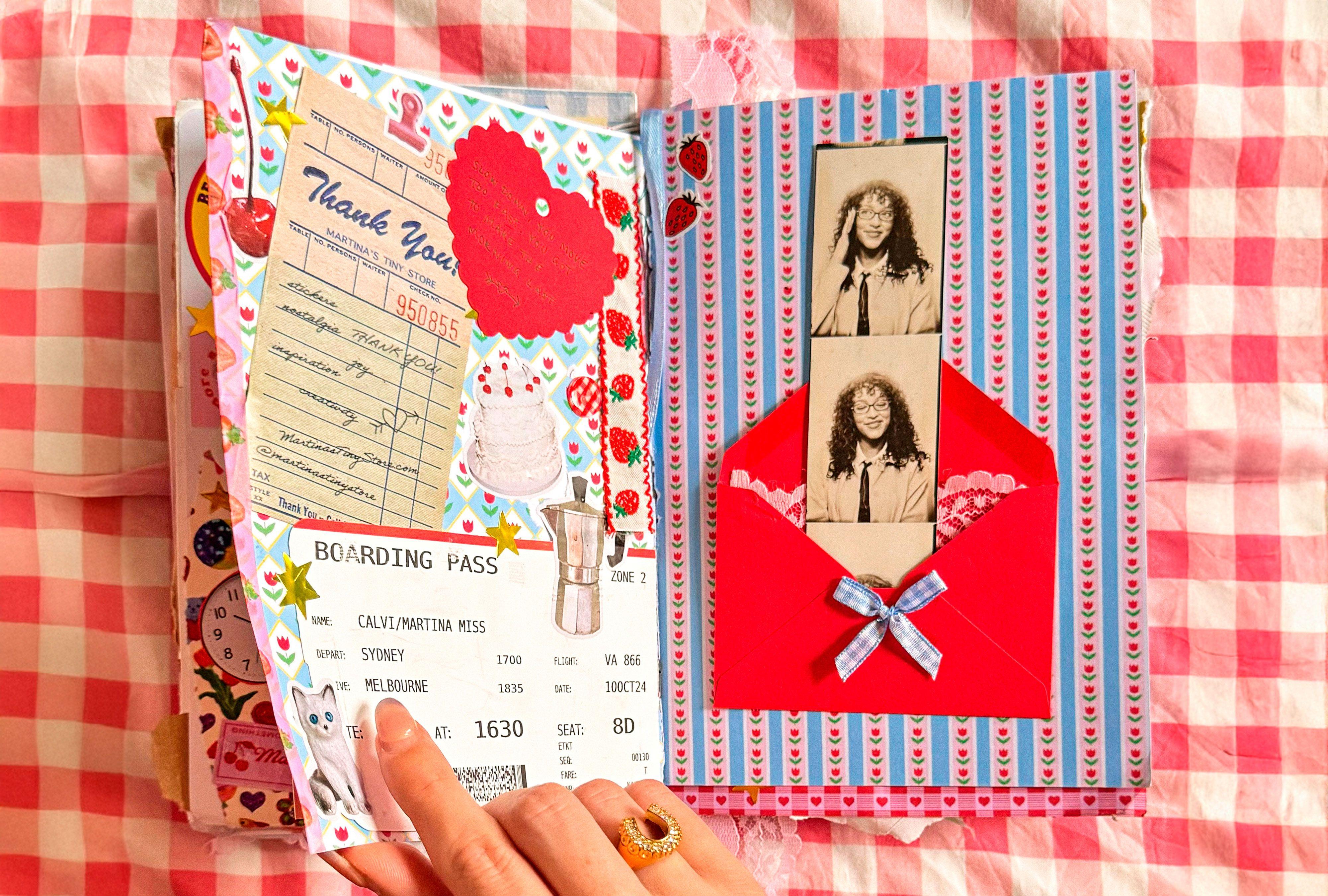
Martina Calvi (@martinamartian) creates art with junk. Things you’d typically put in the trash—receipts, fruit stickers, even sugar packets—are her medium. When arranged in one of her 30+ journals, the detritus becomes a beautiful expression of Calvi’s daily life, often themed around her mood, travels, or a color. “It’s a way to preserve my memories and romanticize the everyday,” she says. “Even the mundane is worth documenting.” Now, she’s teaching others how to do the same in her second book, A Year of Junk Journaling. Here, she shares a few tips to get started.
Martina Calvi
What You'll Need
As the name implies, all that's required is some junk and a journal. For the junk, use what you have, including ticket stubs, maps, stamps, receipts, and wrappers. Turning upcycled scraps (instead of just photos) into spreads is one way a junk journal differs from a traditional scrapbook. For the journal, Calvi likes the Leuchtturm A5, a Moleskine journal, or her Memory Collecting Journal. She usually starts each page with a patterned piece of paper as the background—she glues this, plus other pieces of paper, with a glue roller. She attaches other found items with Beacon Zip Dry glue because it dries quickly and is strong enough to hold 3-D objects. To cut out paper and magazine scraps, Calvi loves the Fiskars nonstick scissors.
Carson Downing
Make Junk Journaling Fun
Once your base is set, add accoutrements. Stickers, ribbons, buttons, and other ephemera add texture and playfulness. “I love getting things from flea markets and thrift stores,” Calvi says. “I’m really inspired there.” She buys stickers from stationery stores (her favorites are Greenwich Letter Press in New York and Sticker Planet) and shops her own website, where she sells washi tapes, patterned paper, and sticker sheets that add whimsy. She also prints 3.5x2-inch instant photos for the journal with her Instax Mini Link 3 for a personal touch.
Martina Calvi
If you’re new to junk journaling, a few tips: Don’t save stickers for special occasions, and remember, there are no rules!
— Martina Calvi
How to Store Your Supplies
Because collecting ephemera is so easy, your collection can become overwhelming fast. It's important to stay organized so the junk stays in good shape and doesn't become clutter. Luckily, storage doesn't have to be costly. In fact, you probably already have what you need. Calvi uses three things to keep things tidy but ready to use:
- Calvi puts stickers in a sticker-collecting book so she can flip through and see all her options in one place. You can also use a binder and pieces of parchment paper.
- Use a big folder for flat pieces and paper.
- A giant shoebox corrals the rest of Calvi's objects—buttons, ribbons, gems, wrappers, and other found objects. If collecting anything that once held food, make sure you clean it out properly so you don't attract bugs.
Related
Carson Downing
How to Stick with It
One benefit of junk journaling is "there are no rules and no pressure, you can just have fun," Calvi says. You have complete freedom to do whatever you want to do without the fear of messing up (good news: there is no wrong way to do it!). Because of this, Calvi uses journaling as a form of artful meditation, and you can too. Her favorite place to do so is her bedroom, where she feels she can get the most personal. You’ll find her cozied up with a cup of tea, a candle, and her mushroom-shaped lamp.
Creating a routine, setting the mood, and using it as a form of relaxation are all ways to help you stick with it. To stay motivated, she follows the prompts from her new book, A Year of Junk Journaling, which has 52 inspiring, easy-to-follow prompts. Dedicate a portion of your day or week to relax, reflect, and cut and paste your tactile memories. "It feels good to use my hands and play with paper," Calvi says.
Examples of Junk to Collect
Once you start looking around for junk you can hold onto, you'll realize how easy it is. Here are a few ideas to get started.
- Postcards
- Magazine scraps
- Newspaper scraps
- Movie stubs
- Concert tickets
- Stamps
- Envelopes
- Letters
- Business cards
- Receipts
- Snack wrappers
- Fruit stickers
- Tissue paper
- Paper packaging
- Maps
- Buttons
- Cards

 Arabic
 French
 Spanish
 Portuguese
 Deutsch
 Turkish
 Dutch
Dutch
 Italiano
 Russian
 Romaian
 Portuguese (Brazil)
 Greek
Greek